On the Maps: how we became “O Dondey”
April 16, 2026 2026-10-14 20:48On the Maps: how we became “O Dondey”

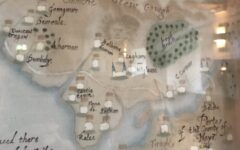
On two of the most important early printed maps of Ireland — John Speed’s 1610 Province of Connaugh and Baptista Boazio’s Irlandiae Accurata Descriptio (first printed 1599, reissued in Antwerp from 1606) — the Ó Dubhda chief appears by name on the Sligo coast, engraved in copperplate, under an unfamiliar English spelling: O Dondey.
The family on the page
For nearly a thousand years the Ó Dubhda ruled the coastal kingdom of Tír Fhiachrach Muaidhe — the lands along the River Moy, from the Ox Mountains to the sea. When Flemish and English cartographers began producing the first printed maps of Ireland in the late sixteenth and early seventeenth centuries, they found the family still there. They wrote us onto the map.
But not with any spelling you’d recognise today. To engravers in London and the Low Countries, working from second-hand English surveys, the name of the chief of the Moy was not Ó Dubhda, nor O’Dowda, nor even O’Dowd. It was O Dondey.
Speed, 1610
John Speed’s The Province of Connaugh with the Citie of Galwaye Described was an early detailed English atlas map of the west of Ireland, engraved by Jodocus Hondius for Speed’s Theatre of the Empire of Great Britaine, published in London in 1611–12. On Speed’s sheet the label O Dondey is engraved along the Sligo coast, inside the belt marked SLEGO COUNTY, between Arras Dondenell ‐ a label whose meaning is still uncertain ‐ and the coastal settlement of Port Nahaly, with the River Moy (“Moy flu”) running just north of the chief’s name.
To anyone reading the map around 1610, the meaning was clear: this is Ó Dubhda country, and this is the chief.
Boazio, 1606
Eleven years earlier, in 1599, the Italian-English cartographer Baptista Boazio had published his own map of Ireland in London. From 1606 Joannes Baptista Vrients reissued it in Antwerp in his editions of Abraham Ortelius’s great atlas Theatrum Orbis Terrarum, and it is that Antwerp sheet we show here. On Boazio’s sheet O Dondey also appears on the Sligo coast, between two labels reading “Arras Dondenell”, by the Moy and across the river from the words Co. Slego.
Boazio’s map is especially valuable to us for a second reason. In the lower-left corner is a small Latin legend, the Expositio Verborum Hibernicorum — an explanation of Irish geographic terms for the continental reader. Its last entry reads:
O — Caput familiae
The prefix O, Boazio tells his reader, denotes the head of the family. The mapmaker is not merely labelling a place: he is declaring that the Ó Dubhda are the ruling family there. It is one of the plainest statements of the Gaelic sept-system on any early printed map.
Why “Dondey”?
The short answer is: because English ears heard it one way and an engraver read it another. In Irish, the chief’s name is Ó Dubhda — the bh is not a hard b at all but a soft w-like glide that melts into the vowel, so that the name sounds roughly like O Dooda. There is no tidy English spelling for that sound, and English clerks tried many.
An English writer did the sensible thing and wrote it as it sounded: something like O Doudey. The n in Dondey is most likely a misreading of a manuscript u. In the handwriting of the day the two letters were made of the same pair of strokes, and engravers confused them constantly. What survives on Boazio’s and Speed’s sheets is a snapshot of our name as it passed from Irish speech, through English ears and pens, onto the engraver’s copper.
It was never the only English spelling. English clerks had been writing Dowde and O’Dowde for generations (the arms were recorded as O Dowde in 1574), and on the manuscript map that Captain John Baxter drew of the north-west around 1600, finished by Boazio himself, the coast is O Dowdes Countrie. O Dondey is the engravers’ variant: a ghost-spelling that the printed maps carried for decades beside the name we still use.
Still on our own ground
By the year 1600 the Ó Dubhda chiefship had already been in continuous existence for more than six centuries, and the English Crown was beginning the long work of surveying, mapping, and ultimately plantation that would dismantle the Gaelic lordships within two generations. These maps catch our family in the last moments of the old order: still on our own ground, still named as the ruling sept, still tied to the River Moy and to the inauguration cairn of Carn Amhalghaidh.
A few decades after these maps were engraved, the Ó Dubhda lands would pass into new hands under the Cromwellian settlement, and the name would fade from the new surveys of Connacht. But on Speed’s 1610 and Boazio’s 1606 — copies held today at the Bibliothèque nationale de France and in the David Rumsey Map Collection at Stanford, among others — we are still there, on the coast, above the Moy, where we had been since the ninth century.
O Dondey.
Sources
- John Speed, The Province of Connaugh with the Citie of Galwaye Described, 1610. Engraved by Jodocus Hondius. From Speed’s Theatre of the Empire of Great Britaine, 1611–12. Scan: Bibliothèque nationale de France (btv1b53057005d), via Wikimedia Commons. Public domain.
- Baptista Boazio, Irlandiae Accurata Descriptio, first published London 1599. Antwerp reissue by Joannes Baptista Vrients in Abraham Ortelius, Theatrum Orbis Terrarum (1606-1612). Scan: David Rumsey Map Collection, David Rumsey Map Center, Stanford Libraries. CC BY-NC-SA 3.0.
See the full cartographic record for the Ó Dubhda family on our Maps catalogue.