
Rathfran Priory
May 2, 2026 2026-10-14 20:47Rathfran Priory
Rathfran Priory
Mainistir Ráth Bhrannaibh — the Dominican Friary of the Holy Cross
The ruins of Rathfran Priory stand on the north bank of the tidal Cloonaghmore (or Palmerstown) River, where it opens into Killala Bay in north Co. Mayo. Founded about 1274 for friars of the Dominican Order and dedicated to the Holy Cross, the priory was an Anglo-Norman house built within the ancient territory of the Ó Dubhda (O’Dowd), whose lordship of Tír Amhalgaidh encompassed this stretch of coast. Together with the Franciscan abbeys at Moyne and Rosserk, Rathfran is one of three medieval religious houses standing within a few miles of one another on Killala Bay — a concentration of monastic ruin found almost nowhere else in Ireland.
I. Location and Setting
The priory lies in the townland of Rathfran, civil parish of Templemurry, barony of Tirawley — about 3.5 km north-north-west of Killala, off the R314 road toward Ballycastle. Its Irish name, Ráth Bhrannaibh, is the form recorded by logainm.ie. The medieval scribes wrote it Ráth Branduibh: the Mac Fhirbhisigh topographical poem speaks of “Rath Branduibh of the sweet bells”, and the Annals of Ulster use the same form for the monastery in 1513. Whether the fort remembered a Brandubh or a Bran, the modern placename scholars leave open. The church occupies a low rise above the river, open to salt winds from the bay.
On a clear day the prospect takes in Bartra Island in the bay, the coast toward Enniscrone, and the long line of the Ox Mountains away to the east. The setting is wilder and more solitary than either Moyne or Rosserk, and it is this that most visitors remember.
II. Foundation, c. 1274
Rathfran was founded about 1274 during the rapid expansion of the Dominican Order — the Order of Preachers — across the western seaboard of Ireland. The identity of the founder has never been fully settled. Most modern authorities (including Heritage Ireland and the reference works that follow Gwynn & Hadcock’s Medieval Religious Houses: Ireland) hold that it was founded by a member of the de Exeter family — possibly Stephen or Richard de Exeter — or by Sir William de Burgh. The de Exeters and de Burghs were linked by marriage, and the two traditions may preserve the memory of a single kin-group endowment.
The foundation was Anglo-Norman, but it was planted within Gaelic country. The surrounding lordship had long belonged to the Ó Dubhda chiefs of the Uí Fhiachrach, and the congregation that came to the priory church on feast days would have been mixed — settler and native, lord and tenant. No contemporary source names an Ó Dubhda as a patron of Rathfran; the priory is not listed among the Ó Dubhda foundations in the Mac Fhirbhisigh genealogies. But the community it served was theirs. Indeed the rath that gave the priory its name appears in the Mac Fhirbhisigh books among the chief seats of the kings of Uí Fhiachrach, and the topographical poem calls the Ó Dubhda chief Ruaidhrí, son of Taithleach, “King of Rath Branduibh”.
III. The 15th Century — A Growing Community
Much of the visible fabric at Rathfran is the work of the fifteenth century. Some of the original lancet windows in the south wall were built up and a separate aisle was added, with parts of the nave partly rebuilt. In 1438, indulgences were granted for the construction of a refectory and bell-tower — evidence that the community was still vigorous two centuries after its foundation and was still adding to its buildings.
Twenty years later the picture was different. By 1458 the priory was reported as impoverished, reduced by “wars and other disasters” — a reflection of the turmoil that marked Connacht through the middle decades of the fifteenth century.
IV. 1513 — Sanctuary Violated
In February 1513 a killing was done within the priory. Edmond Mac William de Burgo, ruler of Conmhaicne Cúile, was murdered at Rathfran by his own nephews, Theobald Reagh and Edmund Ciocarach. That a killing on consecrated ground breached the ancient right of sanctuary made it shocking in a way a killing elsewhere would not have been; the Annals of Ulster record it as a deed done in treachery.
V. Dissolution and Destruction
The Tudor suppression reached Killala Bay in the late sixteenth century. In 1577 Rathfran was formally dissolved and its lands granted to Thomas de Exeter ‐ the dissolution record describing the site of the late dissolved house of the Friars Preachers of Rathfran, by the sea, in the County of Mayo.
Worse followed. In 1590 the army of Sir Richard Bingham, Governor of Connacht, burned Rathfran along with the Franciscan houses at Moyne and Rosserk. In 1596 the lands passed to William Taaffe. The stone of the priory survived, but the roofed community was gone.
VI. The Friars of the Penal Era
The Dominican community did not disappear with the buildings. Friars are known to have continued in the neighbourhood of Rathfran through the seventeenth and into the eighteenth century, keeping faith alive in private houses through the Penal era. By the time Samuel Lewis compiled his Topographical Dictionary of Ireland in 1837, he could still write — though placing the foundation a century too early — that “ruins exist of the fine old abbey of Rathfran … adjoining is a burial-place still used.”
VII. Architecture and Surviving Fabric
The thirteenth-century church is a long, simple rectangle, unroofed but with walls standing in places to their full height. The features most often noted by visitors are these:
- The remains of a fine triple-lancet east window, the central and most telling feature
- A small crucifixion panel set above the west door
- Sedilia — recessed stone seats for the clergy — in the chancel
- A piscina, or stone basin, for washing sacred vessels
- Tomb niches set into the walls
- Foundations of two small cloisters on the north side
- Sixteenth-century living quarters north of the church, incorporating what had been the original sacristy
VIII. Visiting Today
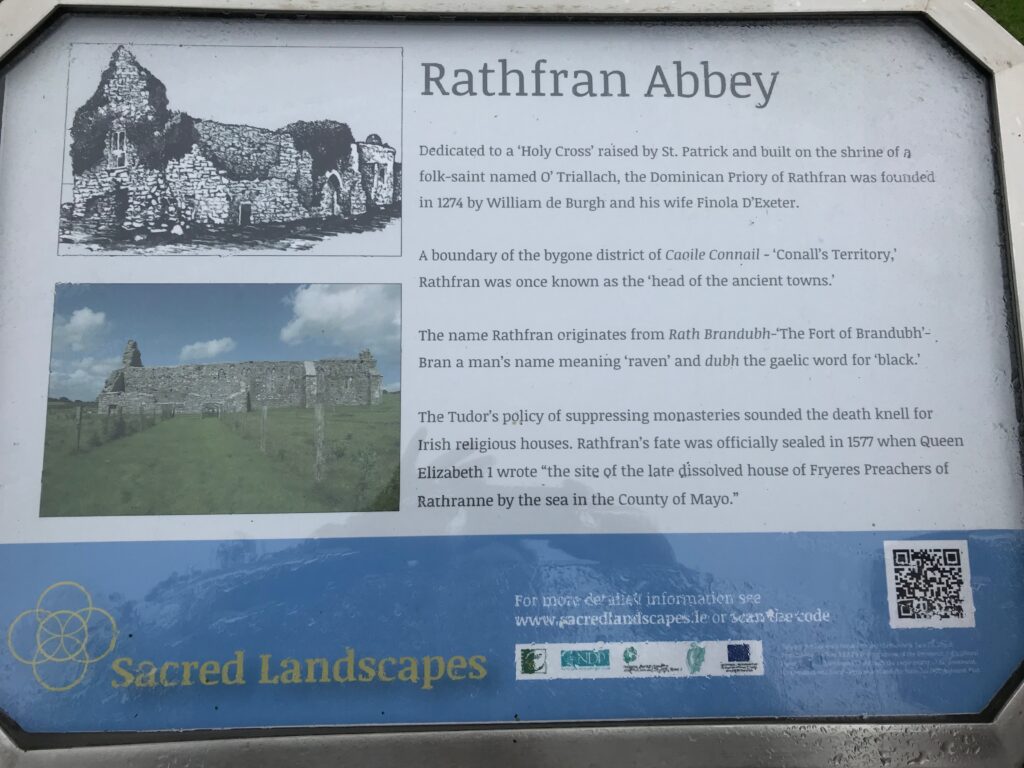
Rathfran is a National Monument in the care of the Office of Public Works (National Monument No. 269), freely open year-round. The site is reached by narrow local roads off the R314 north of Killala; the last approach crosses open farmland and can be muddy under cattle — sturdy footwear is recommended. A Sacred Landscapes information board at the site gives historical context in English.
It has a wilder, more remote feel than the other Killala Bay houses — and with Moyne, Rosserk, and the Augustinian Abbey at Ardnaree, it completes a set of four medieval religious houses that together form one of the most concentrated survivals of monastic heritage in western Ireland — all of them standing within the old territory of the Ó Dubhda.
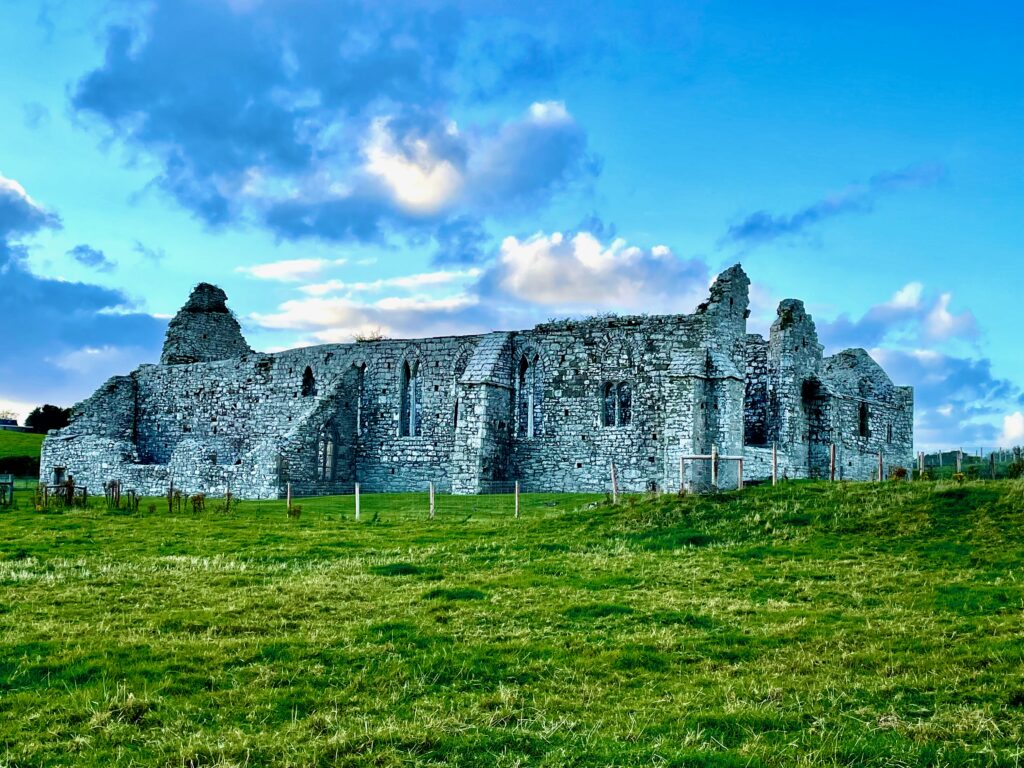
Rathfran Priory — north shore of Killala Bay, Co. Mayo
Rathfran Priory
54°14′16.9″N, 9°14′39.6″W
Dedicated to the Holy Cross
Founder uncertain — de Exeter or de Burgh
Burned 1590 by Sir Richard Bingham
Granted to William Taaffe 1596
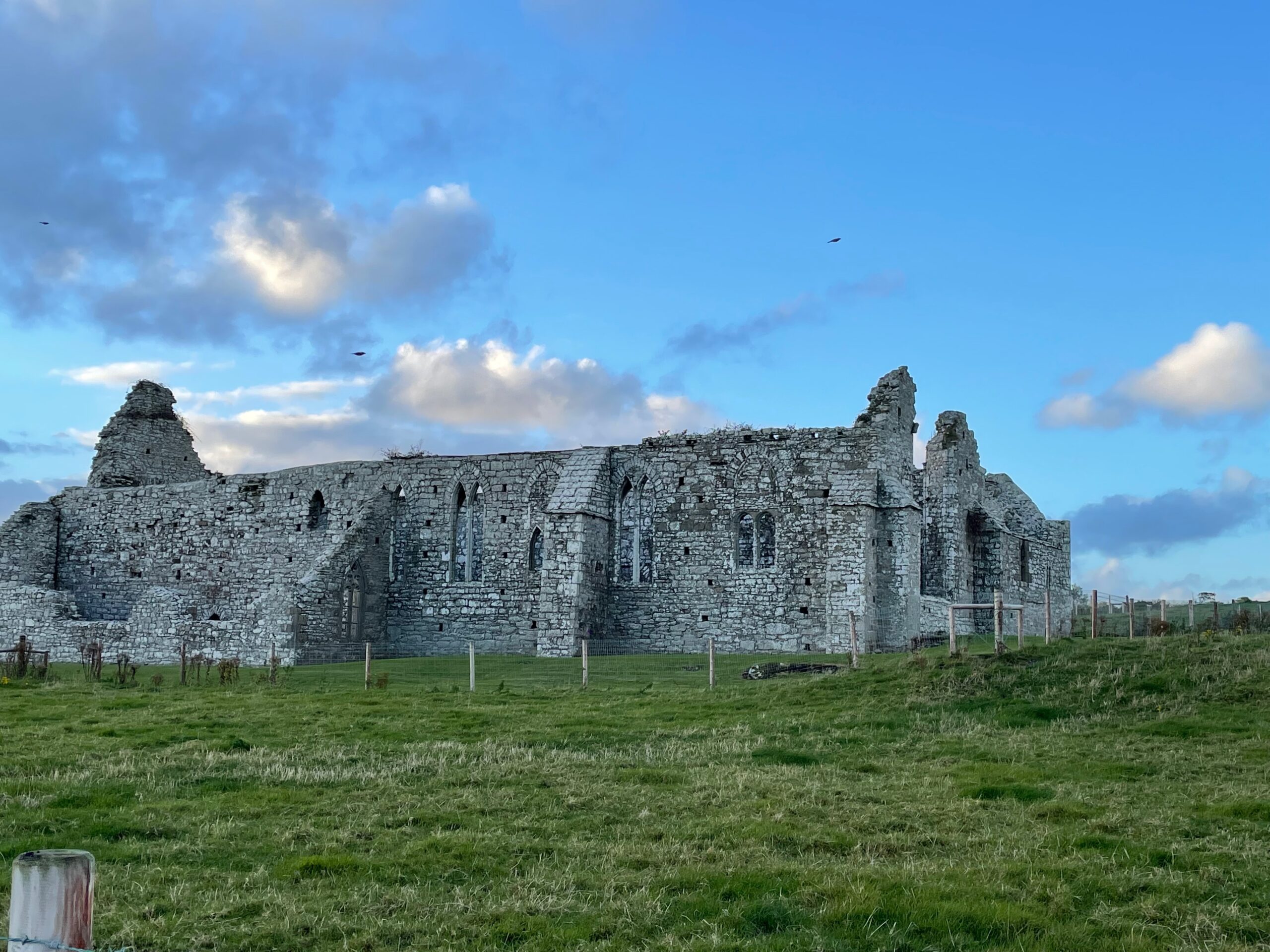
From the Clan
Photographs of Rathfran Priory submitted by clan members.
Latest stories tied to Rathfran Priory.
Tales, research and dispatches from the Ó Dubhda journal.
A Note from the Clan
These pages are researched and written by volunteers of the Ó Dubhda Clan Association. The record here reflects the best evidence we have been able to gather from primary sources — placename records, Lewis’s 1837 dictionary, the Mac Fhirbhisigh genealogies, and the standard monastic reference works.
If you know of a correction, a family tradition, a photograph, or a source we should have cited — please get in touch. We welcome additions, and we would rather be corrected than wrong.