Ballymote Castle
Caisleán Bhaile an Mhóta — an Anglo-Norman stronghold in the heart of MacDonagh country
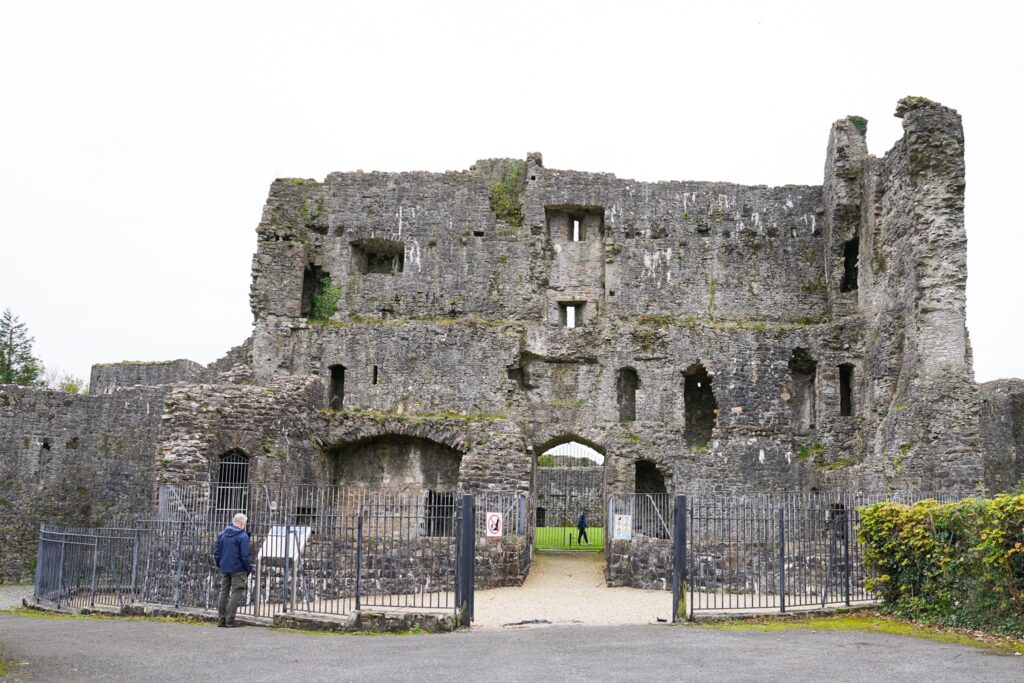
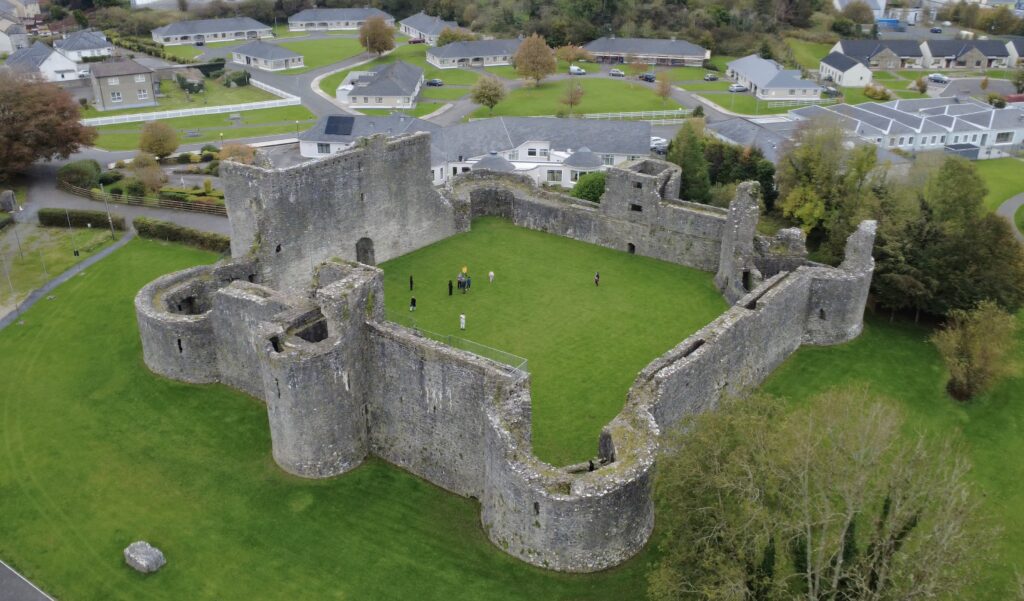
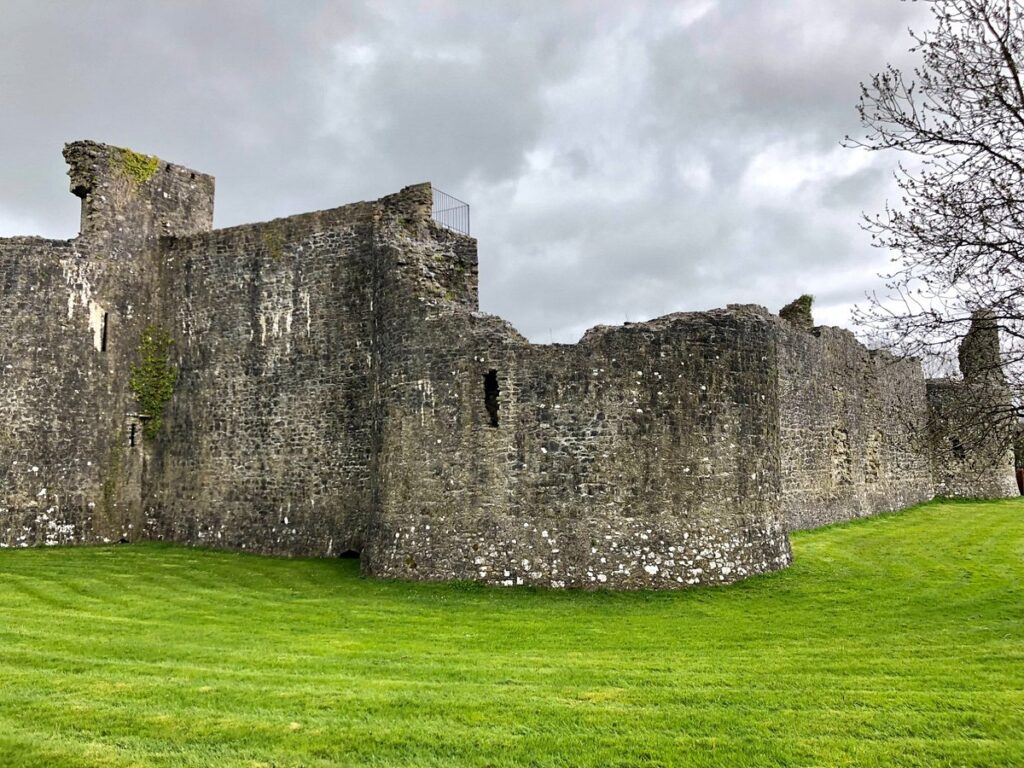
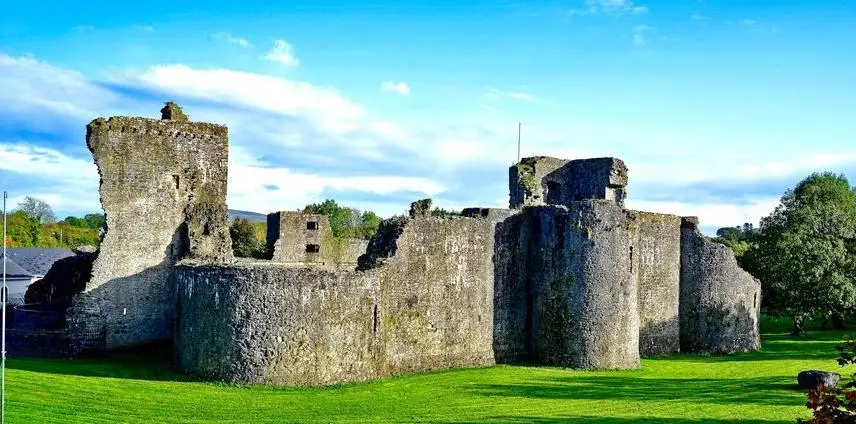
Ballymote Castle stands on the southern edge of the market town of Ballymote in County Sligo, thirty miles south of the Moy estuary. It is the largest and most architecturally ambitious castle anywhere within the wider Ó Dubhda sphere of influence — and, importantly, one the Ó Dubhda never owned. Built around 1300 by Richard Óg de Burgh, the “Red Earl” of Ulster, the castle is an almost-square Anglo-Norman enclosure with D-shaped towers on its east and west walls and a twin-towered gatehouse on the north; the curtain walls survive to a thickness of roughly three metres. The place-name records its origin: Baile an Mhóta, “town of the moat,” from the earthen moat that preceded the stone fortress on this site.
I. Contested Ground, 1317–1584
The castle rarely stayed in one family’s hands for long. De Burgh control broke in 1317, when Ballymote was taken by the O’Connors; the MacDermots (Mac Diarmada) of Moylurg held it from 1347; by 1381 it had passed to their cadet branch, the MacDonaghs of Corann, under whom “Mac Donough of Ballymote” becomes a standing phrase in the Annals of the Four Masters. After a brief return to the O’Connors, Sir Richard Bingham, the English Governor of Connacht, seized the castle in 1584 and held it for the Crown for thirteen years.
II. The MacDonaghs Retake It — and Sell It, 1598
In the summer of 1598 the MacDonaghs recovered the castle. Within months, at the height of the Nine Years’ War, the Four Masters record a remarkable bidding contest between the Crown and the Gaelic confederacy:
“The Governor, Sir Conyers Clifford, and O’Donnell (Hugh Roe) were auctioning the castle against each other, in offering to purchase it from the Clann-Donough. The close of the bargain was, that the Clann-Donough gave up the castle to O’Donnell … for four hundred pounds in money and three hundred cows.”
— Annals of the Four Masters, M1598.28
Red Hugh O’Donnell resided at Ballymote through the winter that followed the great Gaelic victory at the Yellow Ford (14 August 1598), leaving around the feast of St Bridget (1 February) 1599. In late 1601 it was from Ballymote that he marched south on the long road that ended at the defeat of Kinsale.
III. The Taaffe Interlude, 1610–1652
After the flight of the Gaelic lords, the Crown granted Ballymote to the Taaffes of Corran, who in 1628 were raised to the peerage as Viscounts Taaffe of Corran. Theobald Taaffe, second Viscount and a Confederate general, held the castle through the wars of the 1640s. The place appears intermittently in the records of the period but never again carried the strategic weight it had held under O’Donnell.
IV. The 1652 Ó Dubhda Surrender
The Ó Dubhda connection to the castle is slender but real: a single documented moment at the end. When the Cromwellian reduction of Connacht reached its conclusion in 1652 — by which time Henry Ireton was already dead (November 1651) — the siege was completed under Sir Charles Coote, Lord President of Connacht, to whom the Articles of Surrender were addressed. The Irish officer who signed them, commanding the garrison, was Lieutenant-Colonel Tadhg Riabhach Ó Dubhda. Ballymote was one of the last Gaelic-held castles in Ireland to fall, and the surrender was the last act of an Ó Dubhda commander in the field.
V. 1690 — Granard Takes Possession
The castle had one more military chapter. During the Williamite War, Captain Terence MacDonagh held Ballymote for King James II until, facing artillery under Arthur Forbes, 1st Earl of Granard, he surrendered in 1690. Granard took possession of the castle, and it was allowed to fall into ruin from that date forward.
VI. Plan and Fabric
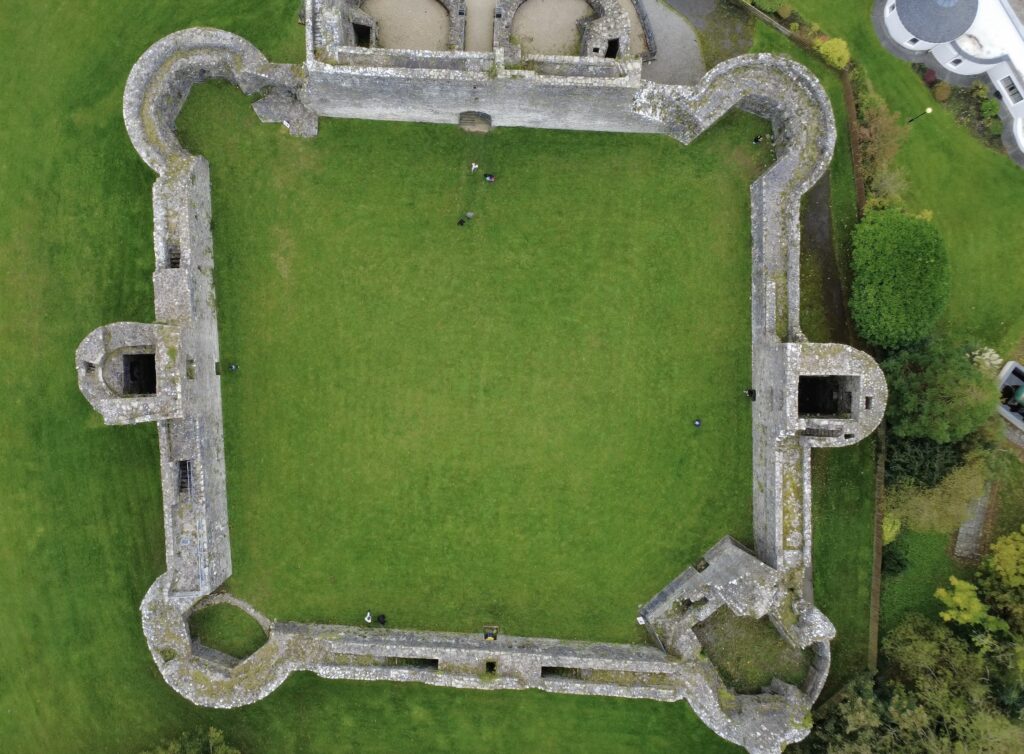
What survives is a near-symmetrical rectangular enclosure, roughly 54 by 34 metres, with four corner towers and D-shaped towers projecting along the east and west walls. The entrance is a twin-towered gatehouse in the middle of the north wall, retaining its portcullis slot and drainage spouts. Walls three metres thick, a moat where no stone could easily be laid without one, a north gatehouse whose flanking towers rose three storeys — the castle’s ambition is still legible. It is the most substantial Anglo-Norman castle within the wider Ó Dubhda sphere, and its very existence is a reminder that this part of Sligo was contested ground, with English, MacDonagh, O’Connor Sligo, O’Donnell and Ó Dubhda interests all bearing on it at different times.
VII. The Book of Ballymote
Ballymote’s cultural weight outstripped its military career. The Book of Ballymote (Leabhar Bhaile an Mhóta) was compiled here, at least in part, around 1391 — a Gaelic manuscript miscellany containing the Lebor Gabála (Book of Invasions), the Dinnshenchas, a key treatise on Ogham script, and a Middle Irish version of the Destruction of Troy. It is now held in the Royal Irish Academy (MS 23 P 12) and remains one of the most important surviving compendiums of medieval Irish learning.
VIII. Visiting
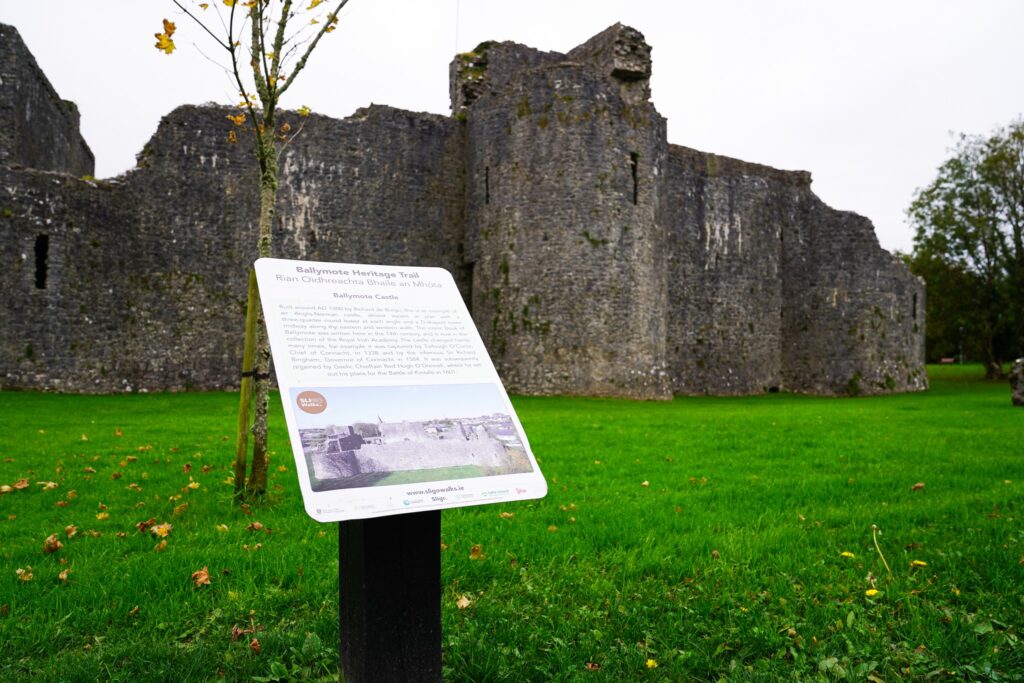
Ballymote Castle is a National Monument in the care of the Office of Public Works. The site is free to access and unguided. Visitors should exercise caution around the ruined walls and follow any OPW signage on site. A local Heritage Trail interpretive panel stands at the curtain wall.