
The Mac Fhirbhisigh Legacy
January 21, 2025 2026-05-07 1:56The Mac Fhirbhisigh Legacy
THE MAC FHIRBHISIGH LEGACY
Lecan, 1417 — and the manuscript that remembers us
For five centuries, one family served as the keepers of our written memory. From their seat at Lackan, in the heart of Tír Fhiachrach, the Mac Fhirbhisigh scribes compiled the Great Book of Lecan — the single most important medieval source for the history and genealogy of the Ó Dubhda.
I. Ollamh to Ó Dubhda
From at least the twelfth century until the final collapse of the Gaelic order in the seventeenth, the Mac Fhirbhisigh — MacFirbis in English — served as the hereditary ollamhain (chief scholars) of the Ó Dubhda. They were historians, genealogists, poets, and copyists; their work was to remember, to write down, and to hand on. What your family knows of itself today — the pedigree from Fiachra son of Eochaidh Mugmhedhoin, the lords of Uí Fhiachrach Muaidhe, the kings and chiefs of Connacht named in the annals — survives because the Mac Fhirbhisigh kept writing it down, generation after generation, on vellum, under the patronage of the Ó Dubhda chiefs.
The earliest record of the family comes from the Annals of Tigernach, under the year 1138: in that entry Amhlaoibh Mór Mac Firbisigh is named as “ollamh of all the Uí Fiachrach in seanchas and filíócht” — professor of history and poetry to the whole dynasty — and as “a wise cleric with many church livings, and the choice of Cong, who died there after the victory of extreme unction and penance.” The school itself was founded in the thirteenth century by a man remembered in the tradition as Domhnall na Scoile (“Domhnall of the School”), and by the turn of the fourteenth century another Mac Fhirbhisigh, an earlier Giolla Íosa Mór, was teaching there; he kept the chair for sixty years, from 1301 to 1361.
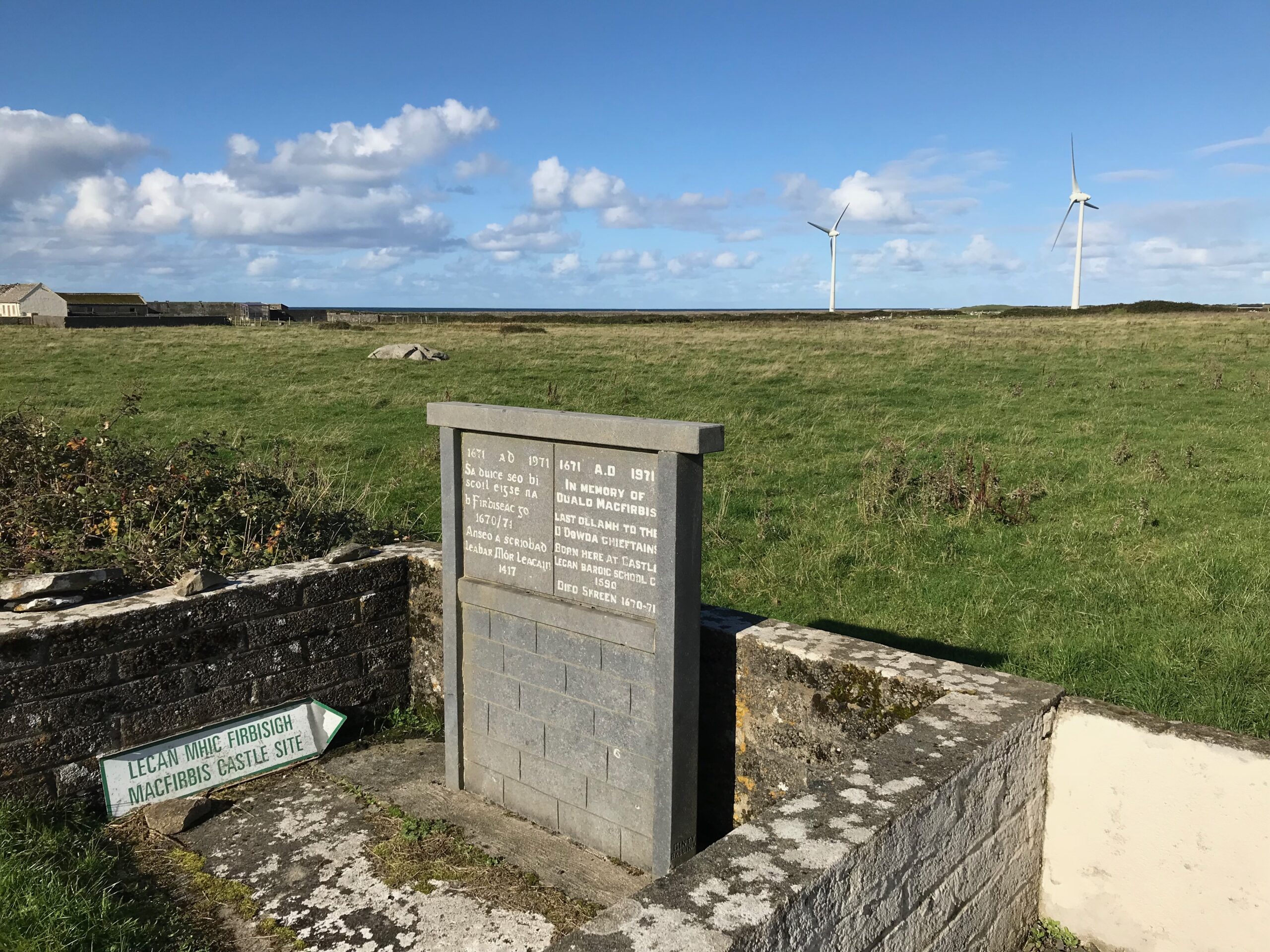
Their home and their school stood at Lecan (now Lackan) in the parish of Kilglass, east of the Moy. The ruin you can visit today is a later tower-house, rebuilt in 1560, but the site itself is far older. For as long as a Gaelic Ireland existed, this was the room in which its history was written.
II. The Great Book of Lecan
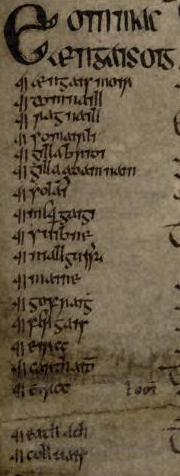
The Great Book of Lecan — Leabhar Mór Leacáin — is the masterwork of this tradition, and one of the great manuscripts of medieval Ireland. It is held today as Royal Irish Academy MS 23 P 2: 311 leaves of vellum, written in double columns of 51 lines, ruled red and yellow.
It was compiled between 1397 and 1418 at Lecan itself, in the scribal house of Mac Fhirbhisigh, under the patronage of Ruaidhrí mac Domhnaill Ó Dubhda, chief of the Uí Fhiachrach (d. 1417). The principal scribe was Giolla Íosa Mór mac Donnchadh Mac Fhirbhisigh — ollamh to the Ó Dubhda — assisted by Ádhamh Ó Cuirnín and Murchadh Riabhach Ó Cuindlis. Scribal notes in the manuscript record that Giolla Íosa began the work before his patron’s death and may have completed the transcription and the colouring of the whole by August 1418. Ó Cuindlis, one of his students, would later be identified by Professor Tomás Ó Concheanainn of UCD (in 1973) as the scribe of the Leabhar Breac — confirming how far the influence of the Lecan school reached.
III. What the book contains
The Great Book of Lecan is not a single text but a great compendium — a deliberate gathering, into one volume, of the texts that mattered most to Gaelic learning. Among them are:
- Lebor Gabála Érenn — the Book of Invasions, the mythological origin-history of Ireland
- Dindshenchas — the lore of places: the stories behind the names of rivers, hills and plains
- Bansenchas — the lore of women: the wives and mothers of the kings of Ireland
- Cóir Anmann — “the fitness of names,” on the epithets and bynames of famous men
- The Book of Rights, laws, saints’ genealogies, and a wealth of poetry
- And, at the heart of it for us, the pedigree and tribal history of Uí Fhiachrach — the Ó Dubhda and their kin
IV. The Lecan pedigree — our own genealogy
The part of the manuscript that reads as our book is the long section on Uí Fhiachrach — the royal genealogies of the northern Connacht dynasty to which the Ó Dubhda belong. Here the scribes traced the line down from Fiachra, son of Eochaidh Mugmhedhoin, brother of Niall of the Nine Hostages, through the kings of Connacht, to Dubhda mac Connmhach of the ninth century, whose name the family still bears, and onward through the hereditary chiefs.
This is the text that was edited and printed for the first time in 1844 by the Irish scholar John O’Donovan, under the title The Genealogies, Tribes and Customs of Hy-Fiachrach, commonly called O’Dowda’s country. It remains the foundation of modern Ó Dubhda scholarship, and the reason we can read our own pedigree today at all.
V. Giolla Íosa Mór
Giolla Íosa Mór Mac Fhirbhisigh (fl. 1390–1418) is named in the colophons as the compiler of both the Great Book of Lecan and — earlier in his life — much of the Yellow Book of Lecan, now held at Trinity College Dublin. Ninety-nine folios in his hand survive. He styled himself ollamh to Ó Dubhda, chief of Uí Fhiachrach, and he worked under the direct patronage of the lord he served. He appears to have died in 1418, very soon after completing his great book.
VI. Dubhaltach, the last of the line
The chain did not end with Giolla Íosa. For another two and a half centuries the Mac Fhirbhisigh kept copying, teaching, and writing, through a catastrophic age for Gaelic Ireland. The last and perhaps the greatest of the line was Dubhaltach Óg Mac Fhirbhisigh (c. 1600–1671) — known in English as Duald Mac Firbis.
In the Cromwellian years, working at the college-house of St Nicholas’s church in Galway, Dubhaltach compiled the extraordinary Leabhar na nGenealach (the Book of Genealogies) — 871 pages of Irish pedigrees, 95% in his own hand. He also assembled the Chronicum Scotorum and the Fragmentary Annals of Ireland, and transcribed the eighth-century law-text on poets, Bretha Nemed Déidenach. In April 1656 he witnessed the marriage of his hereditary lord, Dathí Óg Ó Dubhda (David O’Dowd) — the same Ó Dubhda whose family Mac Fhirbhisigh’s ancestors had served since the twelfth century.
In January 1671, travelling to Dublin, Dubhaltach was killed at Dunflin, Co. Sligo, stabbed by a man named Thomas Crofton. He was the last hereditary ollamh of Lecan, and with him the unbroken tradition of Mac Fhirbhisigh scholarship came to an end.
The Leabhar na nGenealach lay in private hands for three centuries and was finally published in full, in five volumes, in 2003 by the scholar Nollaig Ó Muraíle. Its original vellum leaves are now in the Special Collections of University College Dublin.
Coda
Five hundred years of scholarship, sustained by one family, in service of one other: the Mac Fhirbhisigh wrote for the Ó Dubhda, and the Ó Dubhda are remembered because the Mac Fhirbhisigh wrote. Every page of this website stands on theirs.
The Great Book of Lecan
chief of Uí Fhiachrach, d. 1417
ollamh to the Ó Dubhda
Murchadh Riabhach Ó Cuindlis
double column, 51 lines, red & yellow rubrication
The Great Book of Lecan has been fully digitised and is free to view online, page by page, in high resolution.
The ruin of the scribes' tower-house at Lecan Mhic Fhirbhisigh — their home, their school, and the site where the Great Book was written.
Visit Lackan →The stone chair at Doonflin, Skreen — the place where Dubhaltach was murdered in January 1671. A 2015 work by Martha Quinn.
Visit Memorial →What the scribes left behind
Five centuries of quiet work, surviving in manuscript, in print, and in stone.


Continue Your Journey
A Note from the Clan
Every fact on this page is grounded in the Royal Irish Academy's own catalogue, the Irish Script on Screen project at the Dublin Institute for Advanced Studies, O'Donovan's 1844 edition, Kathleen Mulchrone's 1937 facsimile, and Nollaig Ó Muraíle's biography and edition of Dubhaltach Mac Fhirbhisigh.
If you descend from the Mac Fhirbhisigh, or hold family memory about the old school at Lackan, we would very much like to hear from you — get in touch.