Grangemore Castle
May 2, 2026 2026-05-07 1:53Grangemore Castle
GRANGEMORE CASTLE
Grangemore Castle
An Ghráinseach Mhór — the great grange: a small monastic tower beside an ancient graveyard in Templeboy parish, Co. Sligo
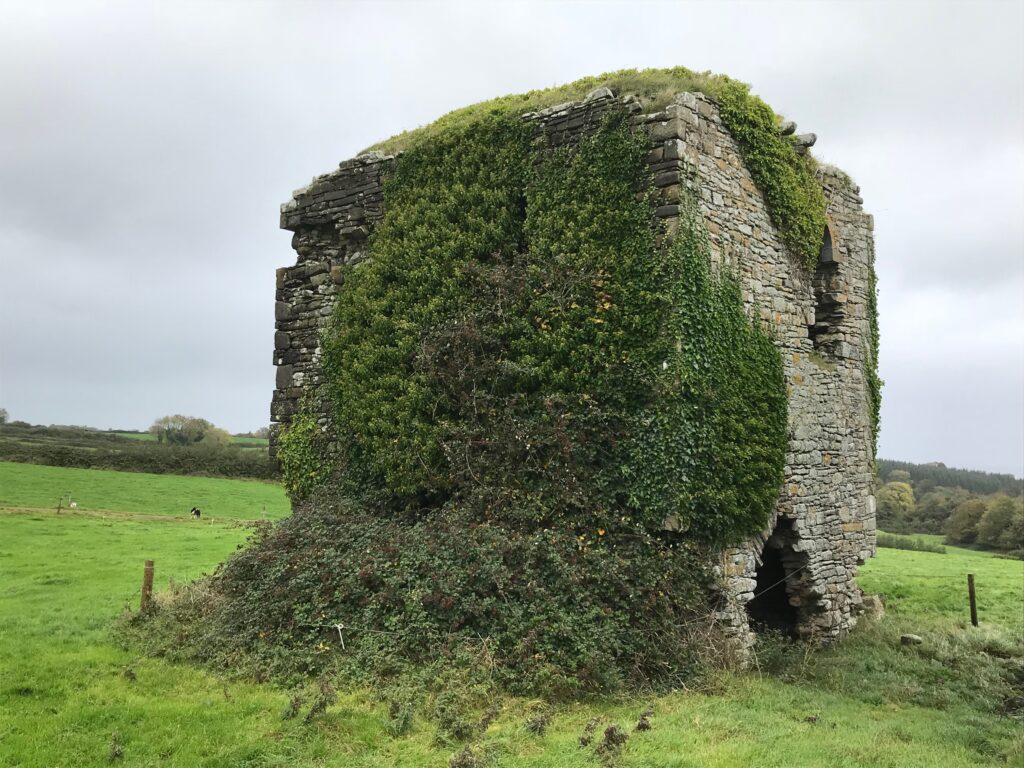
On low ground in the civil parish of Templeboy, in the barony of Tireragh, a small ivy-clad tower stands beside an old graveyard. This is Grangemore — in Irish An Ghráinseach Mhór, “the great grange.” The name declares what the site was: a monastic farm, worked as an outlying possession of one of the religious houses of medieval Sligo. The tower that survives here was not the seat of a Gaelic lord but a refuge used by the monks and friars who held the grange — “a small castle,” the Schools’ Collection of 1937–9 calls it, “which was used by them is still standing.”
Grangemore is counted among the twenty castle sites gathered by Conor Mac Hale in his 1990 history of the family, and so sits on the O’Dubhda castle tour. It is the only site on that tour whose character is ecclesiastical rather than secular — a grange inside O’Dubhda territory, not an O’Dubhda stronghold. The graveyard alongside is still in use and is directly accessible from the public road.
I. The Name
The townland is recorded on logainm.ie (ID 44937) as An Ghráinseach Mhór — “the great grange.” The word gráinseach is borrowed from monastic Latin grangia and refers specifically to an outlying farm held and worked by a religious house. The place-name itself is therefore the first and clearest piece of evidence for what Grangemore was.
The Elizabethan Fiants of 1584 record “Great Graunge and Little Graunge in Tipheraghe,” distinguishing a larger grange from a smaller one in the same barony. Variant forms follow from 1577 onwards — Graunge, Graingemore, Grange more. John O’Donovan, writing the Ordnance Survey Name Books for Co. Sligo in 1836, gave the Irish form directly: “Grainseach mór, ‘great grange.’” The same Name Books describe the townland in 1836 as containing “a fort and a corn mill,” with “a considerable stream [running] north through its centre.” What the 1836 compilers called a “fort” is the small tower whose ruin still stands above that stream today.
II. The Graveyard and the Monks’ Refuge
The fullest surviving evidence for the site’s character comes not from printed histories but from the Bailíuchán na Scol (Schools’ Collection) of 1937–9, in which primary-school teachers in Sligo gathered local tradition from their pupils. Templeboy’s schools contributed several entries on Grangemore; taken together they give a consistent picture of a monastic site with a small fortified tower and an old graveyard still in use:
- “Monks live at Grangemore and they had an old castle there.” (CBÉS vol. 168, p. 294)
- A monastery flourished for centuries near Ardkill, where the monks stored grain in a granary and kept “the old castle of Grangemore,” in which friars lived and said mass before the priest-hunters drove them into hiding. (CBÉS vol. 168, p. 26)
- Twenty yards from the old Castle, in Higgins’ field, a plain flat stone marks the grave of a monk; a cross is carved upon it. (CBÉS vol. 168, p. 48)
- The castle survives beside the old graveyard: “a small castle which was used by them is still standing” — described as “a very impregnable fortress for that period.” (CBÉS vol. 169, p. 138)
- Two graveyards were in use in the parish — an upper one at Grange More and a lower one at Corkhill. Only Catholics were buried in Templeboy graveyard; when a Protestant burial was attempted, local tradition held, the coffin kept rising from the earth. (CBÉS vol. 167, p. 756; vol. 169, p. 139)
The earliest dated tombstone recorded in the Schools’ Collection at Grangemore is that of William Knoy, 1780 — a plain flat slab resting on four supporting stones (CBÉS vol. 167, p. 756). Older graves are certainly present on the site, but none are individually datable from the surviving record.
III. Place in the O’Dubhda Territory
Grangemore lies well within the historical lordship of Uí Fhiachrach Muaidhe, and for that reason Conor Mac Hale, in his O’Dubhda Family History (1990), included it among the twenty castle sites associated with the territory. It is the basis on which Grangemore appears on this site’s castle tour today.
No primary source we have been able to consult, however, records Grangemore as the seat of an O’Dubhda chief, nor as a stronghold of any named Gaelic family. Earlier versions of this page attributed the castle to an “O’Colman” family on the basis of a 1609 map; we have not been able to locate any such map, or any record connecting an O’Colman family to this site, and that claim has been removed as unsupported. The surviving local memory, gathered a century ago from Templeboy’s own schoolchildren, is unanimous: the tower was a monks’ refuge.
That picture is consistent with the place-name itself. Many Irish monastic houses held outlying granges protected by small fortified towers, particularly during the unsettled years of the Reformation, the suppression of the religious houses under Henry VIII, and the penal era that followed. Whether the Grangemore grange was originally attached to the Augustinians of Ballysadare, the Franciscans at Rathfran, or another house within reach of Templeboy is not established by the sources we have to hand.
IV. The Site Today
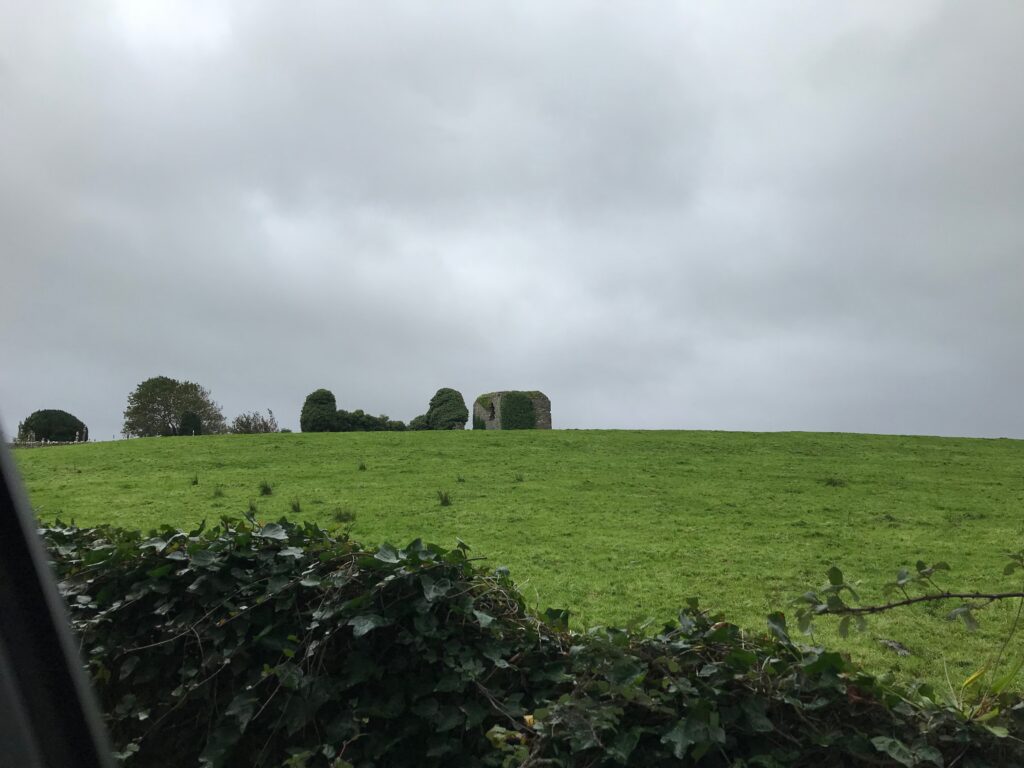
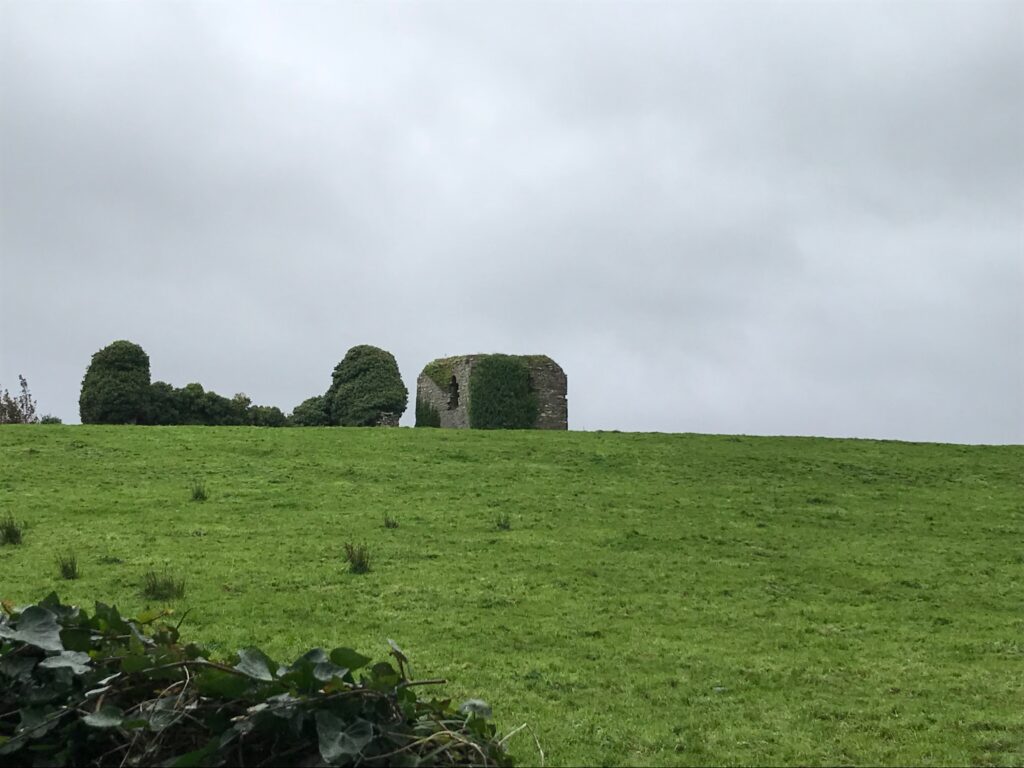
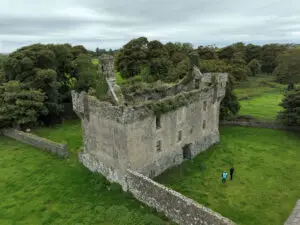
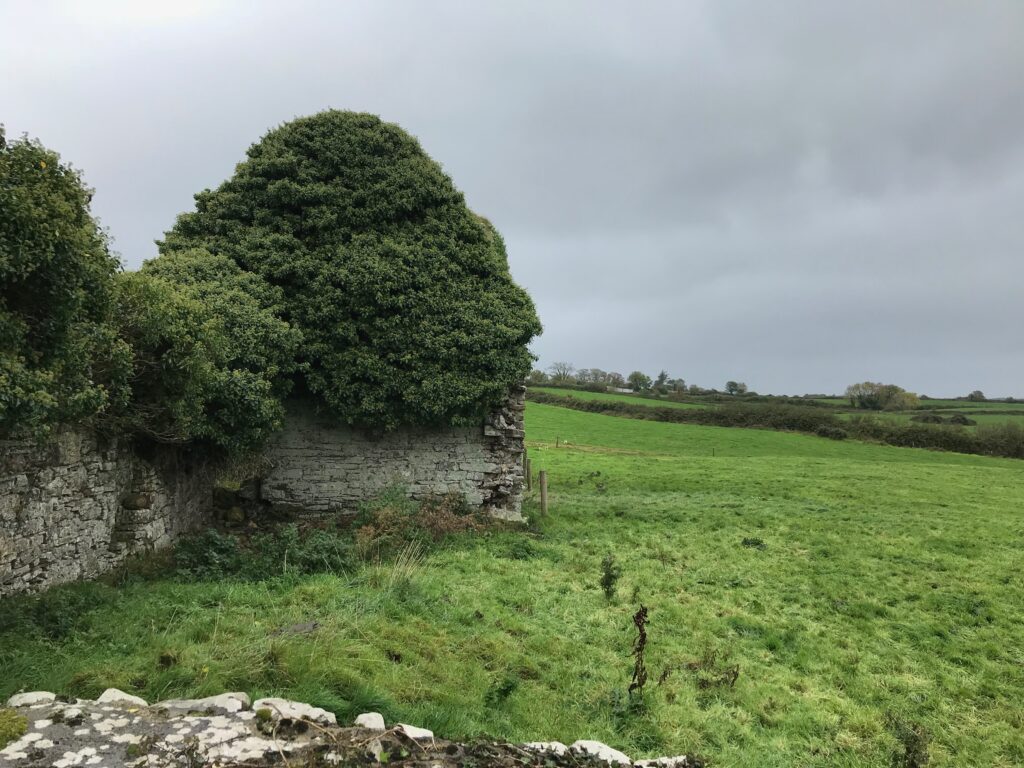
What survives at Grangemore is a small late-medieval stone tower, heavily overgrown, standing in open farmland a short distance from the public road. Ivy masses over the east face; a mature tree has grown hard against the west wall. The structure has not been the subject of a detailed published archaeological survey, and no secure construction date can be given from the present evidence.
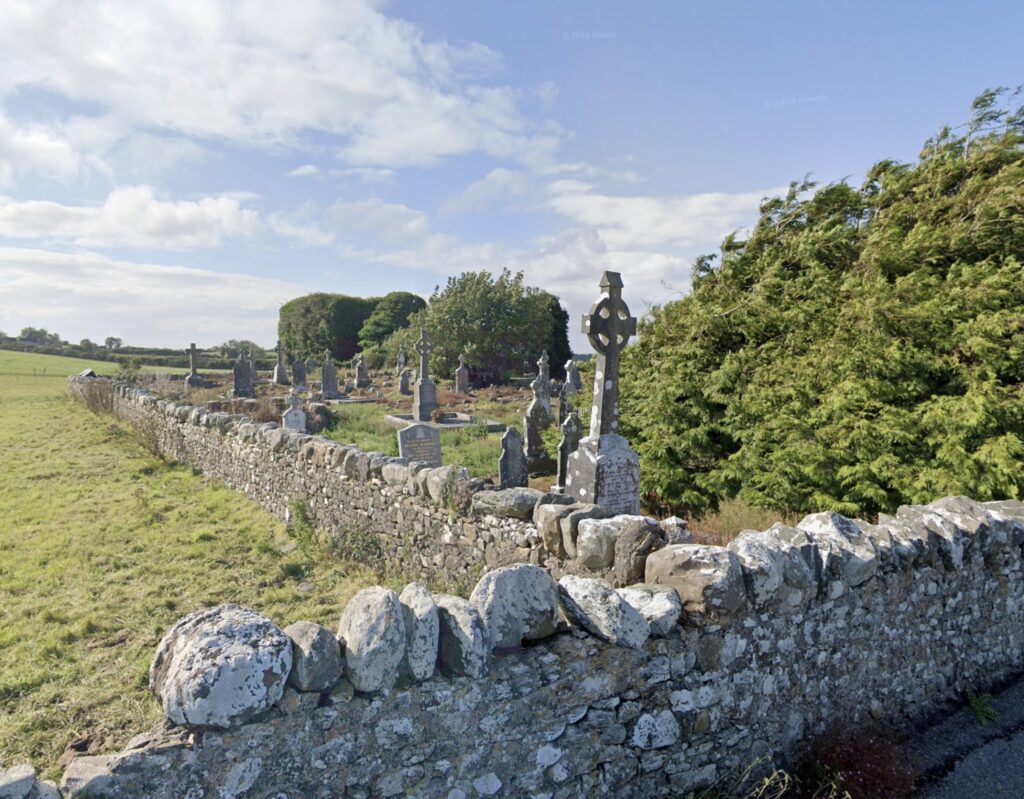
The adjoining graveyard is still in use and is directly accessible from the street, enclosed by a dry-stone wall and entered through a simple gate from the roadside — no permission or interpretation is required to walk among the headstones. At the entrance a modern guide to the legible surnames and their locations has been erected for visitors.
The tower itself stands in a working farm field a little away from the graveyard, and should be viewed from the public roadway unless the landowner’s permission has been sought and given. The ground is uneven and the ivy-covered walls should not be leant against.
Grangemore Castle — north Tireragh, near Dunneill
Grangemore Castle
An Ghráinseach Mhór (“the great grange”)
54.2290° N, 8.8133° W
Townland of Grange More, civil parish of Templeboy
Barony of Tireragh, County Sligo
Small late-medieval tower on a monastic grange
Counted on Mac Hale's (1990) list of 20 sites associated with the O'Dubhda territory
The only ecclesiastical site on the O'Dubhda castle tour
Unknown — no published archaeological survey.
Visible fabric consistent with a small late-medieval tower.
Recorded as “a fort” in the 1836 OS Name Books.
Ruinous, heavily ivy-clad; stands in open farmland
Graveyard alongside still in use
The graveyard is freely accessible from the public road through a simple gate in the dry-stone wall — no permission needed.
The tower itself sits on private farmland and should be viewed from the roadway unless the landowner's permission has been given.
Inside the historical territory of Uí Fhiachrach Muaidhe. Included on Mac Hale's 20-castle list (1990) but not attested as an O'Dubhda seat in any primary source; the surviving local tradition remembers the tower as a monks' refuge.
The name An Ghráinseach Mhór — “the great grange” — identifies this as a monastic outfarm of one of the religious houses of medieval Sligo. The Schools' Collection of 1937–9 records a consistent local tradition of monks and friars using the tower as a refuge, particularly during the penal period. It is the only such site on the O'Dubhda castle tour.
From the Clan
Photographs of Grangemore Castle submitted by clan members.
Latest stories tied to Grangemore Castle.
Tales, research and dispatches from the O’Dubhda journal.

How Many Castles Did the O’Dowds Actually Have? (More Than You Think — and We’re Still Counting)
The popular ’20 castles’ figure keeps growing as new field reports, old maps, and survey records turn up O’Dubhda sites no one had counted. Here’s where the tally stands.
Unearthing the O’Dowd Legacy: The Enduring Mystery of the “Twenty Castles”
The legend of an O’Dowd kingdom ‘ringed with twenty castles’ isn’t poetic flourish — it describes a real defensive network across Mayo and Sligo. We trace what survives.
The 2006 Rally — Edward P O’Dowd Inaugurated
The seventh rally, 15 – 17 September 2006, held its business in the back room of Roper’s Pub (the Atlantic Hotel was being refurbished) and closed with the inauguration of Edward P. O’Dowd of Chicago as the third modern Taoiseach at Enniscrone Castle. At a glanceDates: 15 – 17 September 2006 · Base: Roper’s Pub, EnniscroneAttendance: From Australia (ACT, Queensland), Canada, England, Ireland, Scotland and across the USANotable moment: Inauguration of Edward P. O’Dowd of Chicago; Mícheál Ó Dubhda (Brisbane) elected Tánaiste. The Gathering Registration on Friday included a welcome pack: the clan newsletter, a copy of the O’Dubhda History, a programme, a lapel pin presented by Taoiseach Richard Dowd, and a first drink on the house. The exhibit that year was stronger than any before it — manuscripts dated 1160, 1397 and 1650, and materials on Baron O’Dowda and the more than forty recorded surname variants. Saturday: Two Coaches, Six Sites Two minibuses worked through the day’s itinerary. The O’Dubhda Mermaid Rocks at Scurmore; the thirteenth-century ruins of Castleconnor; the fifteenth-century Moyne Abbey, where Fr John (Seán) Ó Dubhda was martyred; Kilcummin, the French landing place of 1798; and the Neolithic Céide Fields above the Atlantic cliffs. Dinner that evening was at Murphy Brothers’ restaurant in Ballina. The Inauguration Sunday morning began with a memorial Mass for deceased clan members, celebrated by Fr Michael Doody SJ. The Council met and confirmed Mícheál Ó Dubhda (Mike Dowd) of Queensland as the incoming Tánaiste. The members then moved to Enniscrone Castle for the inauguration of Edward P. O’Dowd of Chicago. Following the now-established form, the White Wand was passed hand-to-hand through the gathering before being raised over Edward’s head by the Ollamh. At the same meeting the rule was unanimously adopted that retiring Taoisigh should henceforth hold the title Taoiseach Emeritus as permanent members of the Clan Council. Tours & Sites Mermaid Rocks at Scurmore Castleconnor, Roslee Castle, Easkey, the Split Rock of Killeenduff Grangemore Castle (16th c.) and Skreen — Mac Fhirbhisigh country Rathlee Tower (c.1803) and the cliff-walk at Rathlee Castle Further Reading Thomas J Dowds, The O’Dubhda Gatherings: A History (forthcoming) — chapter 8 odubhdaclan.com archive entry ← Previous Rally The 2003 Rally — Richard F Dowd Inaugurated Next Rally → The 2007 Flight of the Earls Commemoration

A Note from the Clan
These pages are researched and written by volunteers of the O'Dubhda Clan. Our history is vast, and our understanding of it grows with every correction, addition, and story shared by clan members and researchers.
If you have found an error, or have information that would improve this page, please get in touch.