
The Ardnaglass Dog and the Wolf
April 18, 2026 2026-10-14 21:10The Ardnaglass Dog and the Wolf
The Ardnaglass Dog and the Wolf
Schools’ Collection, Dromard and Skreen, 1930s
Of the Ardnaglass folklore cycle, the Dog and the Wolf is the piece with the strongest physical trace. A carved stone depicting the scene was preserved at the castle through the eighteenth and early nineteenth centuries, and in 1841 it was presented to the Royal Irish Academy in Dublin, where it is noted in the Academy’s published proceedings. That stone is the closest thing any Ó Dubhda folktale has to a hard material anchor.
I. The Schools’ Collection tradition
The story as it was being told in Sligo in the late 1930s, when schoolchildren were collecting folklore for the Irish Folklore Commission, was short and plain:
“The castle of Ardnaglass was built by the O’Dowds. Once a dog belonging to the O’Dowds killed a wolf that was doing a great amount of damage among the flocks of Sligo and Leitrim. The O’Dowds in commemoration of this event had a stone sculptured to represent the dog killing the wolf. This stone was taken from the castle and then brought to the Museum in Dublin.”
Bailiúchán na Scol, vol. 0168, p. 425 (Dromard and Skreen, Co. Sligo)
There is no named chieftain, no date, no detail of the hunt: only the castle, the hound, the wolf, and a carved stone that the teller believed the O’Dowds made to remember it, and knew had gone to Dublin.
II. The stone at the Royal Irish Academy
On 22 February 1841 Charles T. Webber presented the stone to the Royal Irish Academy. The Academy’s Proceedings record “an ancient stone, on which is carved a rude bass-relief, supposed to be the representation of a dog killing a wolf”, taken from the Castle of Ardnaglass and “said to commemorate the destruction of the last wolf in Ireland.” Webber also passed on the tradition of the place: long after wolves were thought extinct, a wolf attacked the flocks of Leitrim; the chieftains of Leitrim asked O’Dowd, chieftain of Tireragh, who owned a celebrated wolf dog, to hunt it; the chase ran through district after district until the wolf was killed in a small pine wood at the foot of a mountain in Tireragh, on a quarter still called Carrow na Madhoo, “the dogs quarter”; and O’Dowd had the scene carved and set in the wall of his castle (Proc. RIA vol. 2, no. 28). The Irish Times, writing about Ireland’s last wolves in a later opinion piece, confirms the 1841 donation and its Ardnaglass provenance.
The stone. The stone is the physical residue of the tradition — the thing the Schools’ Collection story was, in some sense, explaining. It is the Dog and the Wolf made material.
Older than the castle. It has been suggested that the carving is older than the late-medieval tower at Ardnaglass, which was built no earlier than the fifteenth century. If so, the stone was reused — an older piece, carved for some other purpose, built into the castle when it was raised, and later reinterpreted in folklore as a commemoration of a specific O’Dowd hunt.
How folklore works. This is not a cynical reading. It is how folk-tradition routinely works: an old object in the landscape accumulates a story that explains its presence. The Mermaid Rocks at Scurmore are a Bronze Age monument with a medieval clan attached. If the Ardnaglass stone is older than its tower, it too is an older carving with a Gaelic hound and wolf attached. In both cases the folklore is the newer layer, not the object itself.
III. Wolves in Ireland
Wolves were a real presence in Irish life until the end of the eighteenth century. They were hunted as vermin, feared by shepherds, and protected only in the abstract sense that the Gaelic and later Anglo-Irish gentry needed something to hunt. The last confirmed Irish wolf was killed in County Carlow in 1786 — though other counties carry their own “last wolf” traditions, each plausible and none definitively first.
The Ardnaglass tradition fits into the wider last-wolf literature, but with a twist. By the 1930s it had become a dynastic story — the O’Dowd hound, generic and emblematic, killing a wolf that was harming the flocks of Sligo and Leitrim. The wolf is less a real animal than a problem the clan solved for its territory. The hound is less a real hound than a sign of the clan’s protective reach. A century earlier, in 1841, the same tradition still had a hunt, a route and a named field.
IV. Reading the folklore
Three readings are worth holding side by side.
The political reading. Gaelic Irish identity had a long association with hounds. Cu Chulainn is the “hound of Ulster”; the great Irish hound was a prized gift between kings, in Irish saga and as early as a Roman letter of the fourth century; and the heraldic vocabulary of medieval Ireland is rich in hounds. For the O’Dowds to be remembered, through their hound, as the defenders of Sligo and Leitrim against the wolf is a way of claiming territorial legitimacy — they did not just live on this land, they protected it.
The archaeological reading. If the carved stone is older than the tower, as has been suggested, reusing older stones in medieval structures is entirely normal — churches, castles, and ringforts across Ireland incorporate earlier carved stone. When no one remembers what a carving originally showed, a story fills the gap.
The literal reading. Wolves really did threaten flocks in north Connacht into the eighteenth century. Hounds really were kept and hunted with. The Ardnaglass tradition may well preserve, in compressed form, a real memory — not of one particular hunt but of the Ó Dubhda line’s role as the people who organised the protection of livestock in their territory. The literal reading and the political reading are not incompatible.
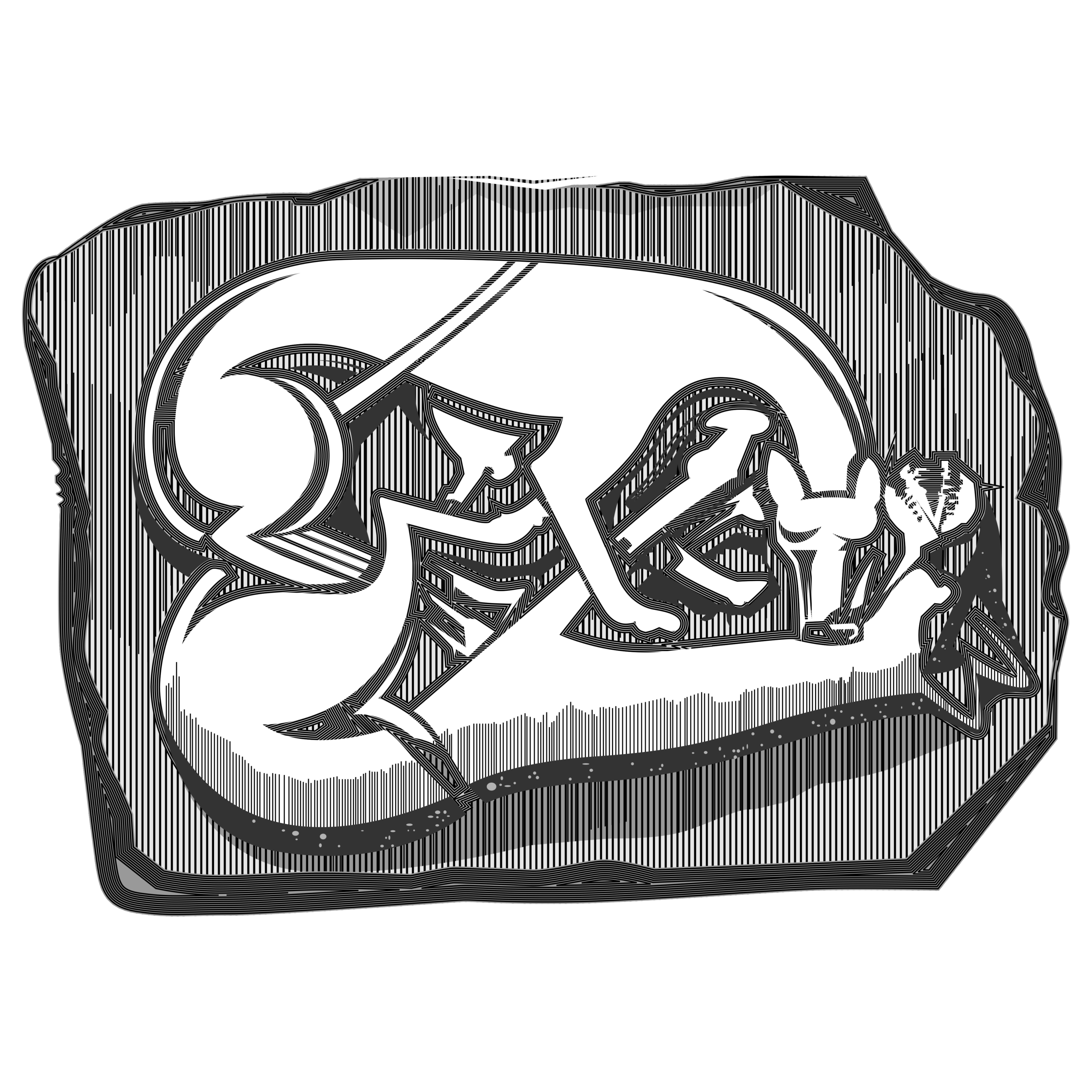
donated 1841
Skreen parish, Co. Sligo
per the Academy’s record
possibly older than the castle
Old objects accumulate stories that explain them. The Ardnaglass stone may predate the castle; if it does, it is a reused carving.
The folklore is not describing what the stone is. It is describing what the community eventually decided it meant.
The life of a story
The Dog and the Wolf is one of the few Ó Dubhda folk-traditions with a dated, documented physical trace — the carved stone now in Dublin. Centuries of story-making converge on that object.
Continue Your Journey
A Note from the Clan
These pages are volunteer-authored. We document every version of each tale we can trace, and we cite our sources. Where evidence is thin or contested, we say so plainly.
If you carry a family version of one of these stories — or know of a printed source we’ve missed — get in touch.