Enniscrone Castle
Caisleán Inis Crabhann
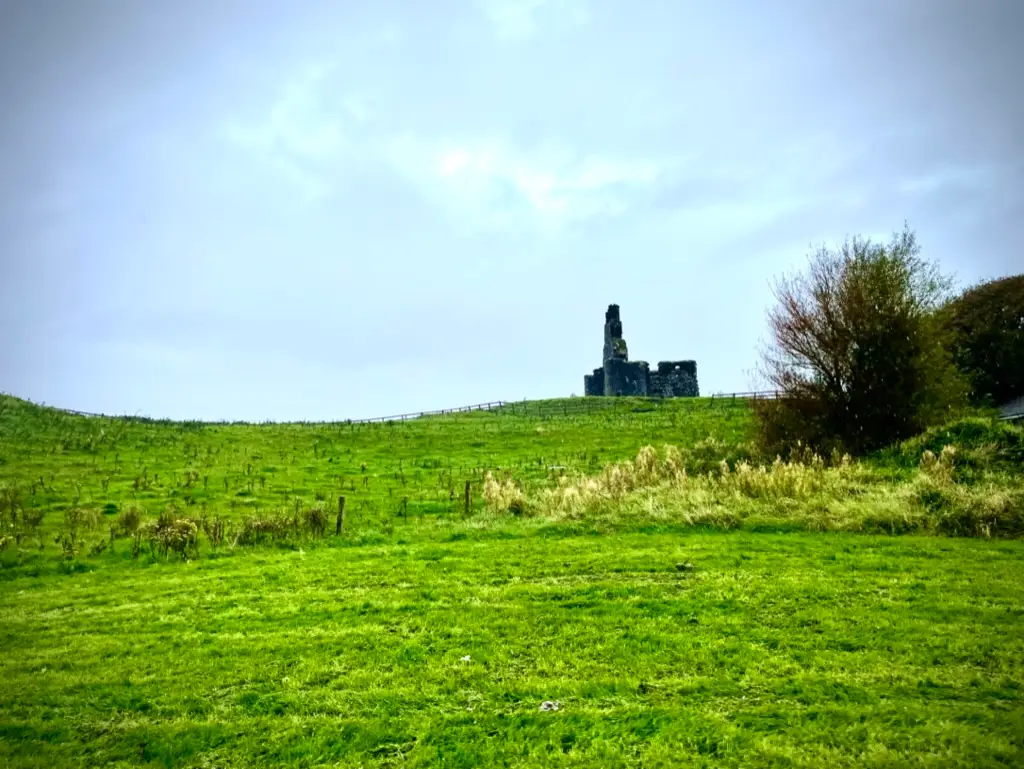
Enniscrone Castle — known locally as Nolan’s Castle, Field Castle, or O’Dowd’s Castle — stands on an elevated ridge in the townland of Carrowhubbuck South (Ceathrú Hobac Theas), a short distance north-east of Enniscrone town. The place-name is recorded on logainm.ie as Inis Crabhann (entry 44890), in the parish of Cill Ghlas (Kilglass) and barony of Tír Fhiachrach (Tireragh); the exact meaning of the Irish form is uncertain. The site sits within the historic territory of the Ó Dubhda, who from the twelfth century onward held much of north Mayo and west Sligo.
Two distinct structures should be kept apart on this site: a late-medieval Ó Dubhda fortification, and the early seventeenth-century fortified house whose ruin still stands. The later building was raised on the ground the Ó Dubhda had defended, but it is not the Ó Dubhda castle itself.
I. The Ó Dubhda on the Ridge (14th–15th Century)
The ridge above Carrowhubbuck was a point of strategic importance well before any stone castle was built there. The Castle Field on which the ruin now sits was already a much older place of habitation and burial: at least two megalithic tombs, Neolithic in date (roughly three-and-a-half to five thousand years old, not the figures sometimes quoted in popular accounts), and a ringfort of the early medieval centuries lie close to the later castle.
A first Ó Dubhda fortification on this hill is traditionally dated to the later fourteenth century, though no securely identified fabric of that phase survives above ground. The site’s firmest documentary peg belongs to the early fifteenth century. The Great Book of Lecan (Leabhar Mór Leacain, RIA MS 23 P 2), compiled between 1397 and 1418 not at Enniscrone itself but at Lecan/Lackan in Tireragh under Ó Dubhda patronage, was the work of Giolla Íosa Mór Mac Fir Bhisigh. It preserves a poem by Mac Fir Bhisigh commemorating the inauguration of Tadhg Riabhach Ó Dubhda as chieftain of Tireragh around 1417. Later clan tradition associates Tadhg Riabhach’s household with Enniscrone, though the precise status of the castle at that date cannot be established from the manuscript alone.
II. Siege and Sale (1512–1597)
In 1512 the castle was taken by the Burkes (Bourkes) of Tyrawley, who had pushed into Ó Dubhda territory from the Mayo side of the Moy. They were in turn dislodged later the same year by the O’Donnells of Tír Chonaill, who reduced the building before withdrawing. The Ó Dubhda rebuilt, but their wider political position was failing: the last formal installation of an Ó Dubhda chieftain under Brehon custom took place in 1595, by which time the family had become a client of the O’Connor Sligo.
In 1597 Mac Donnell gallowglasses, formerly in Ó Dubhda service, sold the castle on to John Crofton, a New English settler. Crofton in turn sold it to Thomas Nolan of Ballinrobe, Co. Mayo. It is the Nolans whose name has stuck in local memory: “Nolan’s Castle” is still a common designation for the ruin today.
III. The Seventeenth Century: Nolan, Coote, Gore, Orme
Thomas Nolan’s son, John Nolan, was in residence at the castle at the outbreak of the Irish rebellion of 1641. In 1642 Charles and Patrick O’Dowd of Ballycotle raided Moyne Abbey and captured Enniscrone Castle from the Nolans — a brief return of the old seat to Ó Dubhda hands during the Confederate rising, recorded in Conor Mac Hale’s annals digest of 1990. During the remainder of the Confederate Wars the building was garrisoned, and in 1645 it was taken by Parliamentarian troops under Sir Charles Coote. In the Cromwellian settlement that followed, Enniscrone passed to Sir Francis Gore. The Gore interest was succeeded in the eighteenth century by that of the Orme family, who remained the local landlords of the Castle Field until the early 1920s, when ownership passed to the Irish State.
IV. The Surviving Ruin
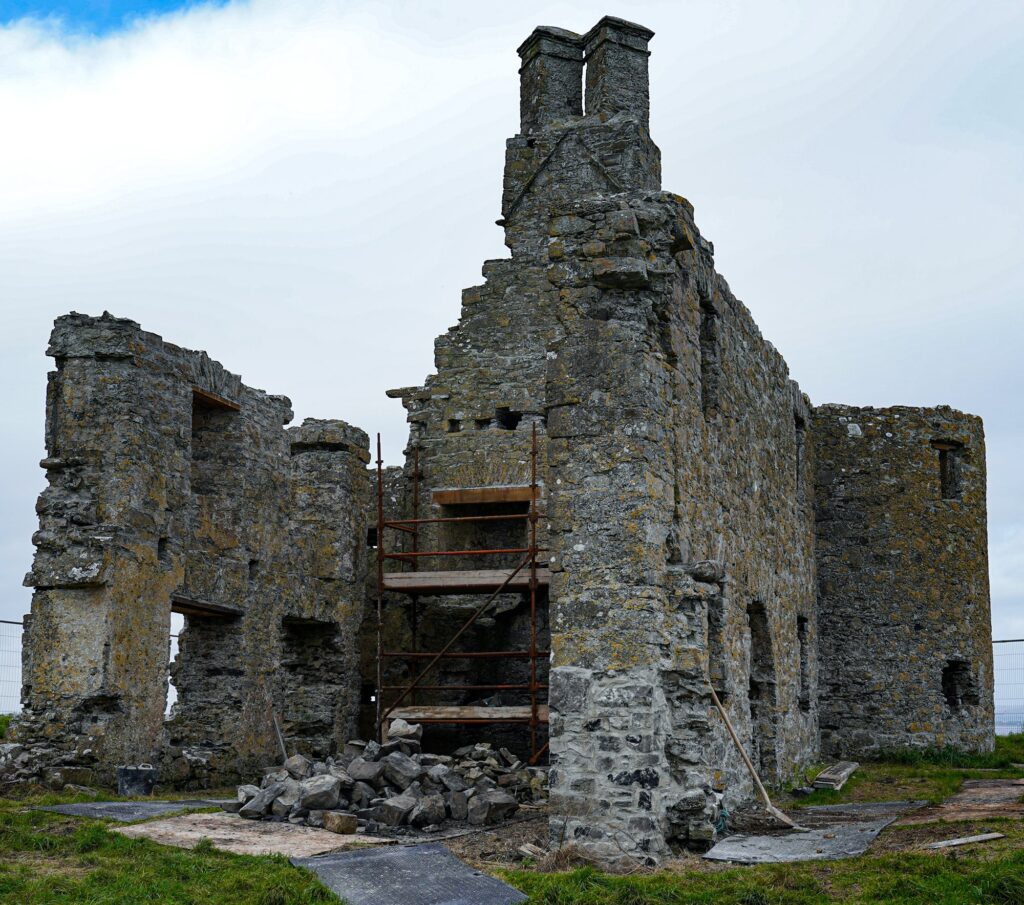
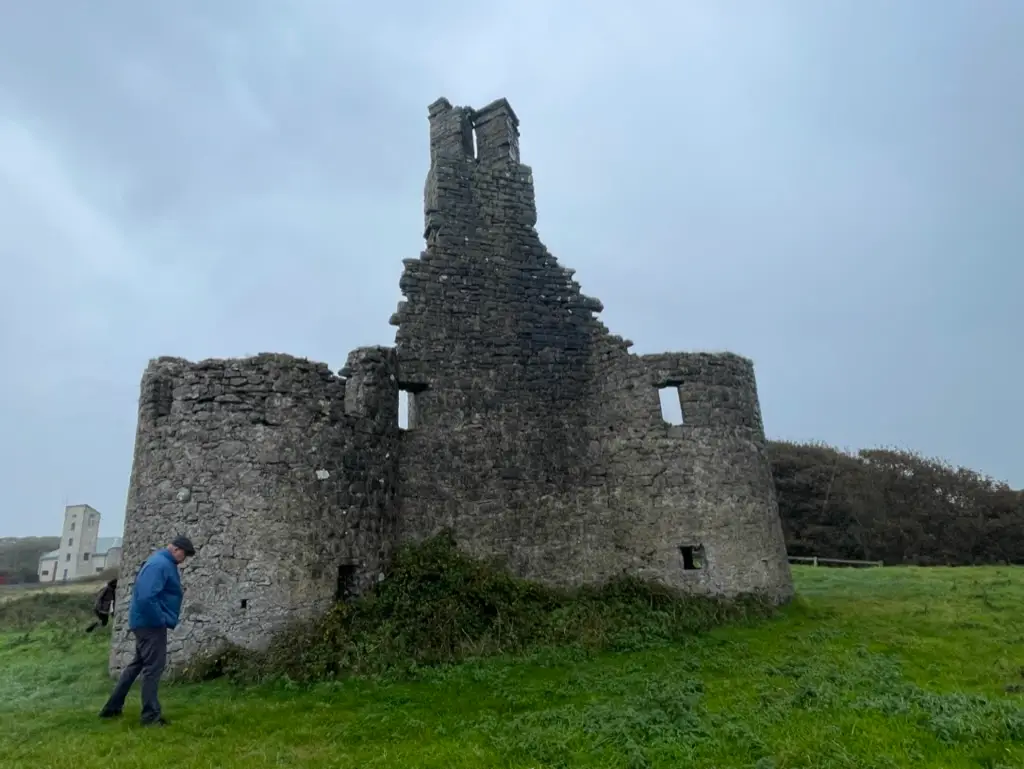
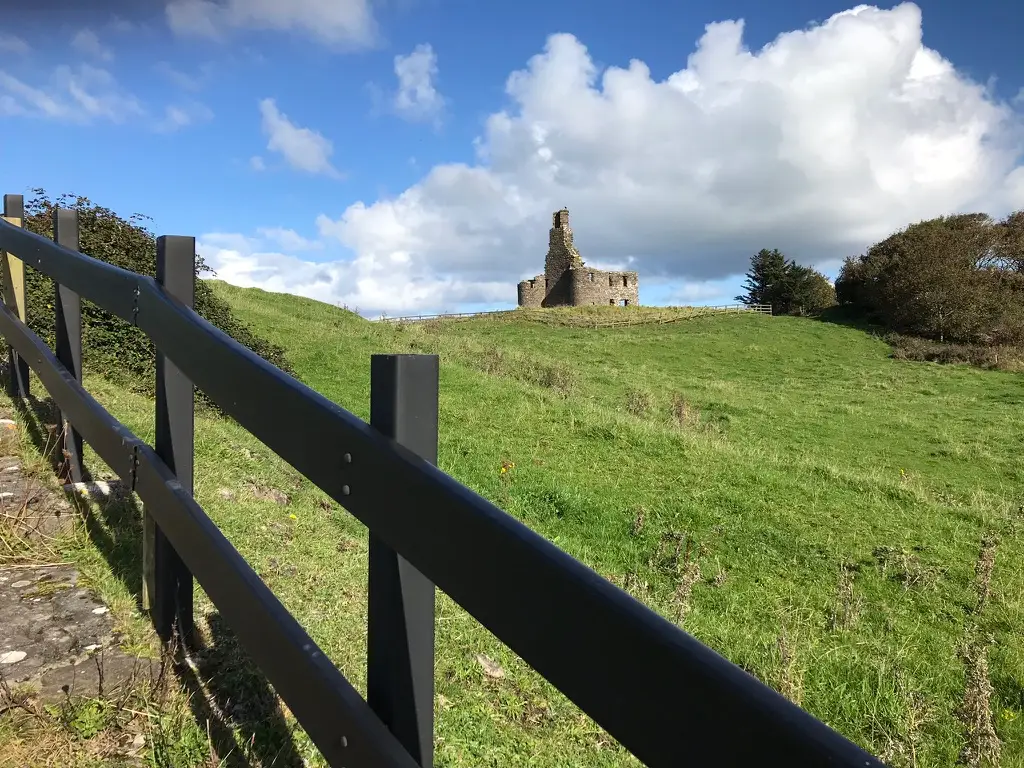
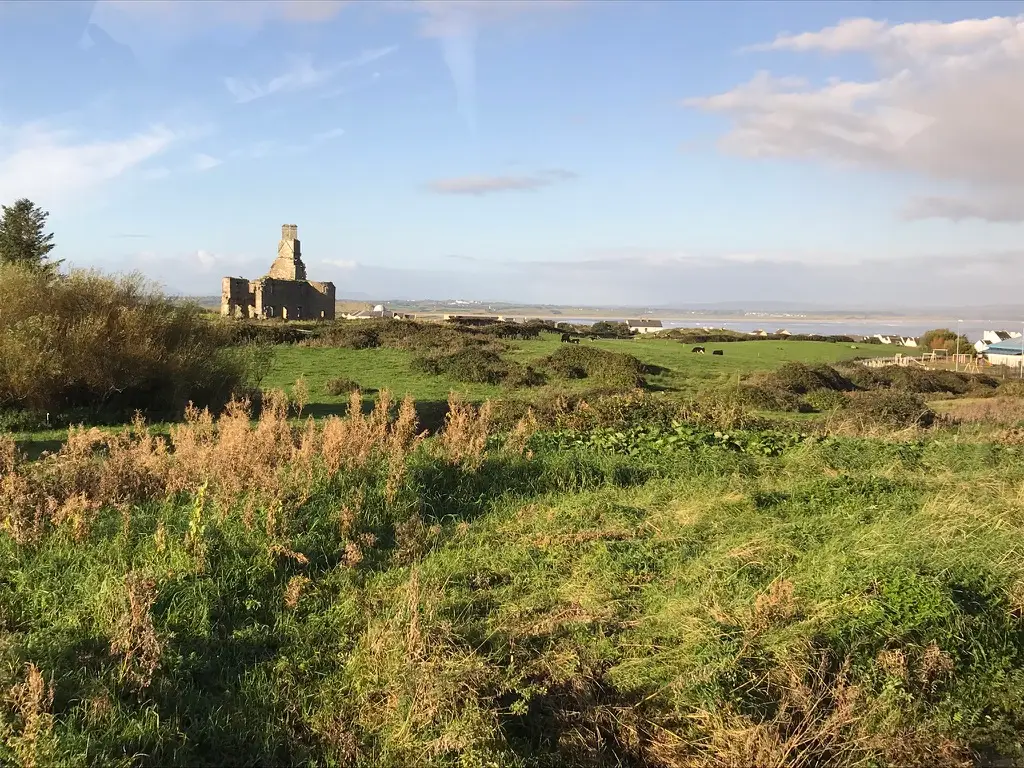
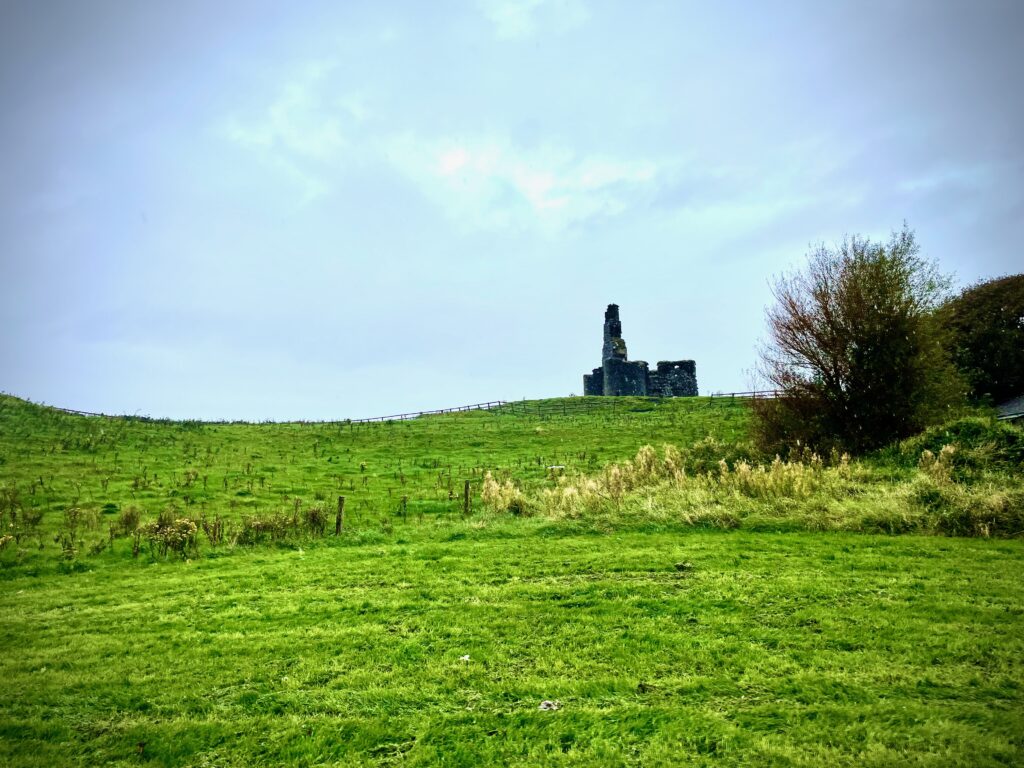
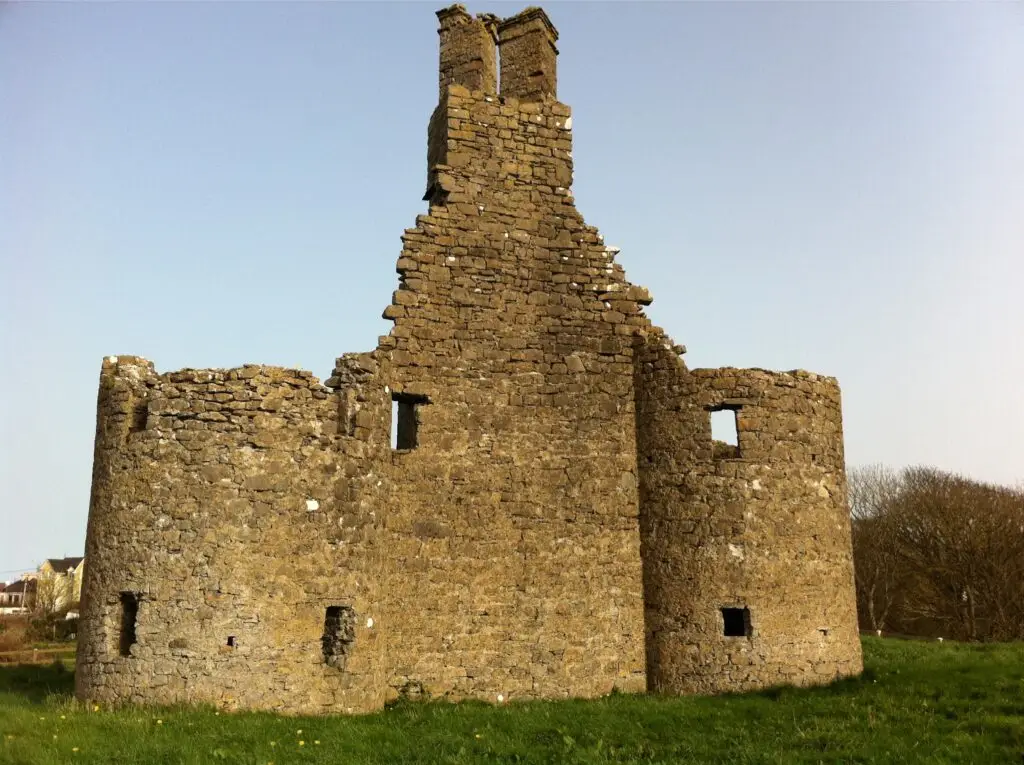
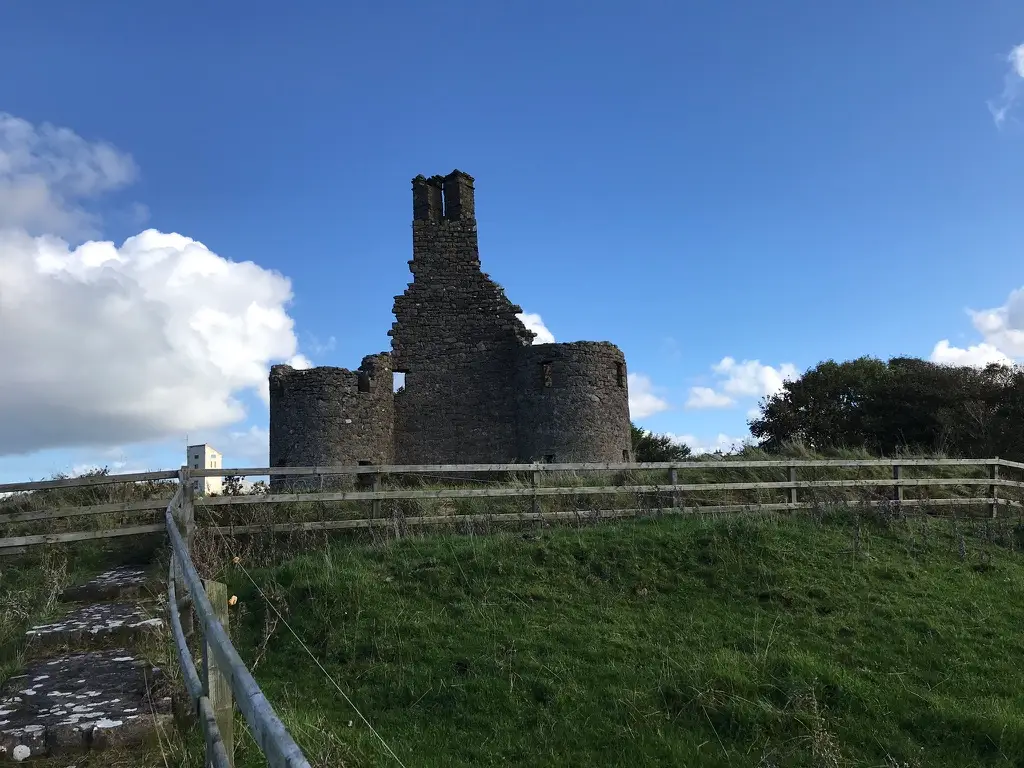
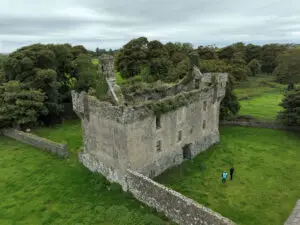
What stands today is not a medieval tower house but an early seventeenth-century fortified dwelling — a “stronghouse” or “semi-fortified house” in the architectural terminology — built on the footprint of the older Ó Dubhda site. It is a rectangular gabled block with three-quarter round towers at the angles; of the four towers, only the two western examples survive. The building was of two storeys with attics, with a large central fireplace and a smaller upper one, their chimneys partly intact; the main arched doorway in the north wall retains its drawbar sockets. The diamond-profile chimney stacks are of late-sixteenth- or early-seventeenth-century type.
Recent research by Frank J. Hall of the University of Galway, set out in the 2023 archaeological report on the castle, uses LiDAR, orthophotography and digital surface modelling to argue that the building’s defensive character has been underestimated. Hall notes numerous gun-loops and a high quality of stonework, and concludes that defence remained a primary rather than a residual concern — a significant revision of the earlier reading of the structure as an essentially domestic residence.
The castle is a Recorded Monument and is undergoing active conservation. In April 2025 the Minister for Housing, Local Government and Heritage announced an allocation of €118,671 to Enniscrone Castle under Phase 2 of the Community Monuments Fund 2025; structural consolidation work on site had already begun in September 2024.
V. The Wider Landscape
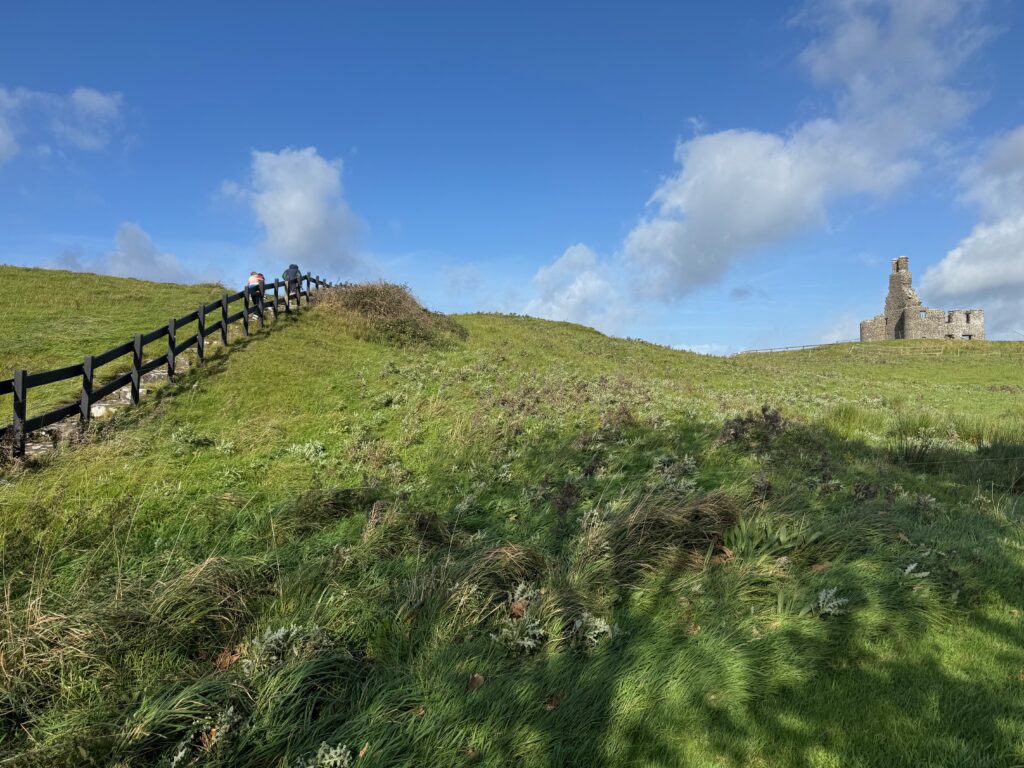
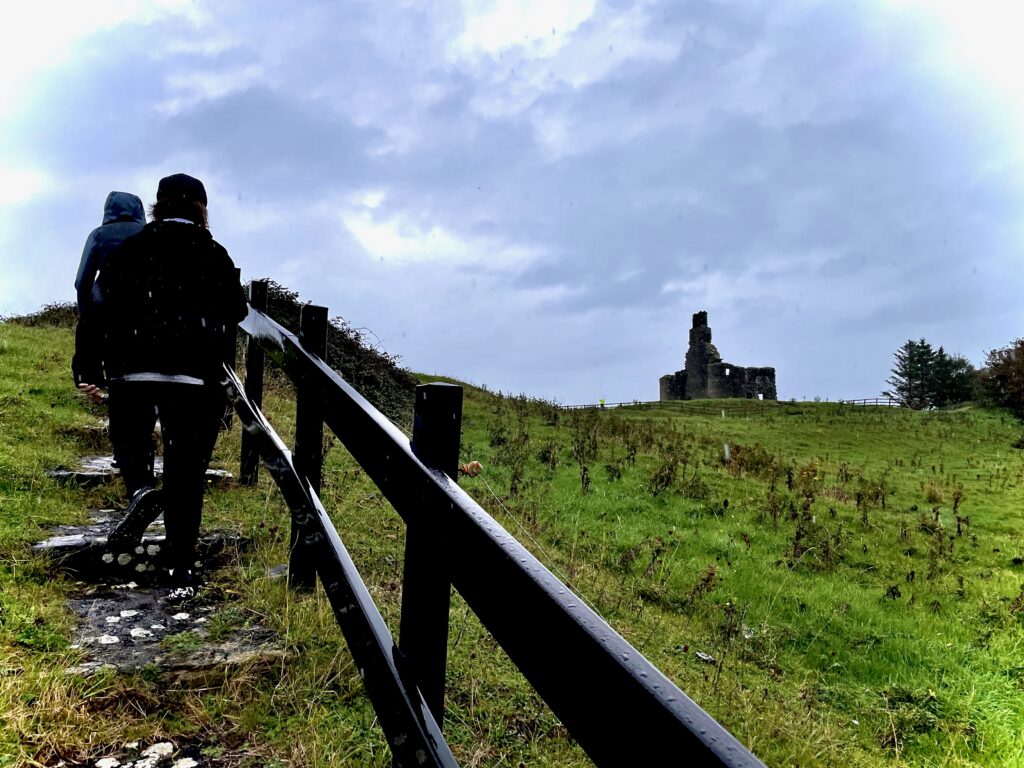
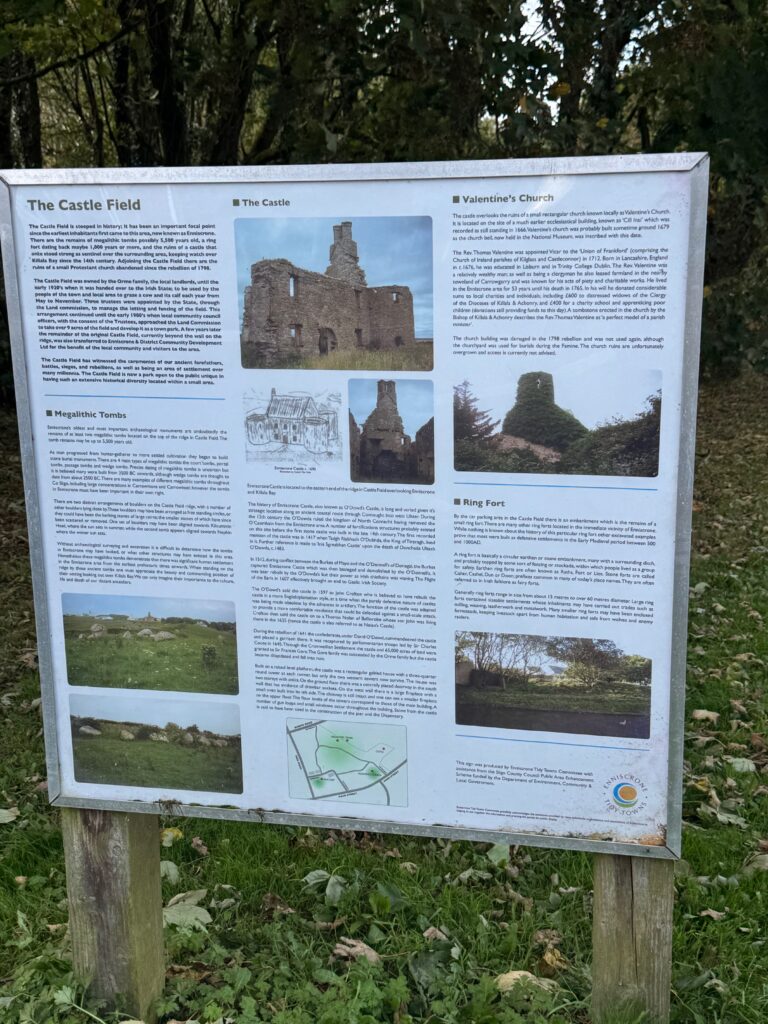
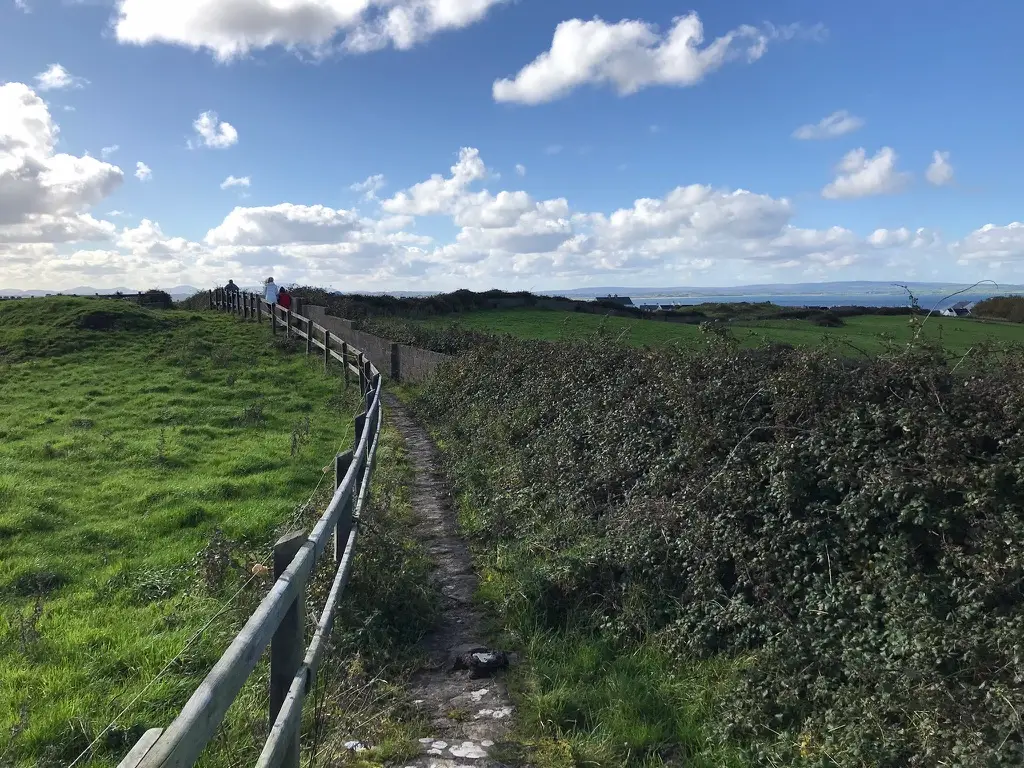
The castle is only one element of a small but densely layered monument complex within Castle Field. The Neolithic tombs on the ridge, the early medieval ringfort, and the nearby ruins of Valentine’s Church all share the same stretch of high ground above Killala Bay. An on-site interpretive panel produced by the local community summarises the four monuments and is a useful orientation for anyone walking the field. From the castle the prospect westward reaches across Bartragh Island to the Tyrawley coast.
VI. Visiting
The ruins stand in an open field on the Carrowhubbuck ridge, with access by foot from the road. The site is currently a live conservation site; visitors should respect exclusion fencing around the building during works, and are reminded that adjoining land is in private ownership.