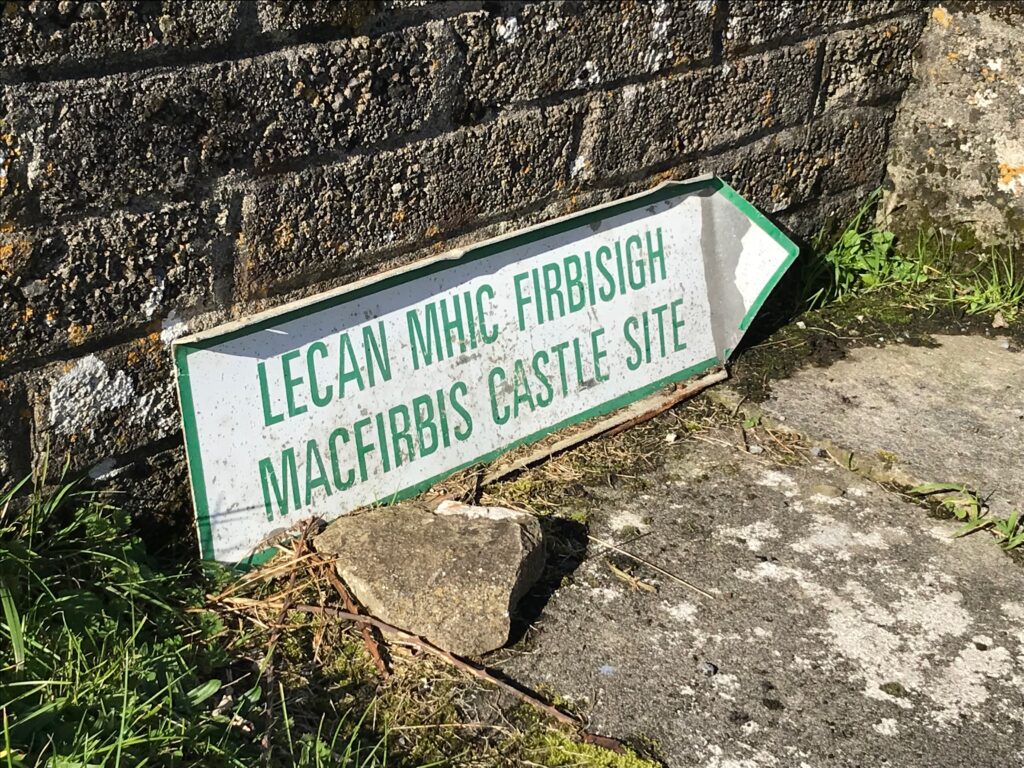
Lackan Castle (Lecan Mhic Fhirbhisigh)
The bardic seat of the Mac Firbis family, hereditary chroniclers to the Ó Dubhda of Tír Fhiachrach, and the place where the Great Book of Lecan was written
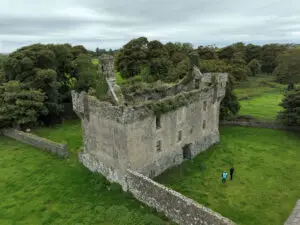
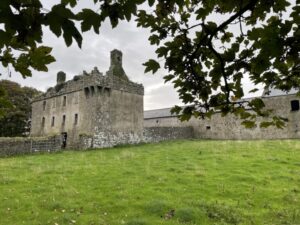
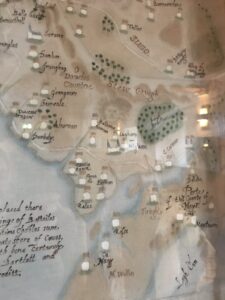
In the townland of Leacán (Lackan), in the civil parish of Kilglass, barony of Tireragh, County Sligo, stood a late-medieval tower known to Irish-speakers as Lecan Mhic Fhirbhisigh — the Lackan of the Mac Firbis family. Conor Mac Hale’s The Ó Dubhda Family History (1990) lists it ‐ as Lacken Mac Firbis ‐ among the twenty Ó Dubhda castles recorded in 1617, by which date the tower had passed into Ó Dubhda hands. But it was never one of the military strongholds of the ring. It was something rarer and in its own way more important: the manuscript-school and residence of the hereditary seanchaidhe and ollamhan of the Ó Dubhda — the Mac Firbis scholars, who presided over Ó Dubhda inaugurations and who, in this place, wrote the Great Book of Lecan.
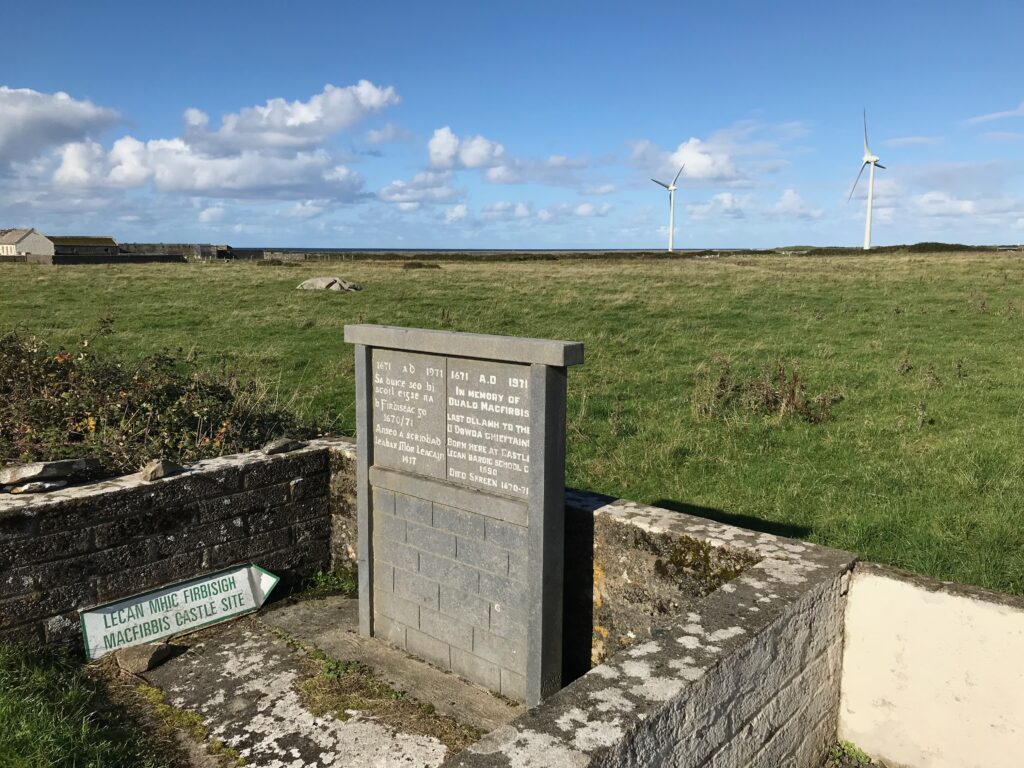
Today almost nothing stands. A small piece of walling and a flat stone in the field called Mc Ferbis’ Desk are the surviving physical traces; the 1971 bilingual memorial erected on the tercentenary of the last great scholar’s death stands on the road at the adjacent townland of Carrowhubbock North, carrying the only public inscription. The remainder — the manuscripts, the genealogies, the inauguration tracts — is preserved in Dublin libraries, as fully as any medieval Gaelic institution is preserved anywhere.
I. The Mac Firbis and the Ó Dubhda: kindred and office
The Mac Firbis (Mac Fhirbhisigh) and the Ó Dubhda (Ó Dubhda) were not patron and client in the ordinary sense. They were kin. Both lines descend from the Uí Fhiachrach: the Ó Dubhda from Fiachra Ealgach, son of the monarch Dathí, and the Mac Firbis ‐ by their own genealogies ‐ from Dathí’s brother Amhalgaidh, whose name is preserved in the barony of Tirawley across the Moy. O’Donovan himself thought the family’s early pedigree “very uncertain”. From this shared ancestry grew an arrangement that lasted, by the testimony of later sources, for some five centuries: the Mac Firbis served the Ó Dubhda chiefs as hereditary seanchaidhe — antiquaries, genealogists, chroniclers — and the Ó Dubhda, as kings of Uí Fhiachrach Muaidhe, maintained them in land and protection.
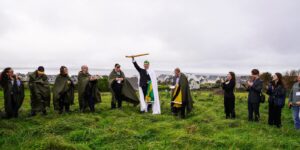
The Dictionary of Irish Biography describes the family as having provided the O’Dowds with “hereditary seanchaidhe (antiquaries or chroniclers) since the twelfth century.” They also held a role in the rite that made each new Ó Dubhda chief: the tract preserved in the Book of Lecan itself records that the Ó Dubhda was made chief on Carn Amhalgaidh ‐ or at Carn Inghine Bhriain if he stood in Tireragh ‐ and that no nomination was lawful until O’Caomháin and Mac Firbis had first pronounced the name, Mac Firbis raising the rod over the new chief’s head; only then did every bishop, coarb and chief of a district repeat it.
II. The castle (Ciothruadh Mac Firbhisigh, 1560)
The family had long been associated with Kilglass parish before any stone tower stood at Lackan. The tower itself — the “Castle of Lecan”, later called Castle Forbes in the 19th century — was built in 1560 by Ciothruadh and James, the two sons of Diarmaid Caoch Mac Firbis, together with their cousin John Óg, son of William ‐ so runs the record in Dubhaltach’s own annals. An earlier Ciothruadh of the family, son of Tadhg Ruadh, left his name on the Yellow Book of Lecan in the colophon “The Yellow Book of Lecan is the name of this book; I am Ciothruagh son of Taidg Ruaidh”.
No detailed architectural survey of the castle survives. The family lost possession of the castle by 1617, when a deed recited in the 1625 Sligo inquisition shows it settled by Donnogh O’Dowde — the exact date and circumstance of the loss is unrecorded, and the round figure of 1608 sometimes given for the family’s departure from Lackan cannot be verified against any primary source we have been able to consult. Whatever the year, by the first quarter of the 17th century Lackan had ceased to be the family’s working seat; the last of the Mac Firbis scholars, Dubhaltach Óg, lived his later working life largely elsewhere.
III. The books of Lecan
The scholarly output of the Mac Firbis school at Lackan is the site’s lasting monument. Two manuscripts above all carry the place-name of Lecan into the literature:
The Yellow Book of Lecan (Leabhar Buidhe Leacáin) — completed c. 1391, principally by Giolla Íosa Mór Mac Firbhisigh, with additions by members of the family thereafter. It is now TCD MS 1318 (H.2.16), in the library of Trinity College Dublin.
The Great Book of Lecan (Leabhar Mór Leacáin) — compiled between 1397 and 1418, in the chieftainship of Ruaidhrí Ó Dubhda of Uí Fhiachrach (d. 1417), whose house maintained the Mac Firbis school; for the inauguration of Ruaidhrí’s successor Tadhg Riabhach in 1417, Giolla Íosa Mór composed his great topographical ode. Giolla Íosa Mór Mac Firbhisigh was the principal scribe. The manuscript is one of the great medieval Irish codices — a vast anthology of genealogical, hagiographical, legal, and mythological material. It contains, among much else, the tract on the inauguration of the Ó Dubhda. It is now in the Royal Irish Academy, Dublin (RIA MS 23 P 2).
A generation and a half later, Dubhaltach Óg’s own Leabhar na nGenealach (Book of Genealogies) — compiled c. 1649‐50 at the college-house of St Nicholas in Galway; late in life Dubhaltach also carried manuscripts north to Antrim, seeking the patronage of the MacDonnells — drew on and extended this same scholarly tradition. It survives in several manuscripts (notably UCD Add. Ir. MS 14) and was published in a full scholarly edition by Nollaig Ó Muraíle in 2003.
IV. Dubhaltach Óg Mac Firbhisigh (c. 1600 – January 1671)
The last of the Mac Firbis scholars was Dubhaltach Óg Mac Firbhisigh — “Duald” in the anglicised form used on the site’s memorial stone. He was born at Lackan in the first quarter of the 17th century (the memorial gives c. 1590; the Dictionary of Irish Biography more cautiously places his birth around 1600). His father, Giolla Íosa Mór Mac Firbhisigh, stood in the direct line of the family’s seanchaidhe office to the O’Dowds.
Dubhaltach received the traditional training of a Gaelic man of letters, studying under the Mac Aodhagáin (Mac Egan) brehon-law school at Ballymacegan and, tradition says, with members of the Ó Cléirigh and Ó Duibhgeannáin scholarly families. In the middle years of the 17th century he worked at Galway, at the College of St Nicholas. In 1665 and 1666 he was in Dublin, where the antiquary Sir James Ware employed him to translate Irish material — drawn in part from the now-lost Annals of Lecan, and from the Annals of Innisfallen and the Annals of Tigernach — into English. Ware’s own historical works drew heavily on this collaboration; Dubhaltach, for his part, was by then the last Gaelic scholar of the old training still practising in Ireland.
In 1656, in a transaction recorded under his own hand, Dubhaltach witnessed a deed for Dáithí Óg Ó Dubhda, “his hereditary lord” — the very last secure documentary contact between the two old houses in their ancestral role.
V. The death at Doonflin (January 1671)
In January 1671 Dubhaltach Óg was travelling from Lackan toward Dublin when he stopped at a small shebeen in the townland of Doonflin, in the parish of Skreen, Co. Sligo. The circumstances of his death at that stop were preserved, two centuries later, by the 19th-century Gaelic scholar Eugene O’Curry, who had the story from local tradition in Tireragh:
While sitting and resting himself in a little room off the shop, a young gentleman, of the Crofton family, came in, and began to take some liberties with a young woman who had care of the shop. She, to check his freedom, told him that he would be seen by the old gentleman in the next room; upon which, in a sudden rage, he snatched up a knife from the counter, rushed furiously into the room, and plunged it into the heart of Mac Firbis.
— Eugene O’Curry, Lectures on the Manuscript Materials of Ancient Irish History, 1861
Later scholarship identifies the assailant as Thomas Crofton; a contemporary Latin note by his pupil Ruaidhrí Ó Flaithbheartaigh (Roderic O’Flaherty) records the event with characteristic brevity: “1670/1 mense Janu: Dualdus Firbisius obiit, a Thoma Croftono occisus” — “in the month of January 1670/1, Duald Firbis died, killed by Thomas Crofton” (Dictionary of Irish Biography). Dubhaltach was a bystander, not a defender of anyone; he was killed by a young man in a fit of rage because the shopkeeper had drawn attention to his presence. He is said to lie in the old church at Kilglass, where, per local tradition recorded in the Schools’ Collection, at least one other member of the Mac Firbis family lies.
With his death the unbroken line of Mac Firbis ollamhan to the Ó Dubhda — in office, by the Dictionary of Irish Biography‘s reckoning, since the twelfth century — came to an end. He was the last traditionally-trained Gaelic antiquary in Ireland.
VI. What survives today
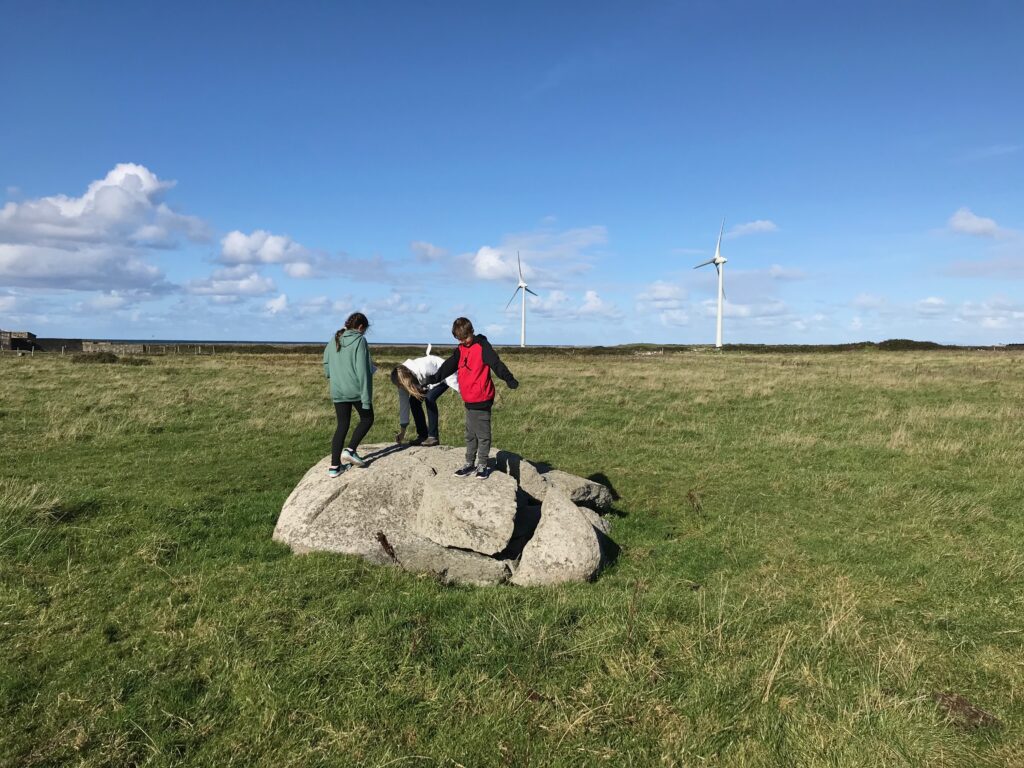
The physical site is minimal. A short stretch of walling — no more than a few courses of stone — is all that was visible at the time of the Schools’ Collection survey in 1937–38, and the situation has not improved. In an adjoining field, known locally as the Castle field, a large flat stone lies in the grass; it is called Mc Ferbis’ Desk, and local tradition holds it to be the working-place of the Mac Firbis scribes. It is recorded as such in the Dúchas Schools’ Collection (CBÉS vol. 0164, Inishcrone schools, 1937‐38).
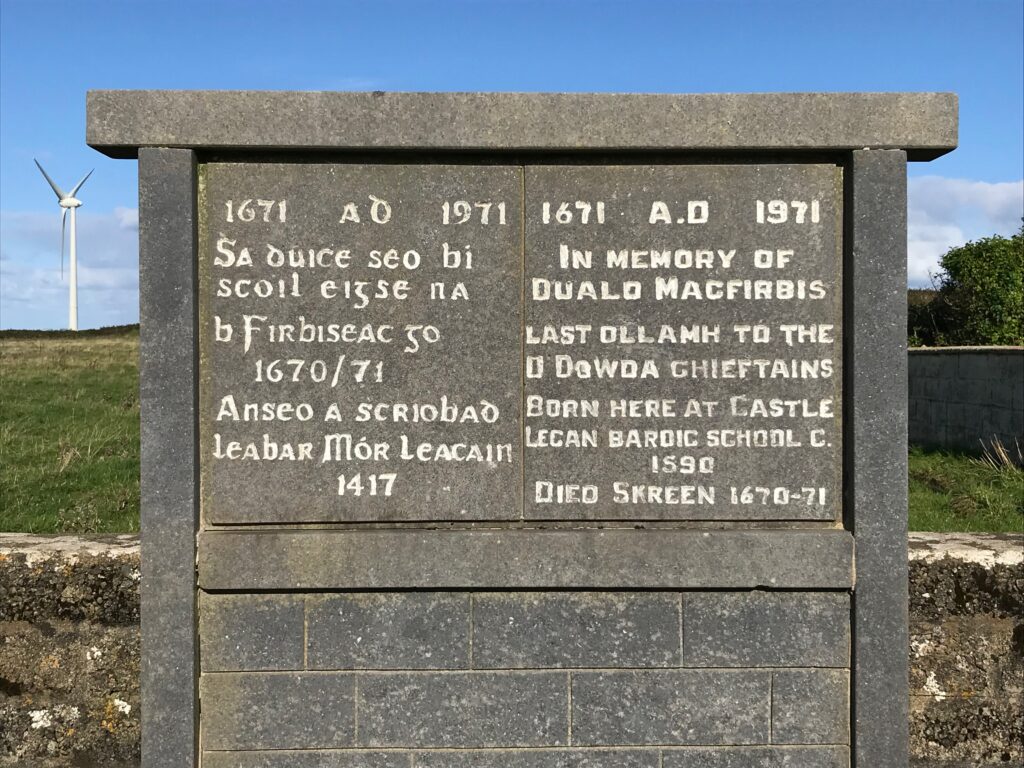
In 1971, on the tercentenary of Dubhaltach’s death, a bilingual memorial stone was erected at the roadside in the adjacent townland of Carrowhubbock North. The Irish side reads “Sa dúiche seo bhí scoil éigse na bhFirbiseach go 1670/71. Anseo a scríobhadh leabhar Mór Leacain 1417” — “In this area was the bardic school of the Mac Firbises until 1670/71. Here was written the Great Book of Lecan, 1417.” The English side names Dubhaltach as “last ollamh to the Ó Dowda chieftains”.
The bardic school is gone; the books, against all odds, are not.
VII. Visiting
Lackan is reached from the R297 north of Enniscrone. The 1971 memorial stands at the roadside in the adjacent townland of Carrowhubbock North; the walling and the Mc Ferbis’ Desk stone lie in fields behind it, accessed from a small road off the main coast route. The land is in private ownership and the approach is across working pasture. Visitors should not cross fences without the landowner’s permission, and should not disturb the stones, which are both local landmarks and, in the case of the flat stone, a piece of living folk-tradition going back centuries. The nearby wind-farm is a modern addition and is visible in most photographs of the site.