
MacFirbis Memorial at Skreen
May 2, 2026 2026-10-14 21:14MacFirbis Memorial at Skreen
MACFIRBIS MEMORIAL
The MacFirbis Memorial at Skreen
A stone chair to Dubhaltach Mac Fhirbhisigh — the last great Gaelic genealogist
Just off the N59 between Ballina and Sligo, at the edge of the parish of Skreen, a tall dark-limestone chair sits on a low paved plinth overlooking the fields that roll toward the sea. It was cut in 2015 by the sculptor Martha Quinn. The chair marks the place where, in January 1671, Dubhaltach Mac Fhirbhisigh — scholar, genealogist, and the last of the great hereditary learned family of Tír Fhiachrach — was murdered.
I. The hereditary genealogists of Tír Fhiachrach
Dubhaltach was born at Lackan, Co. Sligo, probably around 1600 (some accounts put it as early as 1585), into a family whose scholarship stretched back many generations before him. The Mac Fhirbhisighs were ollamh — professional historians and genealogists — in the service of the Ó Dubhda chiefs of Tír Fhiachrach. Around 1400 one of Dubhaltach’s forebears, Giolla Íosa Mór Mac Fhirbhisigh, was the principal scribe of the Great Book of Lecan and wrote part of the Yellow Book of Lecan — two of the most important surviving medieval Irish manuscripts. Literate in Irish, Latin and English, Dubhaltach was trained at the Mac Aodhagáin school at Ballymacegan, Co. Tipperary, and probably also in Galway.
II. The Great Book of Irish Genealogies
Dubhaltach transcribed, translated and compiled a vast body of learned work — collections of Irish annals, early Irish law tracts, saints’ lives, and poetry. His principal work was Leabhar Mór na nGenealach, the Great Book of Irish Genealogies, written mostly in Galway around 1650. A shorter work, the Cuimre (1666), followed in Tír Fhiachrach. For anyone researching Ó Dubhda descent — or the descent of almost any medieval Irish family, political, ecclesiastical or learned — the Great Book remains one of the foundational sources. A complete edition with English translation, prepared by Nollaig Ó Muraíle, was published in 2003–04.
III. The murder at Doonflin
In January 1671 Dubhaltach was killed near this spot, in the townland of Doonflin. The killer was Thomas Crofton, an Anglo-Irish gentleman of the new Restoration settler class; the precise circumstances are now unclear. Tradition, as Eugene O’Curry recorded it, holds that he was lodging at a small house in the village when a young man, rebuked in the shop on his account, snatched up a knife from the counter and stabbed him. Whatever the provocation, the killing removed the last man in Ireland carrying the full hereditary memory of the Gaelic genealogical tradition in an unbroken line.
IV. The memorial
A first monument was erected near the spot of Dubhaltach’s death in 1931. It was replaced in 2015 by the present work — a scholar’s chair cut in dark limestone, tall-backed and large enough for a visitor to sit in. The chair deliberately echoes the ollamh’s seat of learning. At its top, the name An Dubhaltach Mac Fhirbhisigh is incised in Gaelic uncial script. A bilingual plaque in English and Irish, mounted on a low wall beside the chair, sets out the scholar’s life and work.
V. Éigse Mhic Fhirbhisigh
Modern research on Dubhaltach is deeply indebted to Éigse Mhic Fhirbhisigh, the annual scholarly gathering held at Enniscrone between 1971 and 1987. The lectures and papers from those years laid much of the foundation for later scholarship on Dubhaltach’s life and manuscripts. In recent years the Sligo Field Club has given further support to the work.
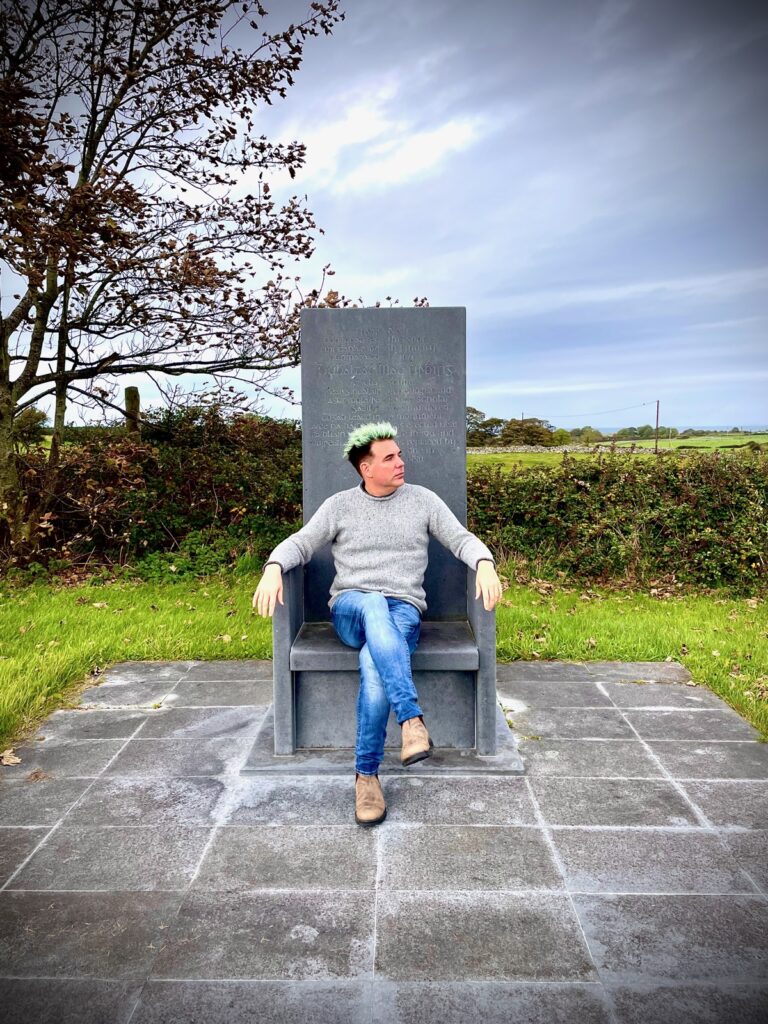
MacFirbis Memorial — Doonflin, on the Skreen coast
MacFirbis Memorial
From the Clan
Photographs of MacFirbis Memorial submitted by clan members.
A Note from the Clan
Our monument pages are researched and written by volunteers. We welcome corrections, additions, and photographs from anyone who has stopped at the chair, or who has better information than we do about Dubhaltach, his family, or the circumstances of his death.
Please get in touch if you have something to share.