The Inauguration of the Ó Dubhda
September 11, 2025 2026-10-14 20:46The Inauguration of the Ó Dubhda

The Ó Dubhda (O’Dowda) were one of the principal dynasties of north Connacht, descending from the Uí Fiachrach lineage. Their inauguration rites are unusually well documented compared to other Gaelic families, owing to the preservation of records by the learned Mac Fhirbhisigh family. These sources, combined with topographical evidence, allow us to reconstruct the distinctive elements of Ó Dubhda inaugurations, the locations used, and the historical trajectory of the practice.
Custodians of the Rite
The hereditary ollamhs of the Ó Dubhda were the Mac Fhirbhisigh, a family of historians and genealogists based in Lecán, Co. Sligo. They compiled the Great Book of Lecan and other genealogical works. The Mac Fhirbhisigh were responsible for:
- Pronouncing the name of the new chief, together with O’Caomhain, before anyone else.
- Preserving and interpreting customary law.
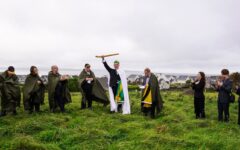
- Raising the white rod over the head of the new Ó Dubhda.
This role gave the ceremony both legitimacy and continuity. The presence of a Mac Fhirbhisigh was central to an Ó Dubhda inauguration.
Inauguration Places
Two inauguration sites are associated with the Ó Dubhda:
Carn Amhalgaidh (Croghan, near Killala, Co. Mayo)
- Ancient mound linked to Amhalgaidh, son of Fiachra Ealgach, who the Book of Lecan says raised the carn for himself and his successors and lies buried in it.
- Served as an inauguration place for Uí Fiachrach rulers and later Ó Dubhda chiefs.
- Archaeological and documentary references note a cairn with deep historical associations.
Carn Inghine Briain (Co. Sligo)
- The second inauguration place of the Ó Dubhda, east of the Moy in Tír Fhiachrach, most likely near Kilrusheighter/Aughris.
- Elizabeth FitzPatrick identifies it with an earthen mound at Coggins’ Hill, with commanding views of Knocknarea and Meadhbh’s cairn; the Book of Lecan names the site but does not say where it was.
- FitzPatrick argues it came into use after the Ó Dubhda recovered Tír Fhiachrach east of the River Moy in the later fourteenth century.
The existence of two sites reflects the clan’s territory on both sides of the Moy. The Book of Lecan allows the chief to be named at whichever carn lay on his side of the river.
The Footprint Stone
John O’Donovan, describing Irish inaugurations in general, records that the rite was held where there was a stone bearing the impression of two feet, believed to be the size of the feet of the first chieftain; for the Ó Dubhda that ancestor would be Fiachra. No such stone is recorded at either Ó Dubhda carn. Where one was used:
- The new Ó Dubhda placed his feet in the stone impressions.
- This physical act symbolized the chief’s literal “standing in” the land and assuming sovereignty.
Footprint stones of this kind are known from other Gaelic inauguration places, which is why the custom is assumed for the Ó Dubhda as well.
Symbolic Elements of the Ceremony
The Ó Dubhda inauguration combined widely attested Gaelic motifs with clan-specific traditions:
- Naming by the Learned: O’Caomhain and Mac Fhirbhisigh were the first to pronounce the chief’s name, before clergy and sub-chiefs followed.
- White Rod of Justice (Slat na Ríghe): Presented to the new chief as a sign of lawful and fair governance.
- Standing in the Footprints: Enacted the claim to territory.
- Oath of Rule: Commitment to govern with justice, witnessed by the assembly.
- Public Acclamation: Collective recognition by the people.
- Feast: As with other Gaelic inaugurations, communal celebration reinforced social bonds.
Historical Continuity and Decline
The Ó Dubhda maintained their inauguration practices into the late medieval and early modern period. According to later clan histories:
- The last election of an Ó Dubhda took place in 1595, marking the effective end of the traditional rite.
- Tadhg Buidhe, the chief made in 1595, fought on the side of Red Hugh O’Donnell in the Nine Years’ War and marched with him to Kinsale in 1601.
- With the collapse of Gaelic lordship in the seventeenth century, inauguration ceremonies ceased to function as legal-political acts.
Significance
The Ó Dubhda inaugurations are notable for three reasons:
- Native Documentation: The Mac Fhirbhisigh preserved one of the few native accounts of a named lordship’s inauguration.
- Dual Inauguration Places: Carn Amhalgaidh and Carn Inghine Briain reflect both continuity with early Uí Fiachrach kingship and adaptation to later clan geography.
- Surviving Memory: The Book of Lecan’s note on the naming, the rod, the arms and the first drink gives rare insight into the order of the rite.
Today, these elements make the Ó Dubhda inauguration one of the better attested examples of Gaelic political ritual, though the Lecan note was never meant as a full account of the ceremony.
References
- FitzPatrick, Elizabeth. Royal Inauguration in Gaelic Ireland c.1100–1600: A Cultural Landscape Study (2004).
- O’Donovan, John (ed.). The Genealogies, Tribes, and Customs of Hy-Fiachrach (UCC CELT).
- Bartlett, Richard. Map of Ulster (1602), for comparative inauguration iconography.
- Ó Dubhda Clan sources: summaries of Carn Amhalgaidh and Carn Inghine Briain inauguration traditions.
- Mac Fhirbhisigh, Giolla Íosa Mór. Great Book of Lecan (c.1397‐1418), genealogical sections relating to Uí Fiachrach and Ó Dubhda.
- Annals of the Four Masters, M1594.3 and M1595.27 (the death of Dathi Ó Dubhda and the conferring of the title on Tadhg Buidhe).