The Dog’s Battleflag
September 29, 2025 2026-10-14 21:34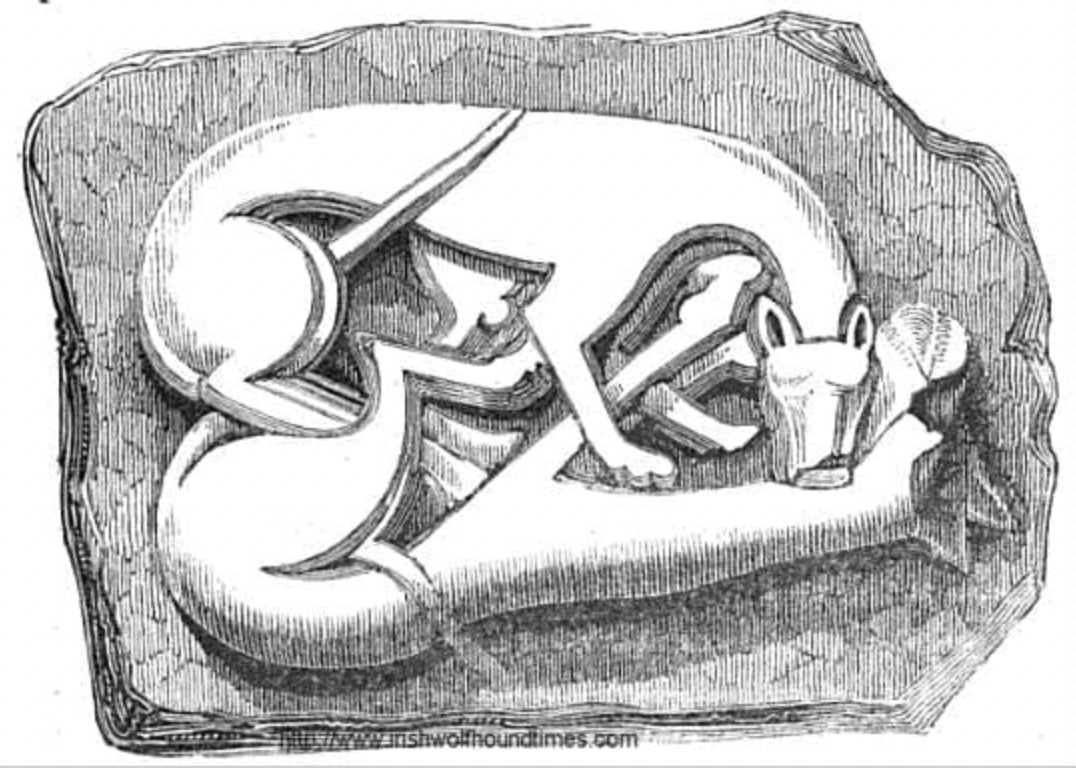
The Dog’s Battleflag
Somewhere in the fabric of Ardnaglass Castle, a stone was once set showing a dog attacking a wolf. Tradition says an O’Dowd chieftain had it carved to mark the killing of a wolf. Nobody recorded the mason or the year, and it has been suggested, though never shown, that the stone is older than the tower it ended up in. In 1841, nearly two centuries after the Ó Dubhda had lost Ardnaglass, Charles T. Webber presented the stone, taken from the castle, to the Royal Irish Academy in Dublin. The Academy recorded it as “supposed to be the representation of a dog killing a wolf”, and Webber’s note said the dog was O’Dowd’s, “of the breed of the ancient Irish wolf dog”. That description has stuck for close to two centuries.
The schoolchildren who recorded the tale in the 1930s didn’t call the carving a battleflag. The stonemason almost certainly didn’t carve it as one. But that — give or take — is what the image has become.
The image that travelled off the wall
Clans at their height had formal arms. The Ó Dubhda have theirs, first recorded by the heralds in 1574, with a second coat said to have been granted to Donal O’Dowd of Ardnaglass in 1608 ‐ a proper heraldic scheme, coloured, charged, full of meaning for anyone who can read it. It is, and remains, the official flag of the clan.
But the formal arms require interpretation. The dog does not. A single hound, running, catches the eye in a way a tincture never quite does; the story it carries — a chieftain, a beast, a district saved — is legible at a glance. Over the twentieth century that plainer image quietly did what a good emblem does. It got copied.
It turns up on clan gathering pins and reunion badges. It turns up inked on people — commissioned by O’Dowdas, Ó Dubhdas and Dowds who wanted one symbol of the family small enough to carry on their forearm or their shoulder. It turns up engraved on pendants, etched on the sides of mugs, cut into the letterhead of our older printed circulars. Nobody officially approved any of this. It just happened, the way emblems do happen in clans that have been paying attention to themselves for a long time — by repetition and resemblance, rather than by decree.
Why a dog, and not a shield
The formal arms belong to a chieftain. The dog belongs to the household. That difference matters to a family four centuries after its last ruling Taoiseach — a family with far more of its people now overseas than in Tireragh itself, and that mostly meets again at gatherings. The shield is an artefact of a vanished polity. The wolfhound is an artefact of a kept-up memory.
It is also, incidentally, the piece of the family’s story that you can walk up to. The stone went to Dublin. The castle it came from is still standing, if fragmentary, a short walk from Dunmoran Strand. The tale is still in the National Folklore Collection, in a schoolchild’s hand. For a diaspora clan, anchoring an emblem in something physical you can actually reach is not nothing.
Battleflag is a strong word
Opening her 1971 Stories from O’Dowda’s Country, Gertie Mac Hale listed among the sounds of the Irish past “the barking of a wolfhound, or the battle cry of a clan.” She did not join the two, and the Clan has not fielded a battle line in four centuries, but the pairing is apt. People who share a name and a piece of country need something to rally under that is smaller than the country and larger than the name. A dog will do.
If you carry the wolfhound — in ink, in metal, on a pin from a rally twenty years ago — you are part of how the image works. It has no owner. Nobody can license it. It travels the way it has always travelled, by people looking at a stone and deciding they want to keep carrying the story it tells.
For the full legend of the hound, the wolf, and the Ardnaglass stone — with the Schools’ Collection transcript of the tale, the record of the 1841 donation to the Royal Irish Academy, and what we have and haven’t been able to verify — see The Ardnaglass Dog and the Wolf in the folklore section.