
The Patron Saint
June 2, 2026 2026-10-14 21:33The Patron Saint
St Patrick
This designation of St Patrick as the Clan’s patron saint was agreed by the Council on 21 May 2026 and will be presented for ratification by the full clan at the 2028 Homecoming.
I. Why our patron
No saint’s story is more knotted into the soil of Tír Fhiachrach than Patrick’s. He was held as a slave for six years on a windswept hillside above Killala — in the very townland the parish later marked with a shrine and called his name. Tírechán, writing in the seventh century, remembers him crossing the Moy at Bartragh, into our country. The land remembers him: at Foghill, at Cruach Patrick, at Downpatrick Head.
And Mike Dowd’s essay argues for a claim older than the soil. Patrick’s father Calpernius and our forefather Daithí descended from the same root — Mugmedon, the “Lord of Slaves” and King of Tara. Patrick was Daithí’s kin before he was Daithí’s slave. That kinship may be why Daithí alone, of all the masters whose runaway slaves were caught and put to death, allowed the returning bishop to walk through his country untouched. It is the oldest claim we have on Patrick: not myth, but blood.
II. Kinship through Mugmedon
The line traced by Mike Dowd in his 2025 essay runs simply enough. Eochaidh Mugmedon — King of Tara — fathered sons whose names founded great lines. Niall of the Nine Hostages founded the O’Neill line. Brian founded the Uí Briúin, from whom came the O’Conors of Connacht. Fiachra founded the Uí Fiachrach, and through his son Daithí — the last pagan High King — the Ó Dubhda.
Patrick’s father Calpernius was of the same royal house, a Romano-Gaulish magistrate descended from a branch that had taken root in Brittany. He carried, his son tells us in the Letter to Coroticus, a noble rank; Patrick says he sold that nobility for the good of others. The essay’s answer to the riddle of the spared runaway is not love but kinship: Daithí let the bishop pass because Patrick was kin.
III. Foghill — six years in Ó Dubhda country
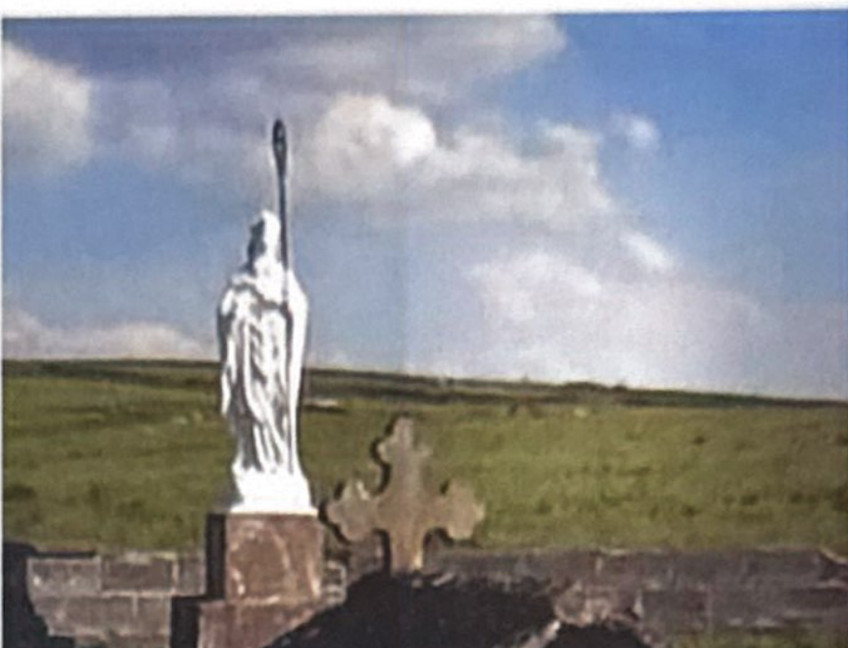
Patrick was not yet sixteen when the Irish raided Brittany, skirted the Roman port of Aleth, and landed at the Forest of Foclut to carry off captives in their thousands. Daithí, who had ridden with the raid, claimed the fluent young Briton for himself and set him to herd in a townland on the bare windswept hill above Killala. The Parish of Killala built a shrine on the field in 1936; the well and statue stand there still, looking north over the same turf and the same Atlantic.
For six years Patrick prayed in that field. The faith his mother Conchessa — niece of St Martin of Tours — had pressed into him as a boy kept him alive. When he ran, he was canny enough not to try the close port at Tia Sala; he walked south-east to an unnamed harbour, heard Celtic spoken on a Gallic ship, and went home to Brittany. The land he came back to, a quarter of a century later as a consecrated bishop, was the land of his old master.
IV. Tírechán’s witness
Around the year 690, a Mayo cleric named Tírechán, born in Tirawley — our own country — compiled the Collectanea, the earliest documentary account of Patrick’s circuit through the west. Tírechán traces him round by Cruach Patrick, through North Mayo, and back across the Moy into Sligo opposite Killala. He crossed the river at Bartragh — the “oyster bank” on the Moy estuary — and waited there for a flood to fall after one of his company drowned.
On the far bank the Gregraidhe, the “Horse People”, threw stones at his household. Three druids cursed him and failed to stop him. The Calraighe of Coolcarney tried to frighten his company by beating spears against shields. He preached anyway. They listened, and they were converted. The map of that day’s travel is the map of our home.
V. The Easter Fire and Samhain
Patrick’s genius was not to replace the pagan calendar but to baptise it. The King of Tara lit the first fire of spring on a hilltop; Patrick lit the Easter fire on the Hill of Slane, in view of Tara, and answered the King’s soldiers when they came. In time the church he planted folded the festival of Samhain ‐ the dousing of all fires on the last night of October ‐ into All Hallows. The Irish saw little had to change, and came to the new faith readily.
It is fitting, then, that we honour him in the same fashion: not by erasing the old Ó Dubhda customs but by gathering around a saint already woven into them. He stood in our field. He crossed our river. He is our kin. He is, by every reasonable measure, ours.
Drawn from St Patrick’s Life Story by Micheál Ó Dubhda (Mike Dowd, 4th Taoiseach of Tireragh, 2009–2012), published by IHR Publications for the 2025 Clan Gathering.
Tabled and agreed by the Clan Council, 21 May 2026.
Patrick’s Day in Ó Dubhda Country
Continue Your Journey
A Note from the Clan
This page is drawn from the work of Micheál Ó Dubhda (Mike Dowd, fourth Taoiseach of Tireragh), whose 2025 essay St Patrick’s Life Story was tabled and welcomed at the Clan Council meeting of 21 May 2026. The Council has put forward Patrick as the patron of the Clan; the designation will go before the membership for ratification at the 2028 Homecoming.
If you have corrections, recollections, or material to add, please get in touch.