Augustinian Abbey, Ardnaree
May 2, 2026 2026-10-14 20:42Augustinian Abbey, Ardnaree
Ardnaree Friary
Mainistir Mhuire Ard na Ria — the Augustinian Abbey of St Mary of Ardnaree
The ruins of Ardnaree Friary stand on the east bank of the River Moy in Ballina, Co. Mayo, in the shadow of St Muredach’s Cathedral. Of the four medieval religious houses on and adjacent to the lower Moy, this one alone was an Ó Dubhda foundation — built by the chief of the Ó Dubhda himself, in the heart of his lordship, and continuously patronised by his family until the Tudor suppression. It is, in the literal sense, the Ó Dubhda abbey.
I. Name and Setting
The Irish form recorded by logainm.ie for the townland (Ardnaree or Shanaghy) is Ard na Ria. The name has attracted more than one interpretation. John O’Donovan, writing the Ordnance Survey Letters in 1836, read it as Ard na Riagh, “the hill of the executions.” A parallel tradition, preserved in later popular usage, glosses it as Árd na Ríogh, “the height of the kings.” The scholarly consensus is cautious: the medieval spellings are ambiguous, and both readings have left their mark on local memory.
An earlier parish church stood on this site long before the Augustinian house was built: the Ecclesia de Ardnariu is recorded in a clerical taxation of 1306, valued at £4. The friary was raised over, or beside, this existing foundation in the early fifteenth century.
II. The Ó Dubhda Foundation, c. 1427
The received date for the foundation of the Augustinian house at Ardnaree is about 1427 ‐ the year given by the eighteenth-century monastic historians and adopted by O’Donovan ‐ and its founder was Tadhg Riabhach Ó Dubhda, Taoiseach of Tireragh and king of Uí Fhiachrach Muaidhe. Tadhg had succeeded to the chieftaincy in 1417 and was one of the most active Ó Dubhda lords of the later middle ages — known also as a generous patron of the Mac Fhirbhisigh scholars at Lecan.
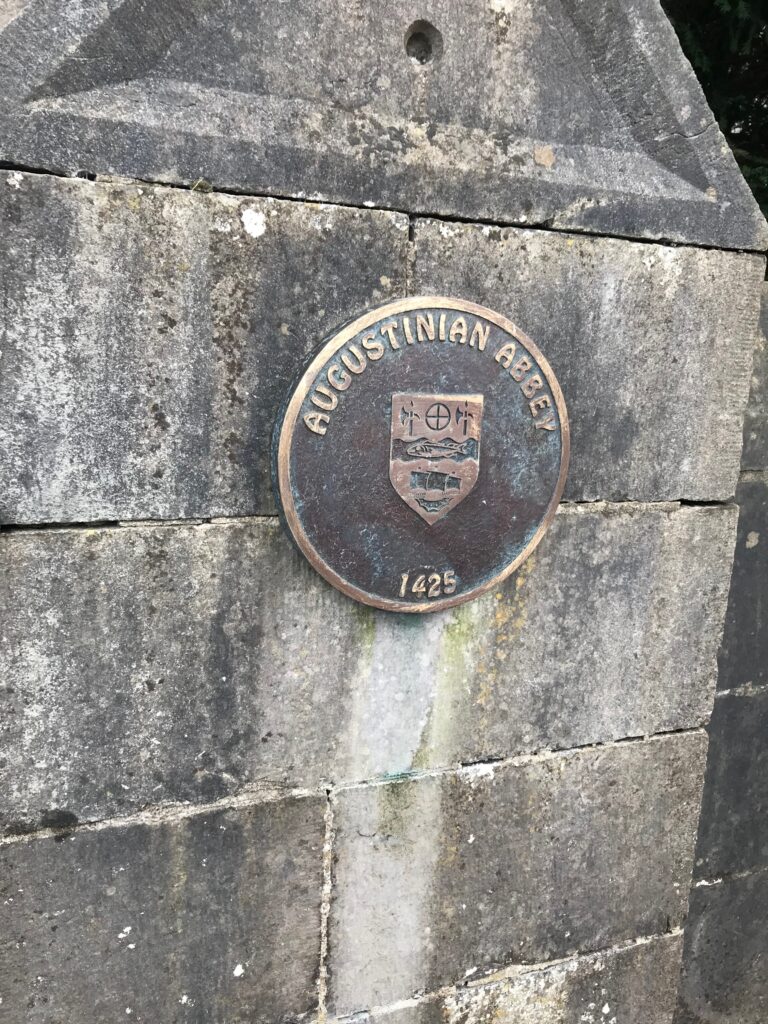
The house was built for friars of the Order of St Augustine — the Augustinian Friars or “Hermits” — and was known in the later record as the Augustinian House of St Mary of Ardnaree. A bronze plaque at the site gives the foundation date as 1425; the slight discrepancy shows how loosely the true date is fixed: civic memory says 1425, the antiquarians said 1427, and recent scholarship notes a papal reference to the house as early as 1410.
The Ó Dubhda remained patrons of Ardnaree until the dissolution. Chieftains of the family were interred in the adjoining ground: Muircheartach Ó Dubhda, son of Donnchadh, was buried here in 1402 ‐ presumably at the earlier parish church on the site ‐ which establishes Ardnaree as a recognised burial place of the family from well before the friary’s formal foundation.
III. A House of Learning
The friary became a centre of religious learning in north Connacht. Some local heritage accounts name one of its friars, Gerard Martyn, O.S.A., as raised to the see of Killala in 1452 ‐ a claim the standard episcopal lists do not confirm, but one that speaks to the standing the abbey held in the province. The abbey’s architectural fabric, with its carved doorways and wall tombs, also bears witness to sustained lay patronage: whole families paid to be buried in niches cut into its walls.
IV. Dissolution under Elizabeth I
The general dissolution of the Irish monasteries began under Henry VIII with the Act of 1537, but in remote Connacht it was enforced only slowly. Ardnaree was formally suppressed in the later sixteenth century; its lands were leased out during the reign of Elizabeth I, and the roofed community came to an end.
V. The Battle of Ardnaree, 23 September 1586
The event that lodged Ardnaree most deeply in the national record happened on the friary’s doorstep. On 23 September 1586, Sir Richard Bingham, Governor of Connacht, surprised and destroyed an Irish-Scottish mercenary army that the Mayo Burkes and the Mac Philbins had invited into Connacht to resist Elizabethan authority. The bloodletting was extraordinary: roughly a thousand fighting men killed in the field, and close to another thousand men, women and children put to the sword in the camp behind the lines.
Bingham afterwards hanged the leaders of the Burkes ‐ among them the aged Edmond Burke, whom the annalists describe as so feeble he was carried to the gallows on a bier. The grim name was already nine centuries old by then. The medieval tradition preserved by the Mac Fhirbhisigh and translated by O’Donovan tells how the four murderers of Bishop Ceallach were put to death on this hill in the seventh century ‐ “he executed the four, cutting off all their limbs while they were living” ‐ and it was from them that the height over the Moy was called Ard na Riagh, the hill of the executions. The slaughter of 1586 only fixed the old name more deeply in memory.
Four years later, in 1590, Bingham’s army returned to the lower Moy to burn the Franciscan houses at Moyne and Rosserk and the Dominican priory at Rathfran. The Augustinian abbey at Ardnaree had no roofed community left to burn, but the cumulative effect of these years was the end of monastic Christendom on the lower Moy.
VI. Titular Priors and a Persisting Graveyard
The Augustinian province continued to appoint titular priors to Ardnaree long after there was any house at Ardnaree for them to prior over: the line of appointments runs on into the nineteenth century. It is a Penal-era pattern known from many Irish houses: the superior was nominated, the faith was kept, the buildings stood open to the sky.
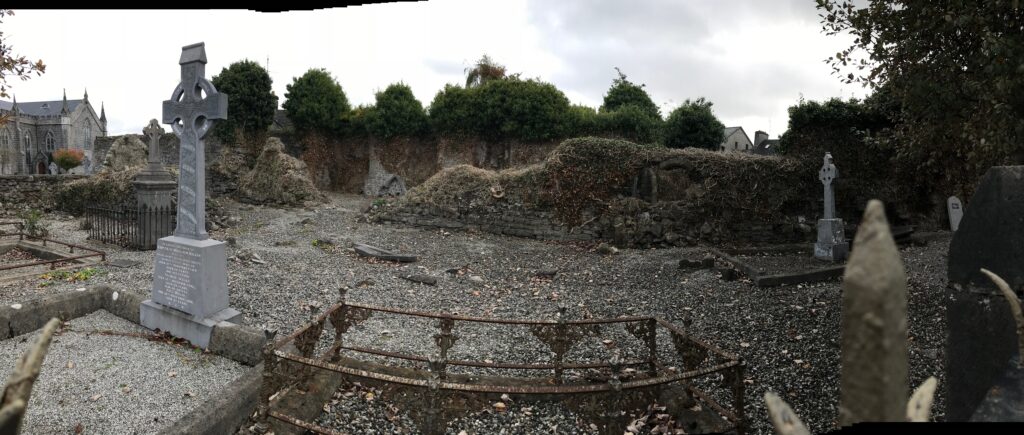
The graveyard around the ruins went on being used as the burying ground of Ardnaree. It was formally closed to new interments in the earlier twentieth century, though families with existing rights continued to bury their dead there into the 1950s. The headstones span several centuries.
VII. Surviving Fabric
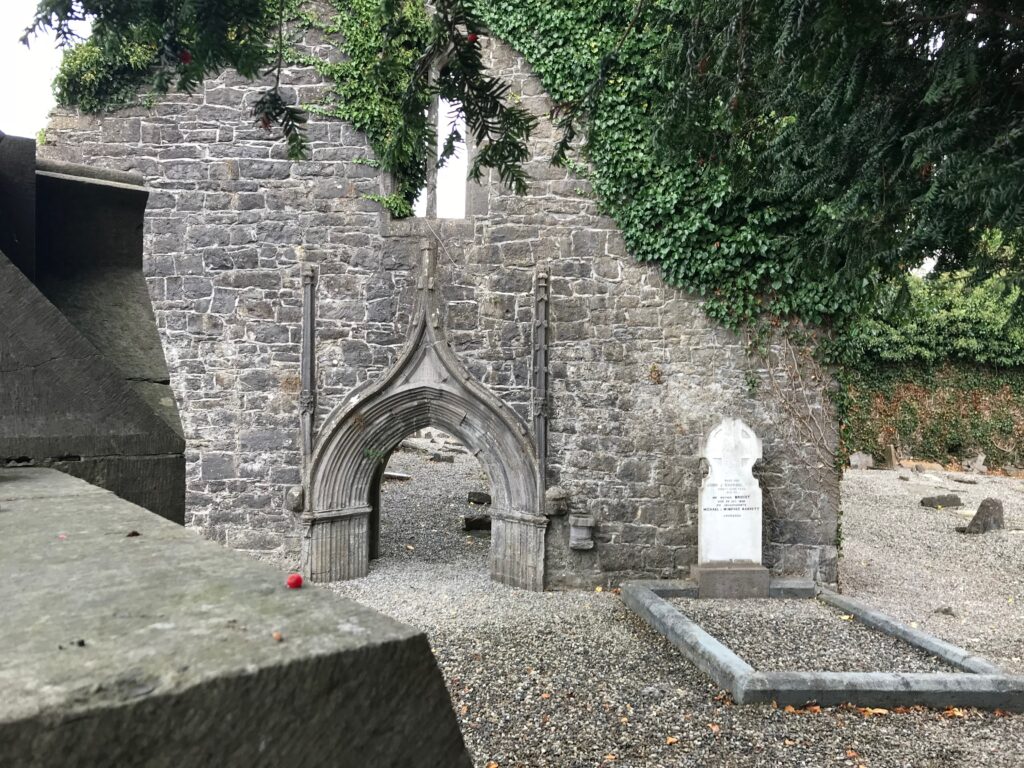
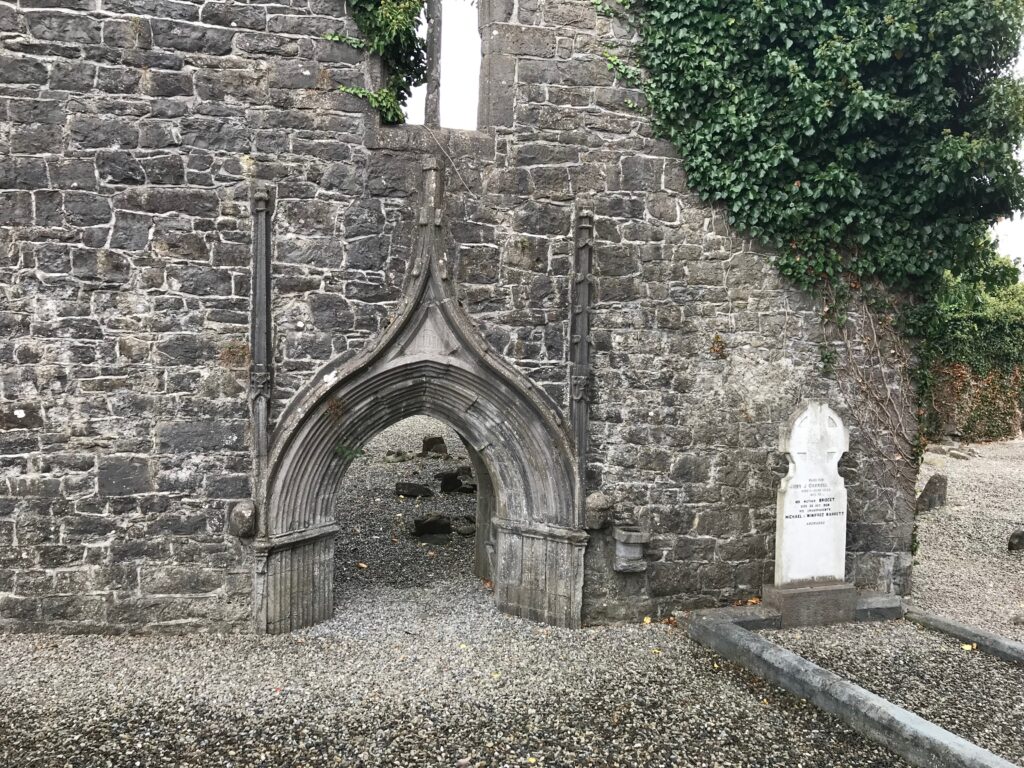
The most striking element to survive is a pointed Gothic arch with finely carved stonework, marking what was once a principal doorway of the abbey church. Sections of the church’s walls stand in places to a good height, and the churchyard around them preserves tomb niches cut into the stonework — a reminder that the abbey served, to the last, as a place of burial for the lay patrons who had kept it alive.
A bronze plaque at the site, cast with the arms of the borough of Ballina, gives the foundation date as 1425. The abbey is stop 14 on the Ballina Historic Town Trail, and an on-site information board sets out the history in Irish and English.
VIII. Visiting Today
The site is freely accessible on foot, just above the Moy and a short walk from St Muredach’s Cathedral. Those making a tour of Ó Dubhda heritage around Ballina will find the abbey pairs naturally with Ardnarea Castle, a few hundred metres further up the east bank ‐ a stronghold first raised in Anglo-Norman hands and recovered by the Ó Dubhda in 1371. The three great friaries of Killala Bay — Moyne, Rosserk and Rathfran — are all within a short drive to the north.
Ardnaree Friary — east bank of the Moy, Ballina, Co. Mayo
Ardnaree Friary
54.1127° N, 9.1515° W
Dedicated to St Mary
By Tadhg Riabhach Ó Dubhda, Taoiseach of Tireragh
Titular priors continued to be appointed well into the 19th century
Surrounded by an historic graveyard; bronze plaque & information board on site
From the Clan
Photographs of Ardnaree Friary submitted by clan members.
Latest stories tied to Ardnaree Friary.
Tales, research and dispatches from the Ó Dubhda journal.

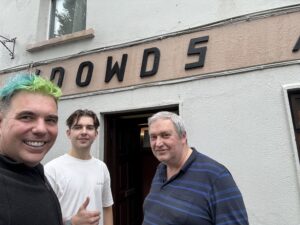
A Pint at Two O’Dowd’s: The Family Ordinary in Ballina
A small pub on Bury Street with our name on the door, John O’Dowd behind the bar, and President Biden’s Ballina story on the north wall. Every member of the clan should stand in this room at least once.
The 2025 Rally — Silver Jubilee of the Inauguration
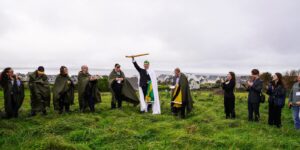
The 2025 rally marked the Silver Jubilee of the Brehon inauguration. Sean O’Dowda Stephens was inaugurated Taoiseach on Coggins’ Hill, with a rowan sapling planted to echo 1990.
Ardnaree Castle Rediscovered: The Foundation Stone of Ballina Reclaimed
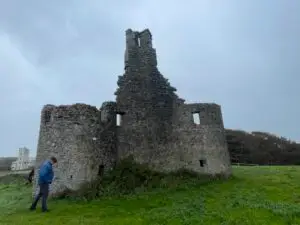
Ballina’s founding fortress, long lost beneath centuries of soil, has been brought back into the historical record by a small grassroots team of local researchers.
The 2015 Rally — Silver Anniversary
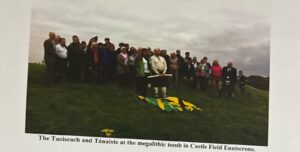
October 2015 marked the silver anniversary of the first hosting in 1990. About a hundred people bearing some variation of the Ó Dubhda name came to Enniscrone — including for the first time French-speaking Québec — for four days of lectures, tours, a banquet at Belleek Castle, and the inauguration of Andrew Dowds. At a glanceDates: 8 – 11 October 2015 · Base: Ocean Sands Hotel, EnniscroneAttendance: c. 100 from Ireland, England, Scotland, Northern Ireland, the Netherlands, South Africa, Qatar, Australia, the USA, Canada and QuébecNotable moment: Andrew Dowds inaugurated Taoiseach; Kieran O’Dowd elected as the clan’s first female Tánaiste. The Silver Anniversary The 2015 rally was the first to count itself in quarters of a century rather than in years. It was also the first to bring the Mac Firbhisigh memorial back to the table — the chair at Skreen had just been restored — and the first at which the clan brought its own blended whiskey to the banquet. Lectures That Year Dr Nollaig Ó Muraíle — Leabhar Mór na nGenealach, the Great Book of Genealogies of Dubhaltach Mac Fhirbhisigh Proinsias Mag Fhionnghaile — Ancient Gaelic dress (and a live demonstration at the banquet) Mike Dowd — a new history of St Patrick Conor Mac Hale — the heritage of Ó Dubhda, with tours through the territory Tours & Sites Carrowmore megalithic cemetery and Moyne Abbey / Rosserk Friary / Ardnaree Friary The newly restored Mac Firbhisigh Chair at Skreen The megalithic tomb in the Castle Field, Enniscrone — site of the photographic portrait of the Taoiseach and Tánaiste Banquet at Belleek Castle with Tireragh Branch Comhaltas music and dance The Inauguration Andrew Dowds, from Cumbernauld, Scotland, was inaugurated as the fifth modern Taoiseach. Andrew is the son of Thomas J Dowds, the first elected Taoiseach of 1997 — making 2015 the first rally at which a son succeeded to the office held by his father four rallies earlier. Kieran O’Dowd, San Francisco-born but settled in Ireland, was elected Tánaiste: the first woman in the role. Her own inauguration was set for 2018. Voices & Visitors Among the platforms and speakers, Kieran O’Dowd brought a Californian white wine blended for the occasion; Mike Dowd’s new book on St Patrick set the tone for 2018’s return to Foghill. The banquet, at Belleek, included a presentation from a representative of Clans of Ireland — of which Clann Uí Dubhda had been a founder member. Further Reading Thomas J Dowds, The Ó Dubhda Gatherings: A History (forthcoming) — chapter 12 odubhdaclan.com archive entry ← Previous Rally The 2012 Rally — Brendan J O’Dowd Inaugurated Next Rally → The 2018 Rally — Kieran O’Dowd, First Woman Taoiseach

A Note from the Clan
These pages are researched and written by volunteers of the Ó Dubhda Clan Association. The record here reflects the best evidence we have been able to gather from primary sources — placename records, Lewis’s 1837 dictionary, the Mac Fhirbhisigh genealogies, and the standard monastic reference works.
If you know of a correction, a family tradition, a photograph, or a source we should have cited — please get in touch. We welcome additions, and we would rather be corrected than wrong.