The Enniscrone Mound
April 18, 2026 2026-04-20 0:22The Enniscrone Mound
The Enniscrone Mound
Where the old rite ended — and where, in 2025, it began again
On a raised earthen mound in the Castle Field at Enniscrone, within sight of the surviving west range of Enniscrone (O’Dowda) Castle, the O’Dubhda of Tír Fiachrach held the last of their inaugurations under the old rite. It is the closing scene of the medieval ceremony — and, four centuries later, the opening scene of its modern revival.
The mound sits in the townland of Carrowhubbuck South, Civil Parish of Kilglass, Co. Sligo. The on-site interpretive panel records four overlapping monuments in the one field — the castle itself, megalithic tombs, Valentine’s Church, and a ring fort — the kind of deep, multi-period layering characteristic of Irish ritual landscapes.
I. The Last Inauguration in Living Memory
By the later 16th century the political weight of the O’Dubhda was contracting. The earlier open-air inauguration sites at Carn Amhalghaidh in Mayo and Carn Inghine Briain on Coggins’ Hill were still remembered, and still understood; but the ceremony had begun to be drawn back inside the fortified residence of the ruling branch. When the last O’Dubhda inauguration in living memory was held, it was held here — on the raised mound immediately beside Enniscrone Castle.
This shift — from open hilltop to castle-side mound — was itself a sign that the medieval rite was ending. A ceremonial tradition requires a landscape; Elizabethan statecraft required a pen. In 1585, under the Composition of Connacht (known locally as the “Indenture of Sligo”), O’Dubhda of Tír Fiachrach — together with every other Gaelic lord of the province — formally renounced the right to inaugurate a successor under native custom. The Enniscrone mound was the last stage on which the old ceremony was performed.
II. The Mound in the Castle Field
The monument is a raised earthen mound within the Castle Field, on the ridge above the Moy estuary in Carrowhubbuck South. It predates the castle beside it by a very long way. The ring fort and megalithic tombs recorded on the interpretive panel place activity at this site in the prehistoric and early medieval periods, long before the O’Dubhda built the four-storey tower now standing.
What matters ritually is the continuity. A mound used for a late-16th-century inauguration is not an invention of that moment. The O’Dubhda were using a place that had already been used — probably for ceremony, possibly for burial, certainly for gathering — for a thousand years or more. When the ruling family drew the inauguration back inside the Castle Field at Enniscrone, they were not creating a new ceremonial ground; they were contracting onto an ancient one.
III. The 2025 Reinauguration
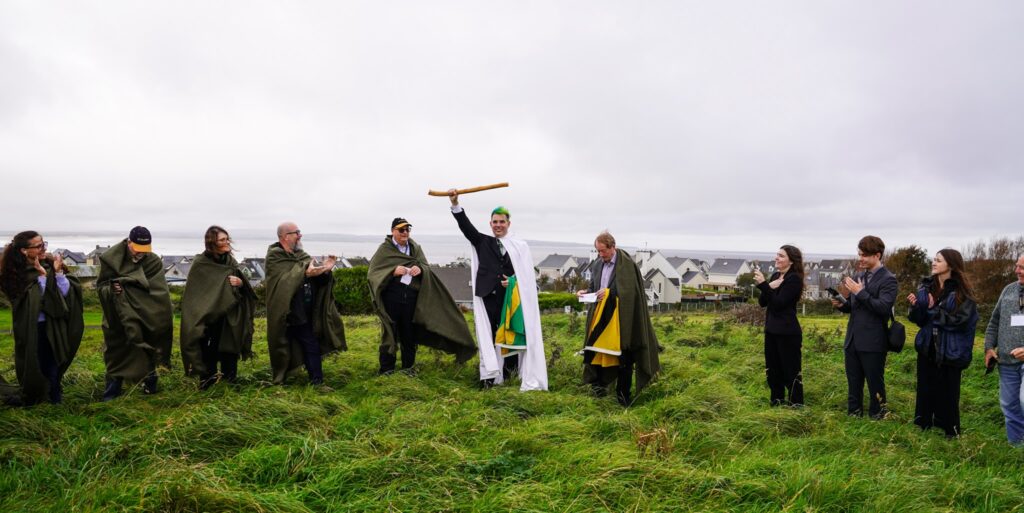
On 9 October 2025, at this same mound, Sean O’Dowda Stephens was inaugurated as Taoiseach of the O’Dubhda Clan. It was the first O’Dubhda inauguration held on this ground since the late 16th century — a deliberate re-opening of a tradition that had been closed by statute law in 1585.
A young rowan (Sorbus aucuparia / caorthann) sapling was planted at the mound on the same day — a deliberate echo of the ancient Rowan of Dubhros from Tóraíocht Dhiarmada agus Gráinne, whose berries were said to grant second youth, and whose tree stood at the heart of Uí Fhiachrach territory. The planting is treated by the contemporary clan as a living symbol: the old rite re-started, the old tree re-planted, the old mound re-entered. See The Rowan Tree for the mythological background.
IV. Visiting
The Castle Field and the surviving castle tower are visible from the public road and from the approach path described on the Enniscrone Castle page. The mound itself sits within the Castle Field; access is subject to the usual restrictions on private farmland. Please follow the visitor guidance on the Enniscrone Castle page and respect the landowner’s signage.
Sources
- Elizabeth FitzPatrick, Royal Inauguration in Gaelic Ireland c.1100–1600: A Cultural Landscape Study (Four Courts / Boydell, 2004) — for the pattern of late-Gaelic contraction of inauguration sites into fortified residences.
- Composition of Connacht / Indenture of Sligo, 1585 — in which O’Dubhda of Tír Fiachrach renounces the right to inaugurate under native custom.
- On-site interpretive panel, Castle Field, Enniscrone — for the multi-period monument record (castle, megalithic tombs, Valentine’s Church, ring fort).
- Photographic record of the 9 October 2025 inauguration of Sean O’Dowda Stephens as Taoiseach of the O’Dubhda Clan; see Clan archive.
The Enniscrone Mound
Castle Field, Carrowhubbuck South
Castle Field, townland of Carrowhubbuck South, Civil Parish of Kilglass, Co. Sligo — on the ridge beside Enniscrone Castle, above the Moy estuary
Raised ceremonial mound within a multi-period monument complex. The Castle Field also contains megalithic tombs, a ring fort, and the remains of Valentine’s Church (per on-site interpretive panel).
Active as ceremonial ground from the prehistoric period. Site of the last O’Dubhda inauguration in living memory, late 16th c., before the Composition of Connacht (1585). Reinauguration 9 October 2025.
Mound survives in pasture within the Castle Field. The surrounding field contains the surviving west range of Enniscrone Castle and the other monuments noted on the on-site panel.
Private farmland. The castle tower and Castle Field are visible from the public road; any closer approach is on the landowner’s terms. See the Enniscrone Castle page for visitor guidance.
Site of the last medieval O’Dubhda inauguration in living memory, and of the 2025 reinauguration of Sean O’Dowda Stephens as Taoiseach of the Clan — the only two moments in four centuries in which a Taoiseach was inaugurated on native ground.
Multi-period monument landscape. No full survey of the mound itself has been published; the broader Castle Field complex is acknowledged on the on-site interpretive panel. The 2025 rowan planting associated with the reinauguration is discussed on The Rowan Tree.
The Enniscrone Mound — Castle Field, Carrowhubbuck South, Co. Sligo
Pin at the Castle Field, beside Enniscrone Castle. The mound lies within the field, on the ridge above the Moy estuary. Please follow the visitor guidance on the Enniscrone Castle page.
A Note from the Clan
These pages are researched and written by volunteers of the O'Dubhda Clan. Our history is vast, and our understanding of it grows with every correction, addition, and story shared by clan members and researchers.
If you have found an error, or have information that would improve this page, please get in touch.