
Scurmore
May 2, 2026 2026-10-14 22:22Scurmore
SCURMORE
Scurmore
A burial mound on the east bank of the Moy ‐ alternative candidate for Carn Inghine Briain
On a ridge above the east bank of the River Moy, a short way south of Enniscrone, a steep-sided prehistoric burial mound stands in pasture, ringed by a fosse and bank. On its north-eastern side lie the great boulders known as the Children of the Mermaid ‐ in local tradition the petrified children of an Ó Dubhda chief and a sea-bride. The site anchors the best-loved of all Ó Dubhda legends in the shore of their own estuary, and has long been put forward as an alternative candidate for the eastern inauguration mound of the kindred.
The scholarly weight has, in recent work, come to rest on Coggins’ Hill at Kilrusheighter, where Elizabeth FitzPatrick and Dr Marion Dowd read the two-tiered mound as Carn Inghine Briain. But Scurmore has its own strong local currency; it is attached to a specific Ó Dubhda ancestor; and no reading of the Moy ritual landscape is complete without it. It is best understood not as a rival to Coggins’ Hill, but as a further station in the same ceremonial geography.
I. The Children of the Mermaid
The stones themselves are five or six large recumbent boulders lying on the north-eastern edge of a bowl-barrow ‐ a circular, steep-sided mound of earth and stone about 21 m across and nearly 3 m high, encircled by a fosse and outer bank (Record of Monuments SL016-051). The Ordnance Survey labelled them ‘Standing Stones’, but the Archaeological Survey found no evidence that any of them was ever upright. The barrow is unexcavated; mounds of this kind are generally prehistoric, and Dr Marion Dowd puts the site at some three to four thousand years old.
What makes the stones distinctive is not their archaeology but their story. In the oral tradition recorded from the Moy country, the stones are children ‐ the children of an Ó Dubhda chief and a sea-bride ‐ turned to stone at the edge of their father’s inheritance. In Gertrude O’Reilly’s telling (1971) the chief is Tadhg Ruadh Ó Dubhda and his bride is Aoife.
II. Tadhg Ruadh Ó Dubhda and the Sea-Bride
The Tadhg Ruadh story belongs to a widely distributed class of Irish tradition: the mermaid-bride tale, in which a coastal ruler captures a sea-woman — often by stealing her cloak or her cap — lives with her, fathers her children, and then loses her when she finds the hidden garment and returns to the sea. The children are left ashore; in some versions they are turned to stone at the shoreline.
What is distinctive about the Scurmore tradition is the naming . The sea-bride’s husband is not a generic coastal lord but the Ó Dubhda himself ‐ in most versions simply ‘O’Dowd’, in O’Reilly’s Tadhg Ruadh Ó Dubhda; and the stones at Scurmore are his children, turned to stone at the Moy’s edge. The effect is to bind the Ó Dubhda line directly to the Atlantic itself — a rhetorical move common to Gaelic ruling lineages whose prestige was coastal, and who wanted their origin-story to reach out to sea.
The name ‘Children of the Mermaid’ already stood on the Ordnance Survey map of the 1830s. The first printed account of the legend is W. G. Wood-Martin’s (1888), who recorded it as still told by the country people; it was collected again from Enniscrone schoolchildren in the 1930s for the Schools’ Collection, and retold by Gertrude O’Reilly in 1971.
The complete tradition — Tadhg Ruadh and Aoife, the fourteen or so recorded versions in Irish and English, the parting curse, and Marion Dowd’s kingship-marriage-to-the-sea reading — lives on its own folklore page.
III. Scurmore as Alternative to Carn Inghine Briain
Scurmore has been proposed as the site of Carn Inghine Briain ‐ the eastern inauguration mound of the Ó Dubhda of Tír Fiachrach ‐ by Conor Mac Hale (1990), who noted the magnificent view from the hill, and it was weighed seriously by Elizabeth FitzPatrick (2004). The case rests on the mound itself: an enclosed, flat-topped barrow on a ridge commanding the Moy estuary and Killala Bay, close in size and form to Carn Uí Eadhra, the probable inauguration mound of the neighbouring Ó hEadhra, within easy reach of Enniscrone Castle, and bound to the Ó Dubhda by its legend.
FitzPatrick (2004) nonetheless prefers Coggins’ Hill at Kilrusheighter, where the two-tiered mound appears to echo Meadhbh’s Cairn on Knocknarea, and where place-names, Lughnasa assemblies and folk allusions to sovereignty all point to a gathering place. The question is not settled, and Scurmore remains the leading alternative.
That reading does not diminish Scurmore. It is a real site in a real ceremonial landscape, it carries a distinctive Ó Dubhda tradition rooted in this ground, and it is part of the answer to the question of how the kindred understood its own relationship to the sea.
IV. Visiting and Access
The Children of the Mermaid stones sit on private farmland in the townland of Scurmore, Civil Parish of Castleconor, Barony of Tireragh, Co. Sligo. They are not signposted, are not on the National Monuments Service public-access list, and cannot be visited without the landowner’s permission. Please do not attempt to approach the stones without explicit, local consent.
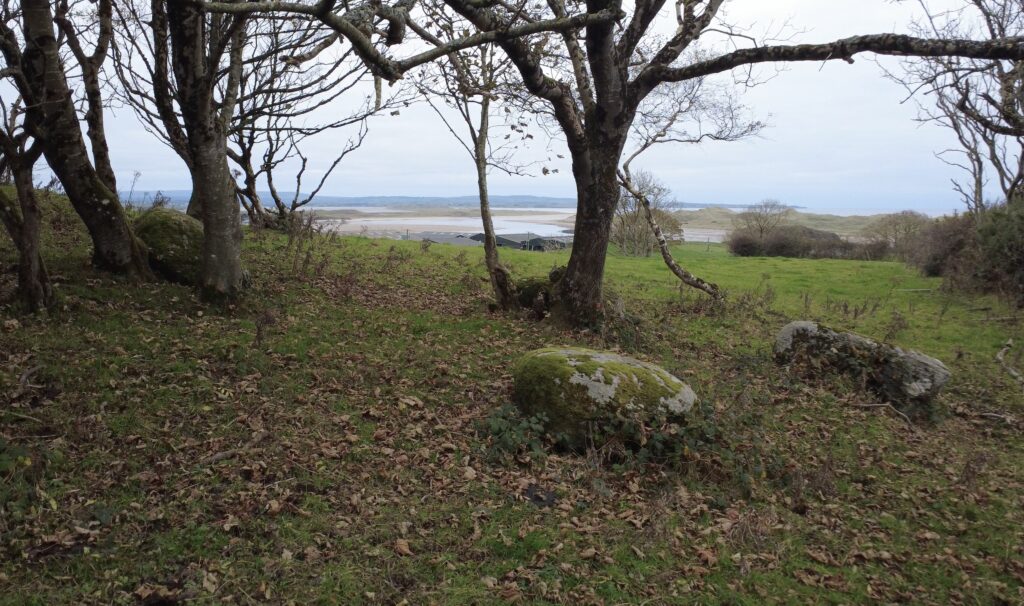
Scurmore
The Children of the Mermaid
Townland of Scurmore, Civil Parish of Castleconor, Barony of Tireragh, Co. Sligo — east bank of the River Moy, south of Enniscrone
Bowl-barrow with recumbent boulders (“Children of the Mermaid”), Record of Monuments SL016-051 ‐ an alternative candidate for the Ó Dubhda inauguration mound east of the Moy
Undated; a prehistoric burial mound, probably Bronze Age. The name 'Children of the Mermaid' is on the Ordnance Survey map of the 1830s; the legend is first printed by Wood-Martin in 1888 and is older in the oral tradition.
Mound and boulders survive in pasture. Recorded by the Archaeological Survey of Ireland; unexcavated. Not on the National Monuments Service public-access list.
Private farmland — not open to the public. Do not approach the stones without the landowner’s permission.
The stones are attached in local tradition to an Ó Dubhda chief ‐ Tadhg Ruadh Ó Dubhda in O'Reilly's telling ‐ said to be the petrified children of his sea-bride. An alternative candidate for Carn Inghine Briain, though scholarly opinion now favours Coggins’ Hill.
Earliest printed account of the legend: W. G. Wood-Martin, 1888; the townland itself appears as 'Skormor' in the Composition Book of Connacht, 1585. FitzPatrick (2004) weighs Scurmore as a candidate for Carn Inghine Briain but prefers Coggins' Hill.
Scurmore — Civil Parish of Castleconor, Barony of Tireragh, Co. Sligo
East bank of the Moy, south of Enniscrone. The Children of the Mermaid stones sit on private farmland within this townland — no precise pin is shown out of respect for the landowner. Please do not attempt to approach without permission.
From the Clan
Photographs of Scurmore submitted by clan members.
A Note from the Clan
These pages are researched and written by volunteers of the Ó Dubhda Clan. Our history is vast, and our understanding of it grows with every correction, addition, and story shared by clan members and researchers.
If you have found an error, or have information that would improve this page, please get in touch.