
Dunneill Castle, Dromore West
May 2, 2026 2026-10-14 21:20Dunneill Castle, Dromore West
DUNNEILL CASTLE
Dunneill Castle, Dromore West
Dún Neill — “Niall’s Fort” — Castle No. 11 of the Ó Dubhda Kingdom
In the townland of Dunneill, just east of Dromore West in the Barony of Tireragh, County Sligo, lies the site of one of the castles of the Ó Dubhda kingdom of Uí Fhiachrach Muaidhe. The very name of this place ‐ Dún Néill, meaning ‘Niall’s Fort’ ‐ goes back to the fort that stood here before the castle. Duald Mac Firbis, in the seventeenth-century account of the families of Tír Fhiachrach that O’Donovan published in 1844, says that Dun Neill ‘is called from Niall, son of Cubuidhe’, and names it as the chief seat of the O’Conbhuidhe (Conway) family. By the fourteenth century it was also a seat of the Ó Dubhda kings themselves.
I. The Place: Dunneill Townland
The castle site sits in the northern part of the townland of Dunneill, within the civil parish of Kilmacshalgan (Cill Mhac Sealgáin) in the Barony of Tireragh — the ancient heartland of the Ó Dubhda clan. The Dunneill River, which takes its name from the same townland, flows through nearby Dromore West on its way to the sea.
Historical spellings of the townland name reveal its long presence in the record: Downeneale (1585), Doneyll (1589), Duneneale (1603), Dooniell (from the Down Survey, 1655–7), and finally the modern standardised form Dunneill. Each iteration preserves the core Irish elements: Dún (fort) and Neill (of Niall).
II. The Castle: An Ó Dubhda Stronghold
Dunneill appears as castle No. 11 ‐ under the name ‘Dromore’ ‐ in the numbered list of twenty Ó Dubhda castles that circulates from the research of Clan Ó Dubhda historian Conor Mac Hale. In The Ó Dubhda Family History (1990) Mac Hale records the family seated here directly: in the documents of 1569 to 1610 the Sliocht Ruairí branch ‘of Duneil (or Dromore West)’ held forty-two townlands in Tireragh. He also notes that in total the family owned about twenty-four castles, and that ‘there are several different lists in existence.’
The term “ten-pound castle” refers to a 1429 statute under Henry VI that offered a subsidy of £10 to anyone who built “a sufficiently embattled or fortified castle or tower house” of minimum dimensions — 20 feet long, 16 feet wide, and 40 feet high. While originally intended for the Pale counties, the tower house style spread throughout Ireland and was widely adopted by Gaelic chieftains, including the Ó Dubhda. This places the likely construction period for many of the Ó Dubhda tower houses in the 15th century.
Dunneill Castle sat squarely within the Ó Dubhda domain. The clan’s territory of Tireragh (Tír Fhiachrach, ‘the land of Fiachra’) carries the name of the royal line: the tribe of Uí Fhiachrach descends from Fiachra, elder half-brother of Niall of the Nine Hostages, and the Lecan genealogical books derive the territory’s own name from his descendant Fiachra Ealgach, son of King Dathi. The Niall of Dún Néill was not, on the evidence of the genealogists, Niall of the Nine Hostages. Duald Mac Firbis names him as Niall, son of Cubuidhe, of the O’Conbhuidhe (Conway) family, whose chief seat this was. Local tradition, as Gertie Mac Hale recorded it in Stories from O’Dowda’s Country (1971), remembers instead that the castle was ‘built by a Niall O’Dowda’.
III. The Historical Record
Duald Mac Firbis’s short annals of the family record that in 1417 Ruaidhri Ó Dubhda, King of Uí Fhiachrach and Uí Amhalgaidh, ‘died at Dun Neill after a reign of thirty seven years’. The Annals of the Four Masters record the same death ‐ of Ruaidhri, ‘fountain of the prosperity and wealth of Tireragh’ ‐ and, under 1380, that of his father Domhnall, ‘defender of his principality against his English and Irish enemies’, each at his own seat; O’Donovan, in 1844, identifies both seats as Dun Neill. Mac Firbis’s genealogies list Ruaidhri’s descendants under the heading ‘Of Dun Neill’, and Mac Hale’s Sliocht Ruairí ‘of Duneil (or Dromore West)’ carry his name. In his topographical poem of 1417, Giolla Íosa Mór Mac Firbis, chief historian to Ó Dubhda, names ‘Dun Neill, soil of bright aspect’ as the land of the O’Conbhuidhe. In the Books of Survey and Distribution, about 1660, the place is still entered as the ‘castle and lands of Doneald’.
The most important primary source for Dunneill Castle comes from John O’Donovan, the renowned Irish scholar who travelled Ireland in the 1830s recording placenames for the Ordnance Survey. In his 1836 field notes for County Sligo (preserved as MS 14 F. 14 at the Royal Irish Academy), O’Donovan recorded:
“The […] of an old castle here” in the Dunneill townland (one word of O’Donovan’s note is illegible).
“A river called by the name of townland runs through [it]; site of Duneal old castle is in the north of this townland.”
This confirms that the castle site was still known and recorded in 1836, that the castle was in the northern part of the Dunneill townland, and that the Dunneill River — which flows through Dromore West — takes its name from the same place.
The Wikipedia article on Dromore West also confirms “ringfort and tower house sites in the townlands of Dromore, Knockaculleen and Dunneill,” further corroborating the archaeological record.
IV. What Remains Today
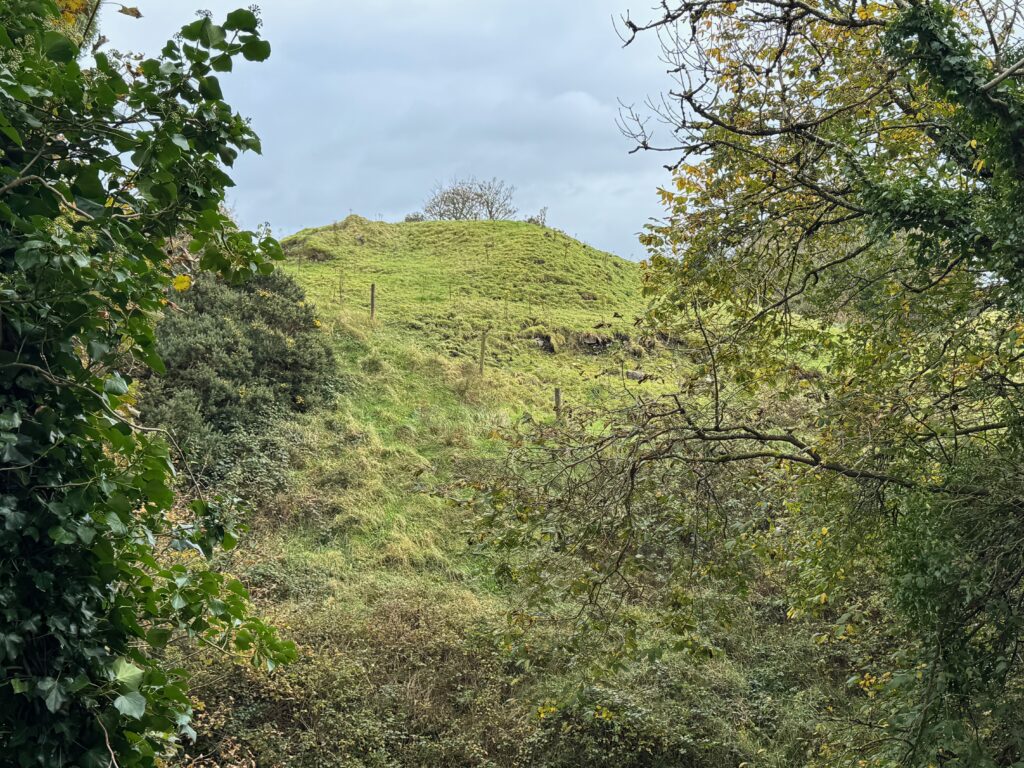
Today the castle site presents as a raised grassy mound, visible from the surrounding landscape but overgrown and without substantial standing walls. This is consistent with many of the smaller Ó Dubhda tower houses, which were reduced to foundations or earthworks over the centuries — possibly during the Cromwellian campaigns of the 1640s and 1650s, when many Gaelic strongholds in Connacht were slighted; no record of Dunneill’s destruction survives.
The site is on private farmland near the Dunneill River. While not a formal heritage attraction, it is an important archaeological site and a tangible connection to the Ó Dubhda past. The nearby Dunneill River Walk, a scenic amenity following the river from Dromore West, passes through this landscape.
Important note: As with many of the 20 castle sites, the present remains may not correspond precisely to the original Ó Dubhda fortification. The “fort of Niall” may have been an older ring fort upon which a later tower house was built, and centuries of agriculture and natural weathering have altered the landscape considerably. What we see today is a site of memory as much as a site of archaeology.
V. The Wider Landscape
Dunneill Castle sits within a rich archaeological landscape. The Ox Mountains rise to the south; the Atlantic coast lies approximately 5 km to the northwest. The townland of Crowagh or Dunneill Mountain — the 4th largest townland in County Sligo at 12.66 km² — borders Dunneill to the south, covering the mountainous terrain above.
Nearby Ó Dubhda castle sites include Roslee Castle at Easkey (No. 10) and Rathlee Castle (No. 9), forming a chain of coastal and inland fortifications that once protected the western flank of the Ó Dubhda kingdom.
Dunneill Castle — Dromore West, Tireragh
Dunneill Castle
Dún Neill (Niall's Fort)
54°14'54.5"N, 8°52'24.3"W
Dunneill townland, Parish of Kilmacshalgan
Near Dromore West, County Sligo, Ireland
Tower House / Fortification site
Castle No. 11 on the circulated list of 20 Ó Dubhda castles drawn from Mac Hale's research
Likely a "ten-pound castle" (15th century)
Seat of the Ó Dubhda kings Ruaidhri (d. 1417) and, per O'Donovan, Domhnall (d. 1380)
Fort site may predate the medieval period
Tower house likely 15th century
Named for Niall, son of Cubuidhe, of the O'Conbhuidhe (Conway) family (Duald Mac Firbis)
Raised grassy mound — no substantial standing walls
O'Donovan recorded the site of an old castle in 1836
Reduced to earthworks, likely slighted during the Cromwellian period
On private farmland near the Dunneill River
Not a formal heritage site
The Dunneill River Walk passes through the area
Direct Ó Dubhda castle in the Barony of Tireragh
One of the Ó Dubhda castles of Uí Fhiachrach Muaidhe
East of Roslee Castle (Easkey) and Rathlee Castle in the chain
Seat of the Sliocht Ruairí branch of the Ó Dubhda
Though reduced to a mound, Dunneill is one of the best-documented seats of the Ó Dubhda kings: Duald Mac Firbis records that Ruaidhri Ó Dubhda, King of Uí Fhiachrach, died here in 1417 after a reign of thirty-seven years, and O'Donovan places the death of his father Domhnall in 1380 at the same seat. Its name reaches back further still, to the O'Conbhuidhe family whose chief seat it was.
From the Clan
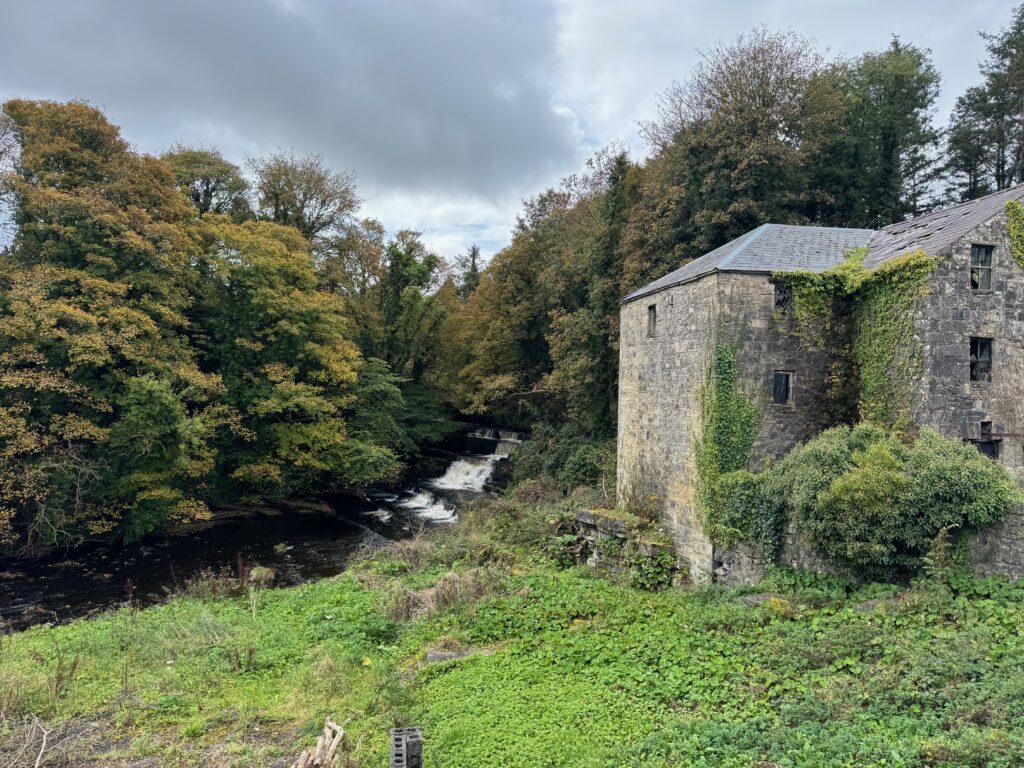
Photographs of Dunneill Castle submitted by clan members.
A Note from the Clan
These pages are researched and written by volunteers of the Ó Dubhda Clan. Our history is vast, and our understanding of it grows with every correction, addition, and story shared by clan members and researchers.
If you have found an error, or have information that would improve this page, please get in touch.