The Brat
April 20, 2026 2026-10-14 20:37The Brat
I. An Ancient Garment
Older than memory. The brat is one of the oldest pieces of Irish dress on record. It is named in the early medieval law tracts, and the Annals of the Four Masters preserve an old tradition that dress was ranked by the number of colours a wearer might carry - one in the clothes of slaves, seven in the clothes of kings and queens - and it stays in the record for more than a thousand years, as the everyday over-garment of Gaelic Ireland from the early Christian period into the seventeenth century.
Pictured by its enemies. The great sixteenth-century sources - John Derricke's Image of Irelande (1581) and Lucas de Heere's watercolours (c.1575) - show Gaelic lords and their households in the mantle. Spenser's own words on it were a complaint: he called the Irish mantle "a fit house for an outlaw, a meet bed for a rebel, and an apt cloak for a thief." To wear one now may be taken as a quiet compliment.
Suppressed, then forgotten. From the Statutes of Kilkenny (1366), which bound the English of Ireland to English apparel, through the Tudor dress laws that followed, successive administrations tried to legislate Irish dress - and the mantle with it - out of use. By the early eighteenth century the garment had retreated to the Atlantic fringe and then slipped out of daily wear. What survived survived in sketches, inventories, and the memory of a few western parishes.
II. The Shape of It
A rectangle of weighted wool. A brat is a single rectangular piece of heavy woollen cloth — fulled to thicken and weatherproof it — with no neck opening and no hood. It is not a poncho. It is not a ruana. It is cloth of weight, worn draped over one or both shoulders and held in place with a brooch, a pin, or by the twist of the cloth itself under the arm.
Selvedge long, fringe short. The two long edges are the woven selvedges of the loom. The two short ends are finished with fringe — in the oldest surviving examples a twisted or knotted band. Our clan fabric is 160 cm wide, which gives us the full drape of the historical garment in a single width, without piecing.
III. The Ó Dubhda Brat
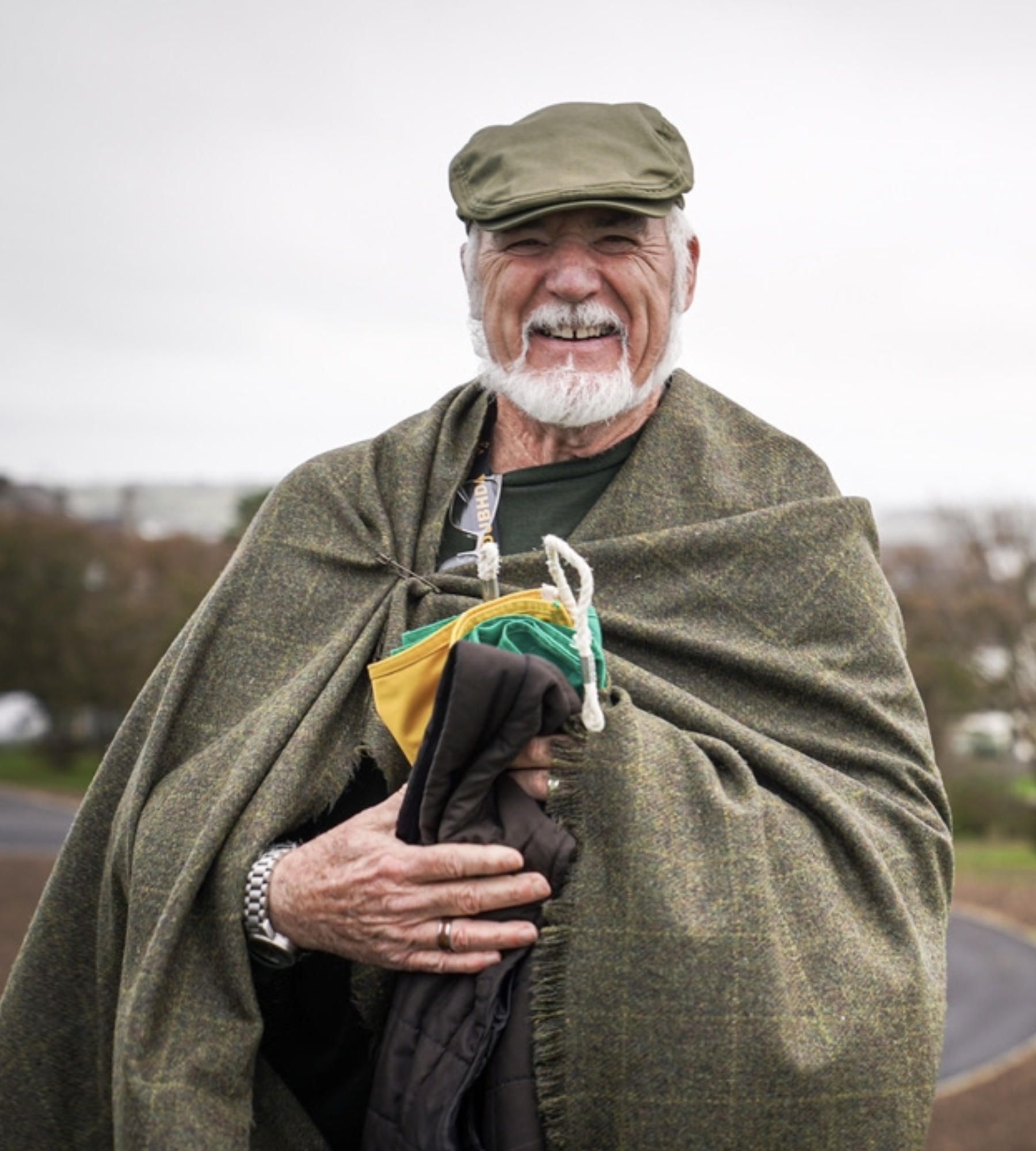
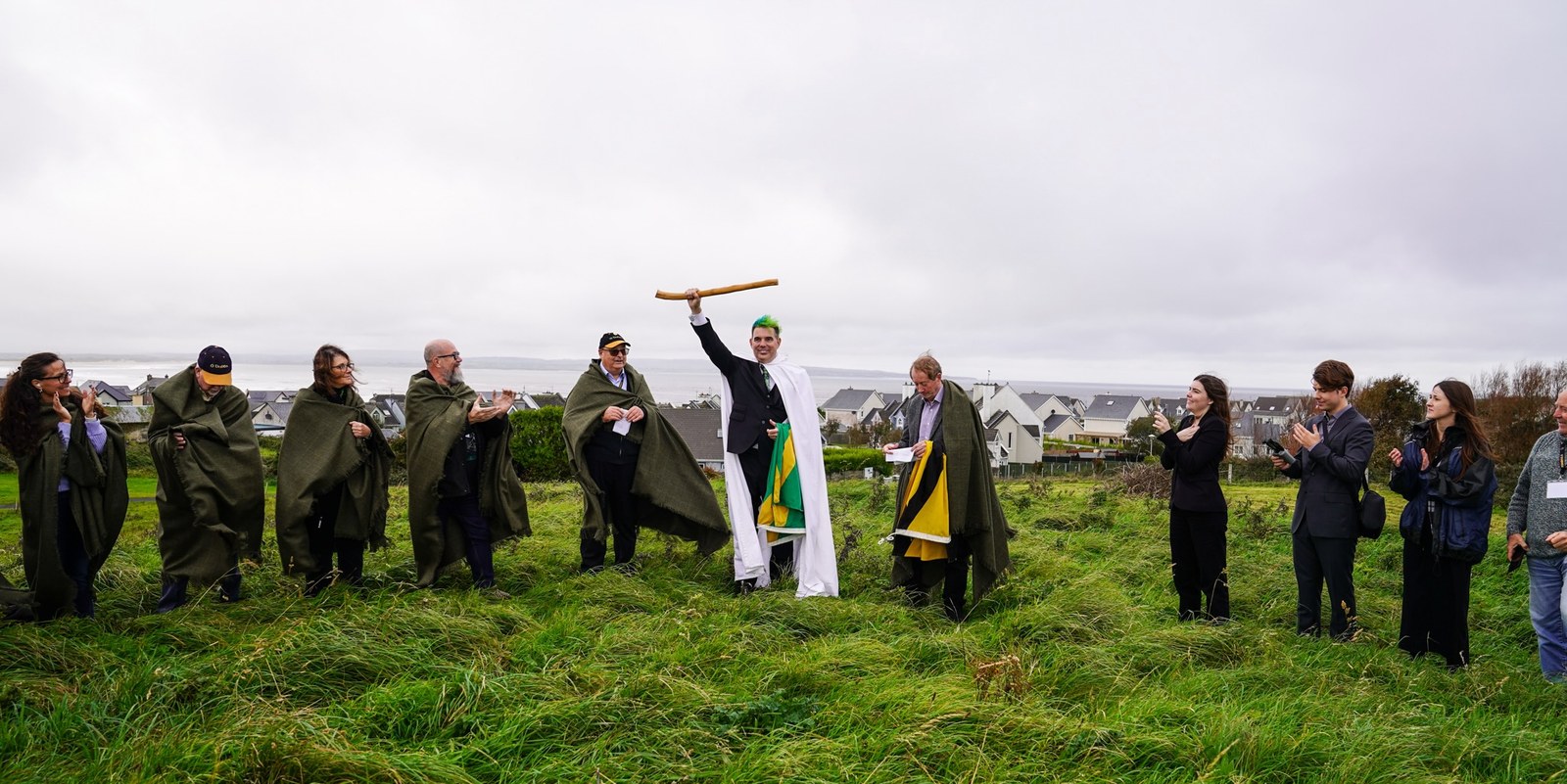
Settled at the Silver Jubilee. For the 2025 inauguration of the Taoiseach on the old mound above Enniscrone — the Silver Jubilee Rally — we settled at last on a clan brat of our own: a single-width woollen mantle in O'Dowda green and gold, to be worn by any member of the clan who comes to ceremony.
O'Dowda green, gold accented. The cloth is woven in a green-and-gold check — O'Dowda green with mustard-gold accents — on a 160 cm loom width, so each brat carries the true woven selvedge of the loom along both long edges. The two short ends are finished with a secured fringe of two to three centimetres; along one long edge runs a longer hand-fringed band that falls open at the shoulder when the garment is draped.
No hood — true to tradition. A brat is not a hooded cloak. The shaggy over-garment sometimes pictured in the later sources is the falaing, a heavier cousin whose very name - a mediaeval loanword - meant a hairy cloak. The plain shoulder-drape is the older, more formal form — and the form we have taken as our own.
IV. How It Is Worn
From the shoulder, not the neck. At ceremony the brat is thrown across the left shoulder, hand-fringed edge falling open to the front, and held at the shoulder with a brooch or pin. In procession the cloth may be drawn across the chest and pinned at the opposite hip. In cold weather the whole body is wrapped, and the fringed edge drawn up as a shelter for the head.
No single correct way. The sources show great variation. What is constant is that the garment hangs from the shoulder rather than from any neck-opening, and that it is cloth of weight — not a shawl — carrying its own drape. At the 2025 inauguration each clan member settled the brat as it sat best on their own shoulders; no two were worn identically.