
Act I — Deep Ireland
April 21, 2026 2026-07-06 17:56Act I — Deep Ireland
Deep Ireland
Eight millennia of human presence on the Moy valley, from the first hunters arriving behind the retreating ice to the Iron Age warrior aristocracy that would produce Fiachra. Rome never crossed the Irish Sea; our ancestors remained free, and outside writing.
After the Ice
First footprints on the Moy
Hunter-gatherers reach the Atlantic coast as the ice retreats. The Moy estuary — salmon-rich, sheltered by Killala Bay — is exactly the kind of place they stop. Seasonal fishing camps, like those known at Mount Sandel, open the human story of the land that will one day be called Tireragh.
Standard Irish Mesolithic; Mount Sandel parallelsThe Tomb-Builders
 c. 4500 BCE World
Farming arrives from Anatolia
A migration wave carries wheat, cattle, and stone-building techniques from the Aegean across Europe. The same people who build the Irish tombs will, centuries later, begin Stonehenge.
Cassidy et al., ancient-DNA studies (2020)Carrowmore - among Europe's oldest cemeteries
At Carrowmore near Sligo, Neolithic farmers build one of Europe's oldest megalithic cemeteries. Listoghil, its central cairn, is dated c. 3500 BCE. The monuments look out over the same bay the Ó Dubhda will later defend.
Bergh & Hensey antler-dating; heritageireland.ieCéide Fields — the world's oldest farms
On the north Mayo coast, a community clears forest and lays stone walls around small fields. Buried under blanket bog for five thousand years, these are the earliest known field systems anywhere on earth.
Caulfield excavationsCarrowkeel — the ridge of tombs
Fourteen passage tombs rise on the Bricklieve ridge above Lough Arrow, linked by the Unshin river down to Carrowmore. The landscape the Ó Dubhda will inherit is already mapped by the dead.
mythicalireland.comBronze and the Wider World
Bronze comes to the Moy
Copper from Kerry and tin traded from Cornwall reach the west of Ireland. Field walls and burnt mounds from this era still mark the land across Tireragh and Tirawley - the ringforts come much later, but the boundaries begin here.
Standard Bronze Age Ireland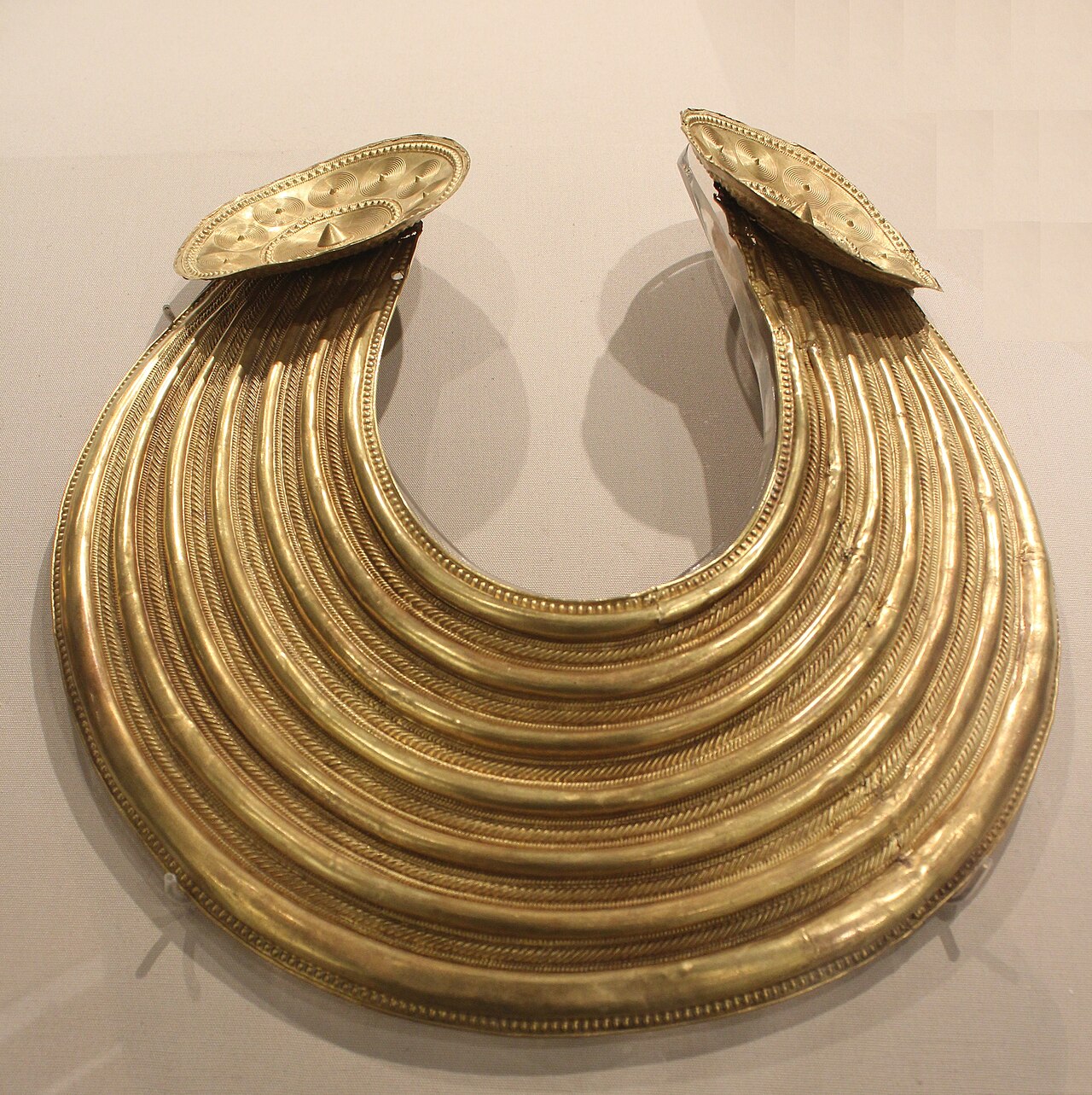 c. 2000 BCE World
Irish gold reaches Scandinavia
Bronze Age trade routes carry Irish gold lunulae - crescent moon collars - as far as Denmark. Ireland is on the map — unreachable by land, but plugged into a maritime world that runs from the Baltic to Iberia.
Archaeological record; National Museum collectionsCelts, Romans, and a Land They Never Reached
 c. 300 BCE World
La Tène — the Celtic world
Art styles, weapons, and a warrior aristocracy spread from central Europe westwards. Ireland absorbs the culture without the migration. The warrior-aristocracy that will produce Fiachra is taking shape.
Standard Celtic Iron Age 58–50 BCE World
Caesar conquers Gaul
Roman legions subdue the Gauls. Britain will follow a century later. Ireland — Hibernia to the Romans — is beyond the horizon and stays that way.
Caesar, De Bello Gallico c. 82 CE World
Agricola looks across the sea
The Roman governor Agricola, standing on the Scottish coast, reckons one legion and a handful of auxiliaries would suffice to take Ireland. Rome never crosses. Our ancestors remain free — and outside writing.
Tacitus, Agricola c.24The royal mound at Cruachan
Rathcroghan in Roscommon becomes the ceremonial capital of the Connachta. Close by, in the royal cemetery of Reilig na Riogh, Dathi will be laid centuries later beneath a red pillar stone.
O'Donovan 1844, pp. 24, 346 (Mac Firbis, 1666)A people called Hy-Fiachrach — in waiting
The name does not yet exist, but the territory is set: the Moy valley, the baronies later called Tireragh, Tirawley, Erris. The stage is ready; the family is one generation away.
Bridges to Act II“ And then, midway through the fourth century, a man named Eochaidh Mugmedon - the Slave-Lord - became King of Connacht, and then of all Ireland. His sons would divide his inheritance between them. ”