Maps

Maps

THE CLAN · HERITAGE

MAPS

Na Léarscáileanna
“A catalogue of historical maps that name the O’Dubhda, depict our castles, or record the territory we ruled along the River Moy from the ninth to the seventeenth century.”

the O'Dubhda in the Irish cartographic record

A catalogue of historical maps of Ireland that name the O'Dubhda, depict our castles, or record the territory we ruled along the River Moy from the ninth to the seventeenth century.

How to read this catalogue

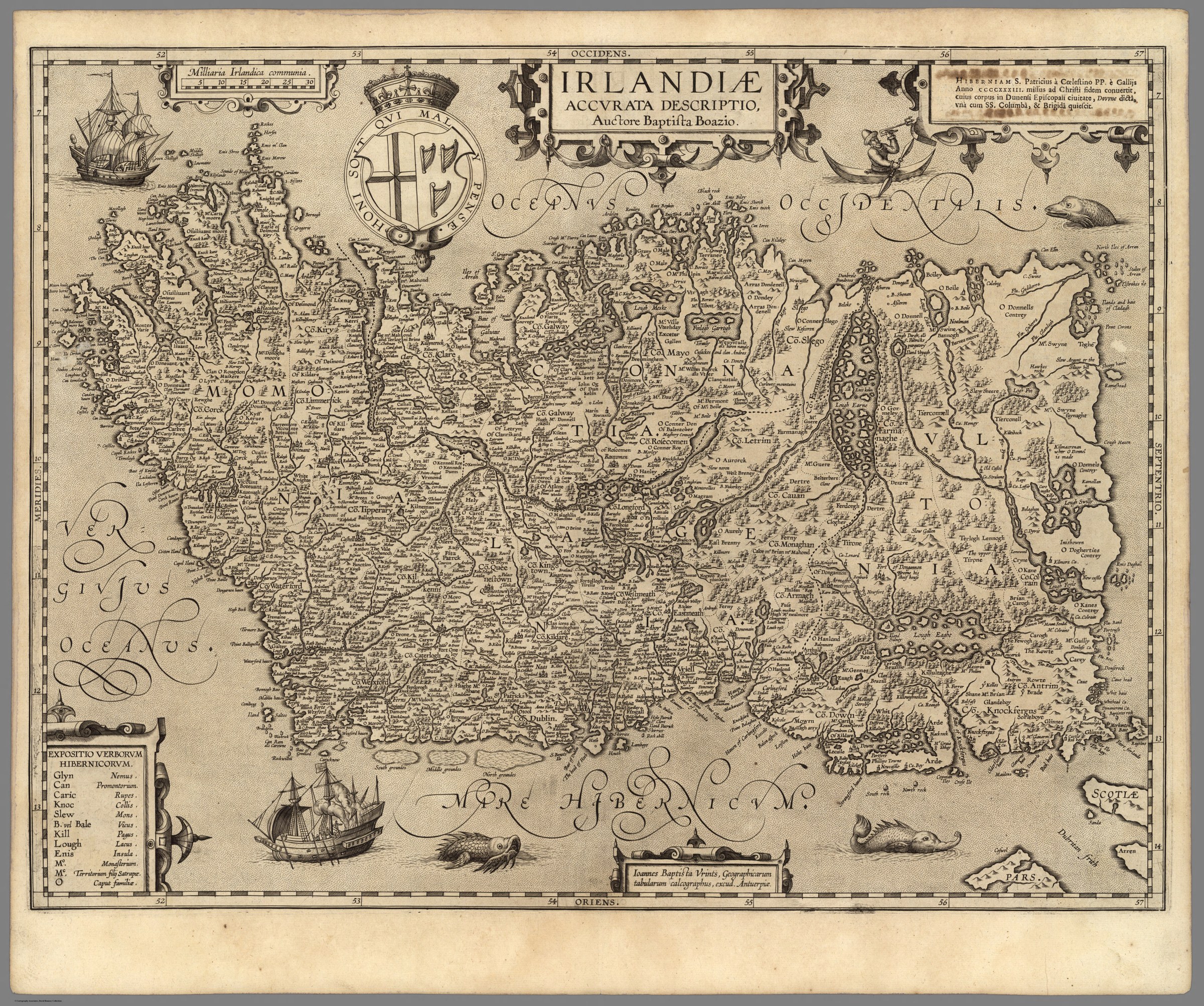
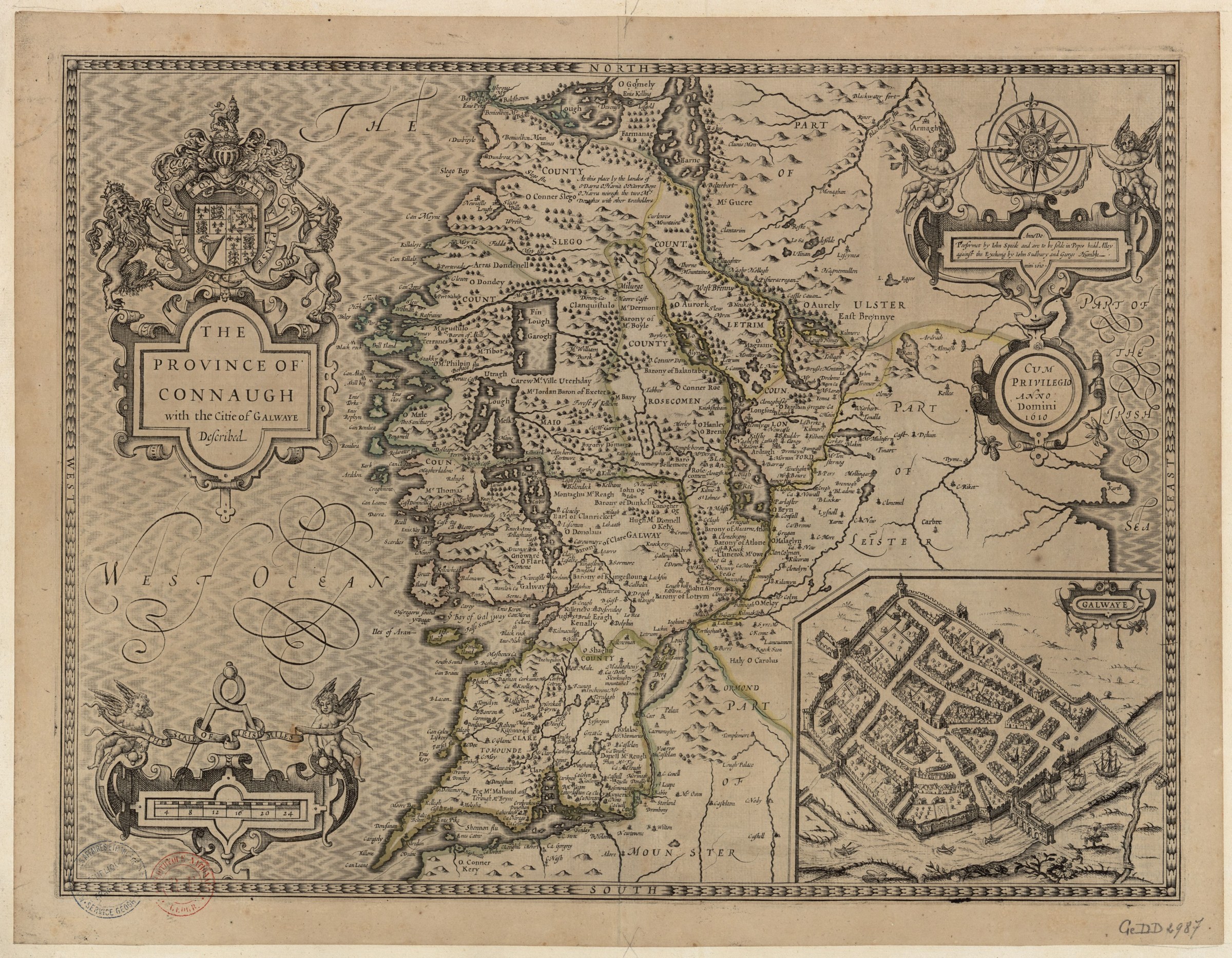
Two of the maps below — Boazio 1606 and Speed 1610 — name the O'Dubhda chief directly, as O Dondey, on the Sligo coast. Others show our kingdom without labelling the family. Taken together they form the earliest continuous printed record of our country.

For the story behind the spelling, read On the Maps: how we became “O Dondey”.

The Catalogue

Four centuries on paper

Chronological, oldest first. Click any image for the full map.

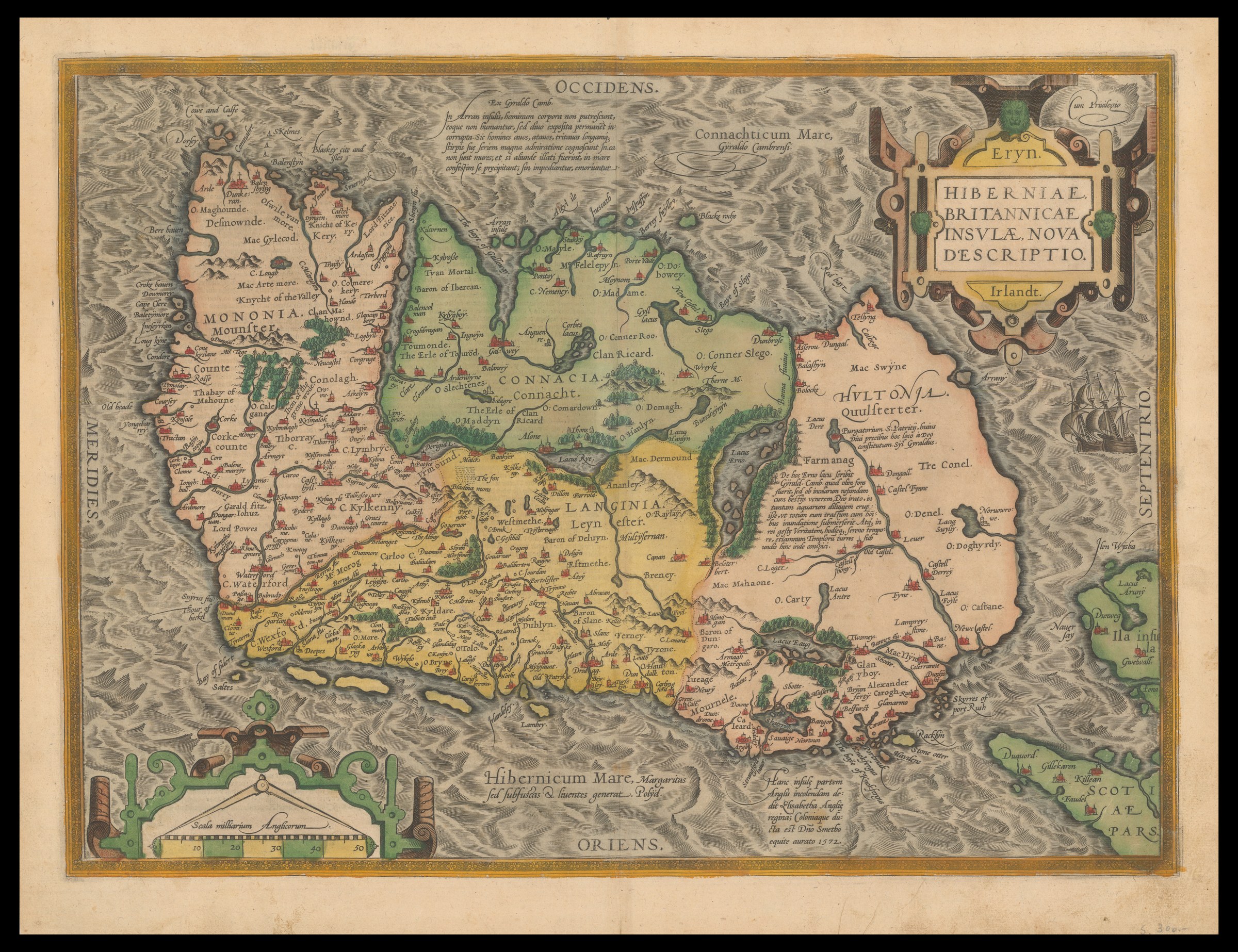
1573
Ortelius

Eryn. Hiberniae Britannicae Insulae Nova Descriptio

Neighbouring septs: “O: Conner Slego” “O: bowey” “O: Mad Jame” “O: Conner Roo”
Abraham Ortelius's first map of Ireland, published in Antwerp as part of the Theatrum Orbis Terrarum — the first modern world atlas. Oriented with west at the top, following the Mercator 1564 wall-map model. On the Sligo coast the engraver marks the Bay of Slego and labels several Connacht ruling families by O-prefixed name, inaugurating the cartographic convention that would later place O Dondey on the maps of Boazio and Speed. The O'Dubhda themselves are not yet named.

Source: Bibliothèque nationale de France, via Wikimedia Commons. Public domain.
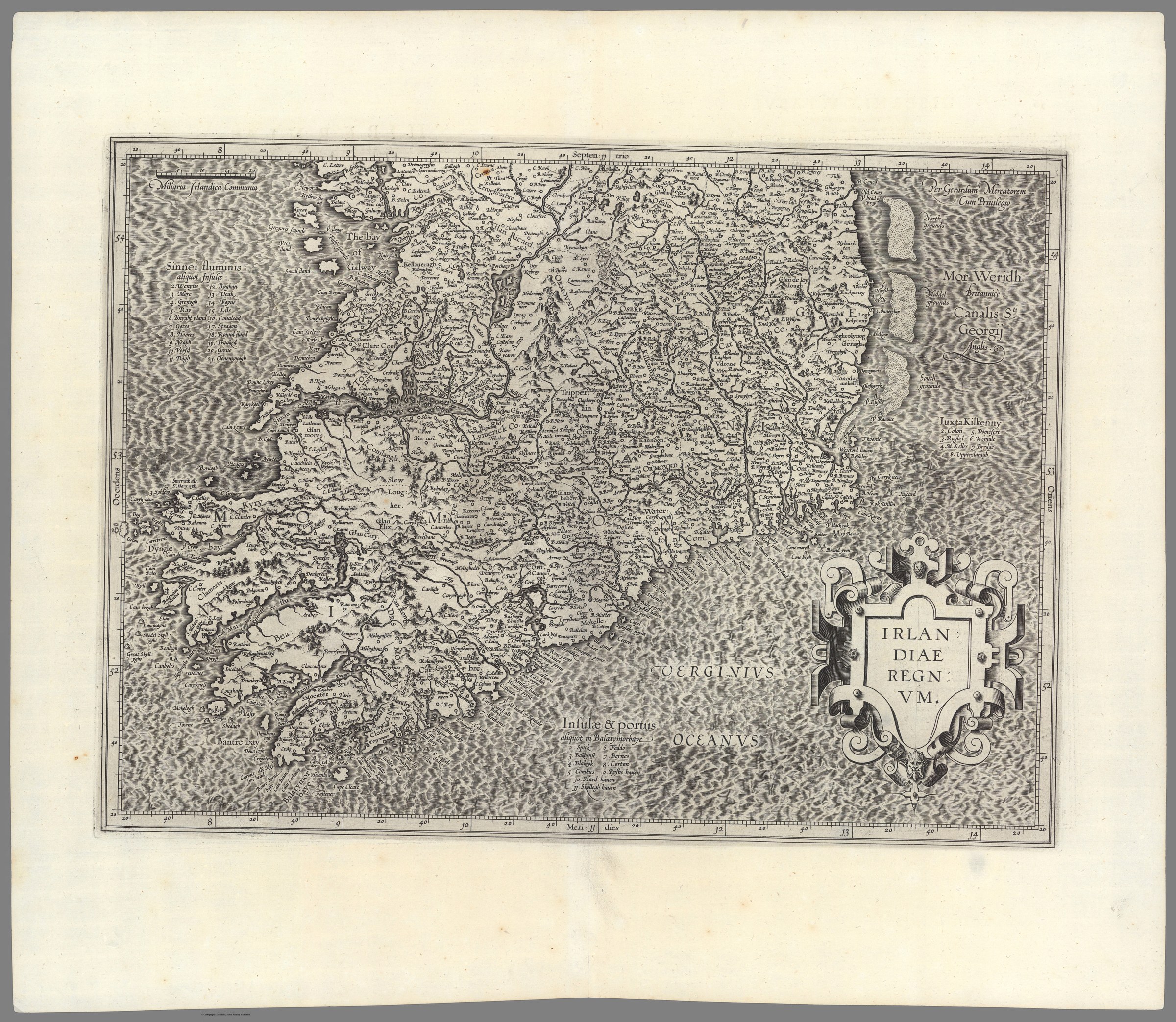
1595
Mercator & Hondius

Irlandiae Regnum

No family label — sets the geographic template.
The most detailed map of Ireland of its period. Issued posthumously by Jodocus Hondius from Gerard Mercator's plates, and continued through the Mercator-Hondius atlases for decades afterward. Based substantially on the 1567–1571 surveys of Robert Lythe — the first English state mapping of Connacht. The detailed north-Connacht coastline and river system on this map set the template that later English cartographers (Boazio 1606, Speed 1610) would annotate with our name.

Source: David Rumsey Map Collection, Stanford Libraries, via Internet Archive. CC BY-NC-SA 3.0.
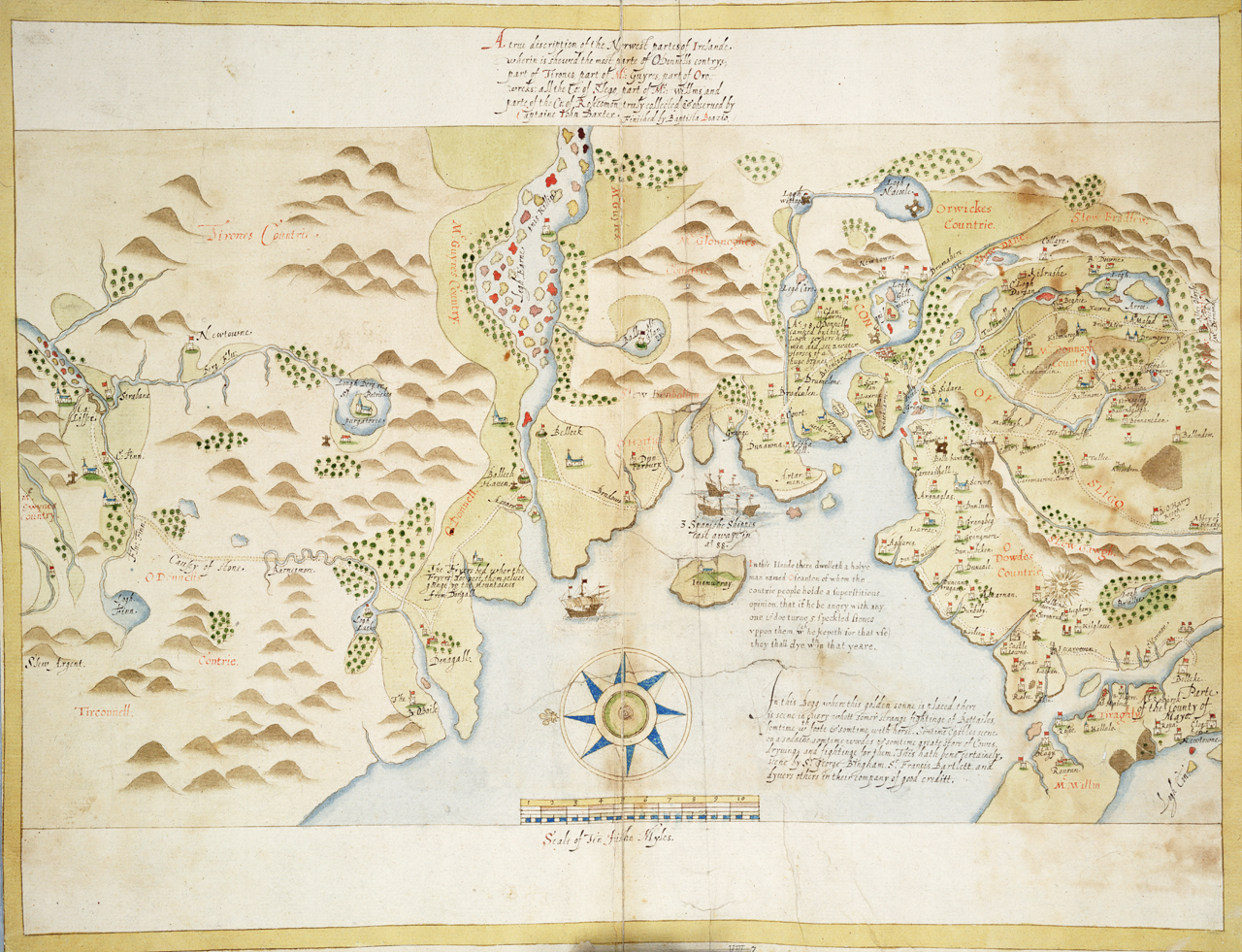
c.1600
Baxter & Boazioa spy's eye view

A true description of the Norwest partes of Irelande

On the map: “Co. of Slego” “Tirones Cowntry” “Orowercks” “3 Spanish Shippes cast away”
Hand-drawn in watercolour and ink, this is a working intelligence map — compiled by the English captain John Baxter from direct observation and finished in Antwerp by Baptista Boazio. The cartouche lists the territories covered: “the most parte of O'Donnells contre, part of Tirones, part of McGuyres, part of Orowercks: all of the Co. of Slego, part of McWillms and parte of the Co. of Roscomon.” Drawn in the warring years before the Battle of Kinsale (1601), it records towers, churches and roads as Baxter himself rode through them — a rare snapshot of unconquered Gaelic Sligo, with the three Spanish Armada wrecks at Streedagh marked just off the coast. The sheet is oriented with north to the left, so our country — the Sligo coast and the mouth of the Moy — runs along the right-hand edge, a dense clutch of castle towers set between the Ox Mountains and Killala Bay. The original is held at Royal Museums Greenwich as part of the Dartmouth Collection; a framed copy is on public display at Parke's Castle, where many visitors first meet it.

Source: Royal Museums Greenwich, Dartmouth Collection P/49(7). Public domain.
1606
Boazio★ names the family

Irlandiae Accurata Descriptio

On the map: “O Dondey” “Arras Dondenell” “Co. Slego”
Baptista Boazio's map of Ireland, engraved in Antwerp by Joannes Baptista Vrients for the final edition of Ortelius's Theatrum Orbis Terrarum. Labels O Dondey on the Sligo coast beside Arras Dondenell (Ardnarea / Dún Néill), within the county marked Co. Slego. Its Latin key, the Expositio Verborum Hibernicorum, explicitly declares O — Caput familiae: the prefix O denotes the head of the family. Few early European maps state the Gaelic sept-system quite so plainly.

Source: David Rumsey Map Collection, Stanford Libraries. CC BY-NC-SA 3.0.
1610
Speed★ names the family

The Province of Connaught with the Citie of Galwaye Described

On the map: “O Dondey” “Arras Dondenell” “SLEGO COUNTY” “Moy flu”
John Speed's map of Connacht — the first detailed English atlas map of the west of Ireland. Engraved by Jodocus Hondius and published in Speed's Theatre of the Empire of Great Britaine (London, 1611–12). O Dondey is lettered on the Sligo coast inside SLEGO COUNTY, between Arras Dondenell (Ardnarea) and Port Nahaly, with the River Moy (“Moy flu”) running east of the chief's name. The strongest early English attestation of the O'Dubhda name on a printed map.

Source: Bibliothèque nationale de France (btv1b53057005d), via Wikimedia Commons. Public domain.
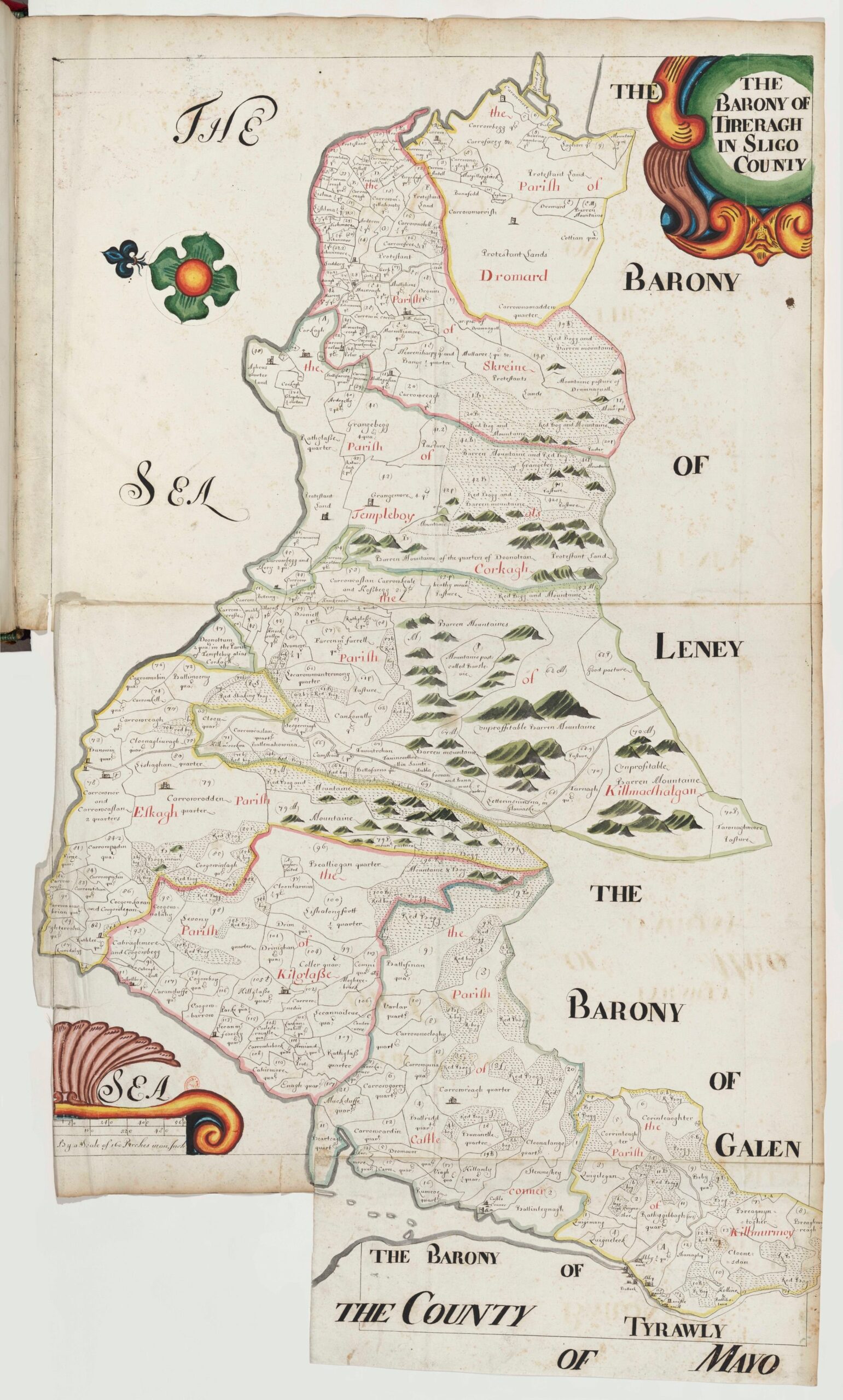
1657
Down Surveythe whole barony

The Barony of Tireragh in Sligo County

On the map: “Tireragh” “Dromard” “Skreen” “Templeboy” “Easkey” “Killeragh”
The barony sheet from Petty's Down Survey — a hand-painted working document drawn between 1656 and 1658, showing the whole of Tireragh: the heartland of the O'Dubhda, running along the south shore of Killala Bay and Sligo Bay from the Moy eastward to the Carbury border. The surveyor has picked out each parish (Dromard, Skreen, Templeboy, Easkey, Killeragh) and every townland boundary, with a distinctive green-stipple flourish for the mountain spine of the Ox Mountains (Slewdaffe) and a red-hatched coastline.

The accompanying description, preserved in the Down Survey terriers, describes Tireragh and Carbury as “lying upon the sea coast, devided from the barony of Tirerill . . . by a great mountaine” — a small window into how the surveyors understood the landscape we still walk today.

Source: Bibliothèque nationale de France (MSS Anglais 1), digitised by the Down Survey of Ireland Project, Trinity College Dublin. Stitched from Zoomify tiles for display here.
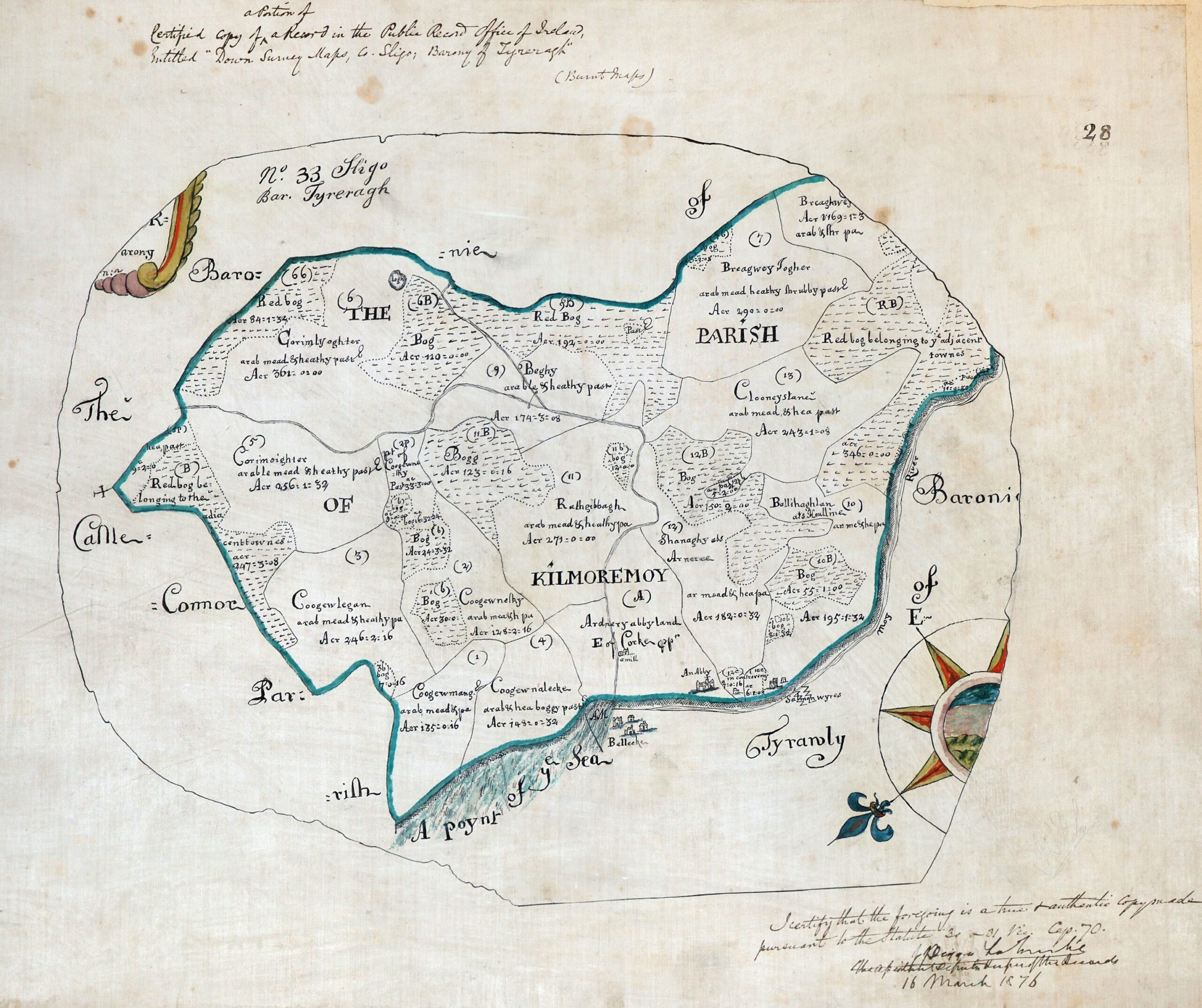
1659
Down Surveylocates Ardnaree

Parish of Kilmoremoy, Barony of Tireragh

On the map: “Ardnaree” “Kilmoremoy” “Tireragh”
Parish №33 of the Tireragh barony sheet — zooming in to the east bank of the Moy, where the surveyors platted the townland of Ardnaree, the ancestral O'Dubhda stronghold across the river from Ballina, together with its forfeited landholdings under the Cromwellian settlement. Combined with the accompanying written terriers (the Books of Survey & Distribution), this map is the key cartographic source for locating the site of Ardnarea Castle — long remembered in tradition but not pinned to the ground until recent local research tied the Down Survey evidence to the surviving field features.

Source: National Archives of Ireland (QRO 1/1/3/18), digitised by the Down Survey of Ireland Project, Trinity College Dublin. Public domain.
1695
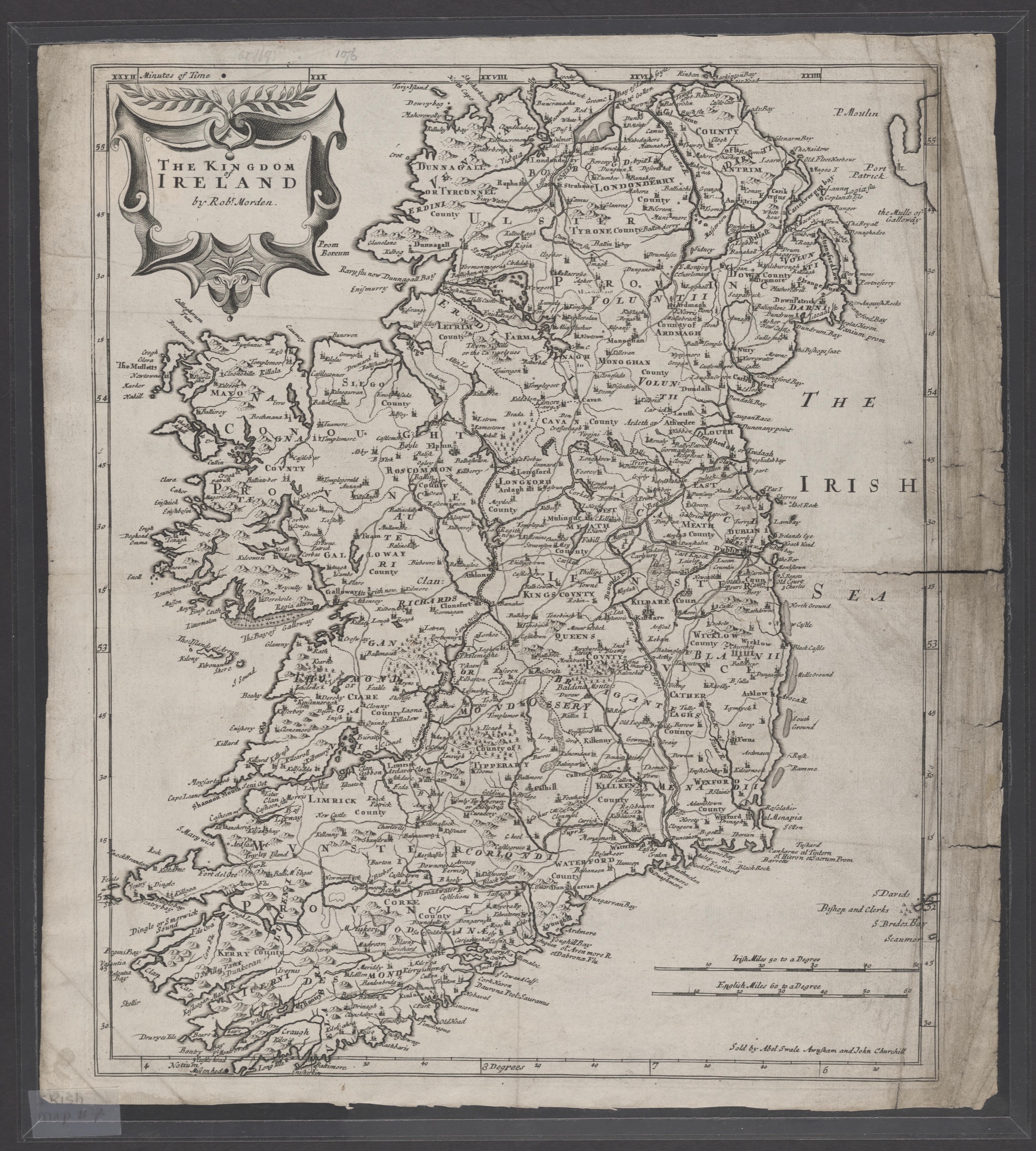
Morden

The Kingdom of Ireland

A snapshot after the Williamite settlement — no family labels, but the county survives.
Robert Morden's general map of Ireland, engraved for the 1695 edition of Camden's Britannia — the first major atlas of the British Isles to reach a wide English readership. By this date the Gaelic sept-labels of Boazio and Speed have been scrubbed away: Morden shows counties, baronies, and walled towns, but not the families who had lost the land. What remains for us is the County of Slego outline with Killaly, Ballina, Castleconner, Dromore and Skreen all shown by name — a quiet cartographic record of the moment our territory passed finally into new hands after the Williamite War.

Source: University of Wisconsin Digital Collections, via Wikimedia Commons. Public domain.
1778
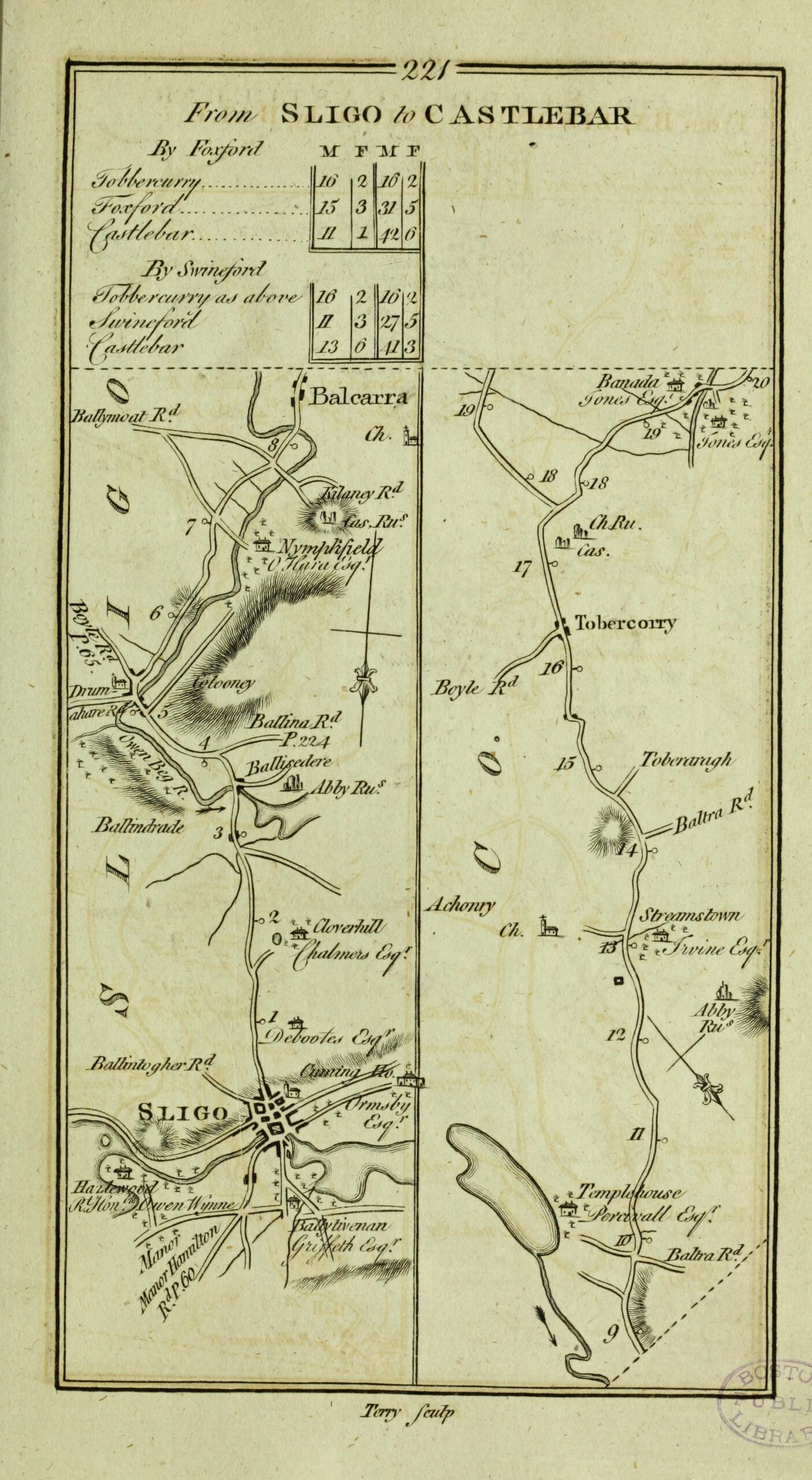
Taylor & Skinnerplate 221

From Sligo to Castlebar

On the map: “Sligo” “Ballysadare” “Collooney” “Temple House” “Tobercurry” “Balleara”
Plate 221 of Taylor & Skinner's Maps of the Roads of Ireland (surveyed 1777, published 1778) — a strip-map at approximately one inch to two English miles, showing the coach road from Sligo south through Ballysadare, Collooney, Balleara and Tobercurry to Castlebar, and a parallel branch by Swinford. The gentlemen's seats of the post-plantation gentry are marked in tiny italic — Temple House (one of the later estates in our country), Aghanagh Ch., Ballintogher — giving us the eighteenth-century face of O'Dubhda territory as the new ruling class drew it for travellers.

Source: Full scan at Internet Archive. Public domain.
1797
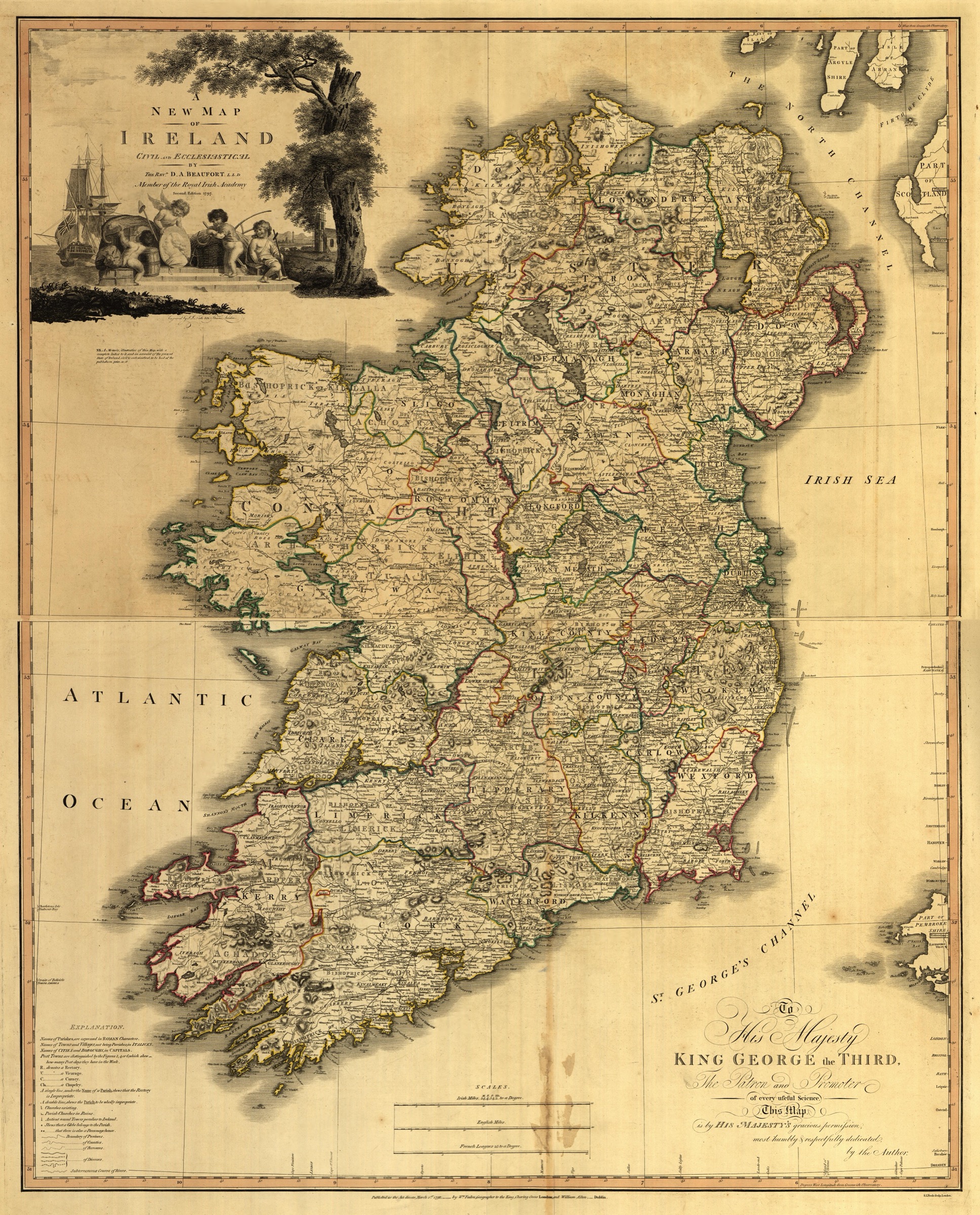
Beaufort

A New Map of Ireland Civil & Ecclesiastical

On the map: “Tirreragh” “Tirawly” “Killala” “Ballina”
The Rev. Daniel Augustus Beaufort's two-sheet map of Ireland, published in London by William Faden and Dublin by William Allen — the most accurate whole-island map of the eighteenth century and the immediate reference for the first Ordnance Survey a generation later. Beaufort draws every barony outline by name: our territory appears as Tirreragh in Sligo and Tirawly in Mayo, with the dioceses of Killala and Achonry overlaid for the ecclesiastical layer that gives the map its title. Not a family attestation, but the most complete picture of the administrative Tír Fhiachrach that anyone had drawn before the OS.

Source: Library of Congress, Geography & Map Division (g5781f ct000402). Public domain.
A Coda — the Scholarly Maps
Two modern maps that gather the medieval material and the surviving fabric into usable form — the nineteenth-century reconstruction of the territory, and the twentieth-century index of the castles within it.
1844
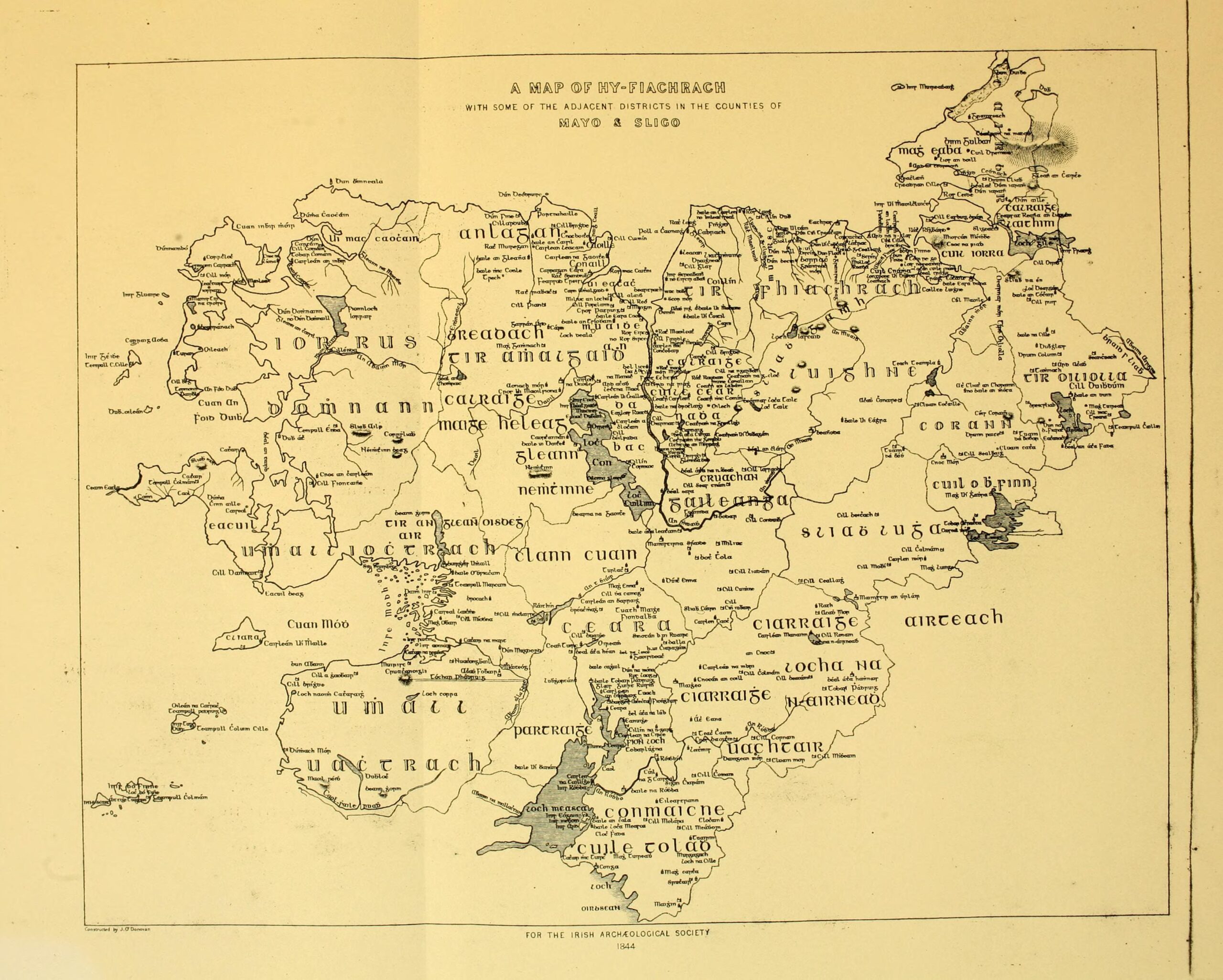
O'Donovan & Mac FhirbhisighO’Dowda’s Country

A Map of Hy-Fiachrach, with some of the adjacent districts in the counties of Mayo & Sligo

On the map: “O’Dowda” “Tír Fhiachrach” “Tír Amhalghaidh” “Hy-Fiachrach”
The frontispiece map of the Irish Archaeological Society's 1844 edition of The Genealogies, Tribes, and Customs of Hy-Fiachrach, commonly called O'Dowda's Country — John O'Donovan's translation and commentary on the seventeenth-century compilation by Dubhaltach Mac Fhirbhisigh, drawn in turn from the fourteenth-century Book of Lecan. Every territory is lettered in Irish script: Tír Fhiachrach and Tír Amhalghaidh (the two halves of Hy-Fiachrach), together with Cera, Coran, Luighne, Gailenga, Umhall, Irrus Domhnann, Sliabh Lugha, Cúl Ó bhFinn, and at the heart of it the kingship seat of the O'Dubhda on the lower Moy. Unlike the colonial maps above, this is not a contemporary attestation — it is the first time the medieval territory was reconstructed on paper, worked out from the genealogies themselves.

Source: Internet Archive (genealogiestribe44macf). Public domain.
1990
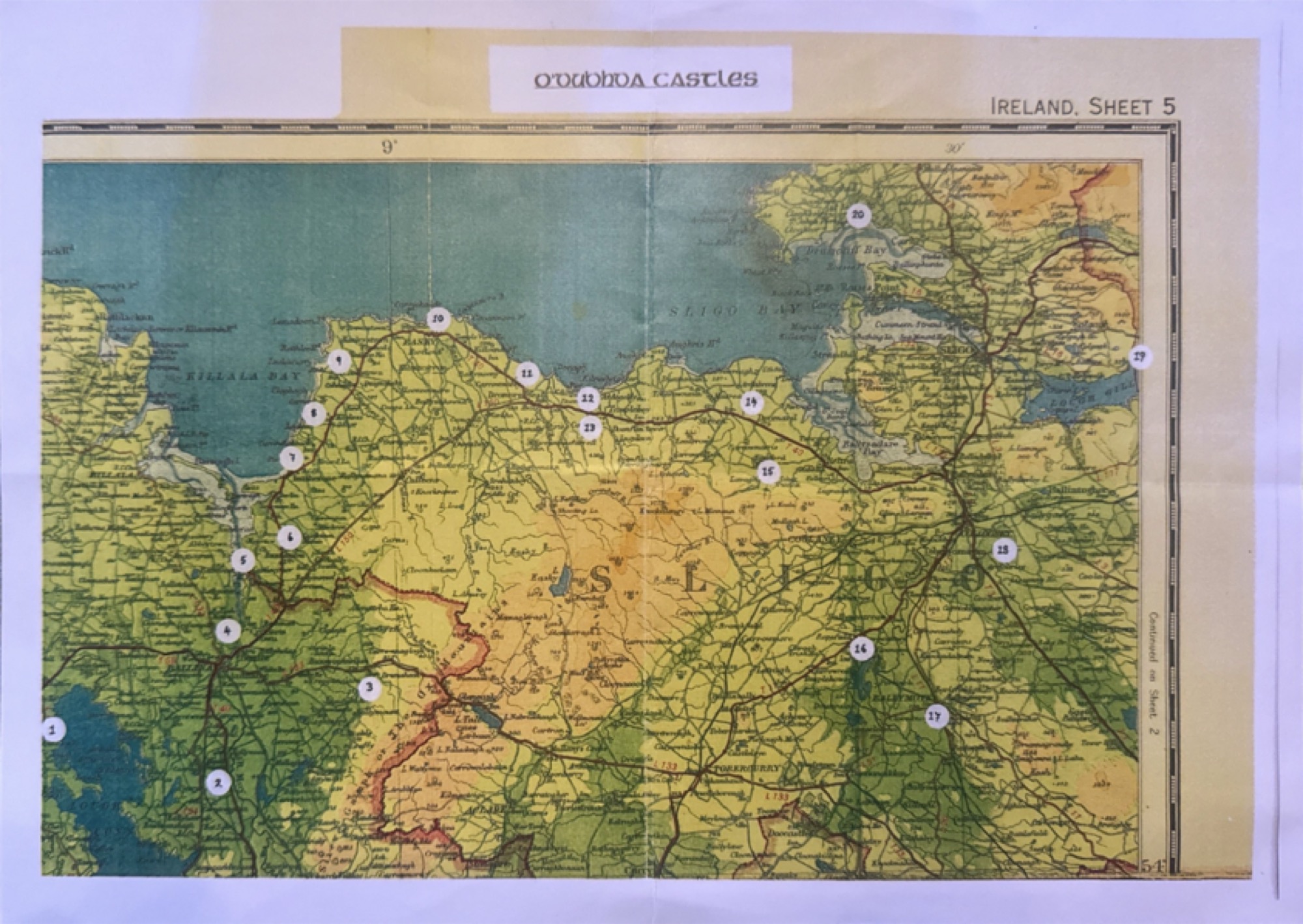
Mac Halethe 20 castles

O’Dubhda Castles — Ireland, Sheet 5

On the map: “O’Dubhda” “Tír Fhiachrach” “Tír Amhalghaidh”
Conor Mac Hale's working map from The O’Dubhda Family History (1990) — twenty numbered pins placed over a mid-twentieth-century touring map of north Connacht (Bartholomew Ireland, Sheet 5), each marking an O’Dubhda castle or stronghold across Tír Fhiachrach and Tír Amhalghaidh. Mac Hale's inventory is the single most-referenced modern index of the castles and the starting point for almost every castle page on this site, including our Castle Tour and the Lost Castles page for the sites that remain unlocated or unverified.

A note on what the map does and does not say: several of the twenty pins mark later buildings standing near, but not on, the original castle site — and a handful are sites for which the castle itself has never been located on the ground. Mac Hale's map is a research index, not a field survey. A full archaeological re-survey of the O’Dubhda territory has not been carried out since.

Source: Conor Mac Hale, The O’Dubhda Family History (1990). Reproduced from the Internet Archive scan. Courtesy the author.
On the research list

Maps we are still chasing

Each of these is relevant to the O'Dubhda story and will be added to the catalogue as we gather clean scans and verify their content.

c.1780s   unidentified

Eighteenth-century Sligo county map

A black-and-white county map photographed in a Dublin print shop showing TYrerach, Leney, Castle Conner, Rath lee, Kilnegarvan, Cashelboy, Callen and Moygara — a striking concentration of O'Dubhda placenames. Working hypothesis: Bernard Scalé's Hibernian Atlas Sligo plate (1776); the typography and hatching match, but the title cartouche in the reference scans differs, so attribution remains open.

Research in progress — attribution not yet confirmed.

1837–42   Ordnance Survey

First-edition 6-inch, Sligo & Mayo

The Ordnance Survey six-inch sheets covering Tireragh and Tirawly record every standing castle ruin, holy well, townland boundary and road in our country at the moment of the Great Famine — the reference layer underlying every modern Irish map. Sheets are available on the National Library of Scotland viewer and OSi GeoHive, but the correct Tireragh sheet numbers have not yet been identified and clipped for this catalogue.

Available via NLS, OSi GeoHive, and logainm.ie.

Contribute

Do you know another map?

If you know of an antique or historical map where the O'Dubhda appear by name — or where one of our castles or townlands is shown — we would love to hear from you.

Get in touch

Stories

From the Blog

Research and stories from the O’Dubhda blog — beginning with the story of the name itself.

Closeup of O Dondey labelled on the Sligo coast in John Speed's 1610 map of Connacht
16 April 2026  ·  Maps

On the Maps: how we became “O Dondey”

On two early-seventeenth-century maps of Ireland — Speed 1610 and Boazio 1606 — the O’Dubhda chief appears on the Sligo coast under an unfamiliar English spelling. A story of sound, script, and a family on the page.

Read the story →

A Note from the Clan

This catalogue is volunteer-compiled. The scans shown here are sourced from public institutional collections and reproduced under their respective licences; full attribution is given on each entry.

New entries are added as new maps surface. If you know of one we have missed, please tell us.