
The Mermaid Rocks
April 18, 2026 2026-10-14 21:27The Mermaid Rocks
The Mermaid Rocks of Scurmore
My back to your country, O’Dowd. The mermaid’s parting words, Schools’ Collection, Co. Sligo
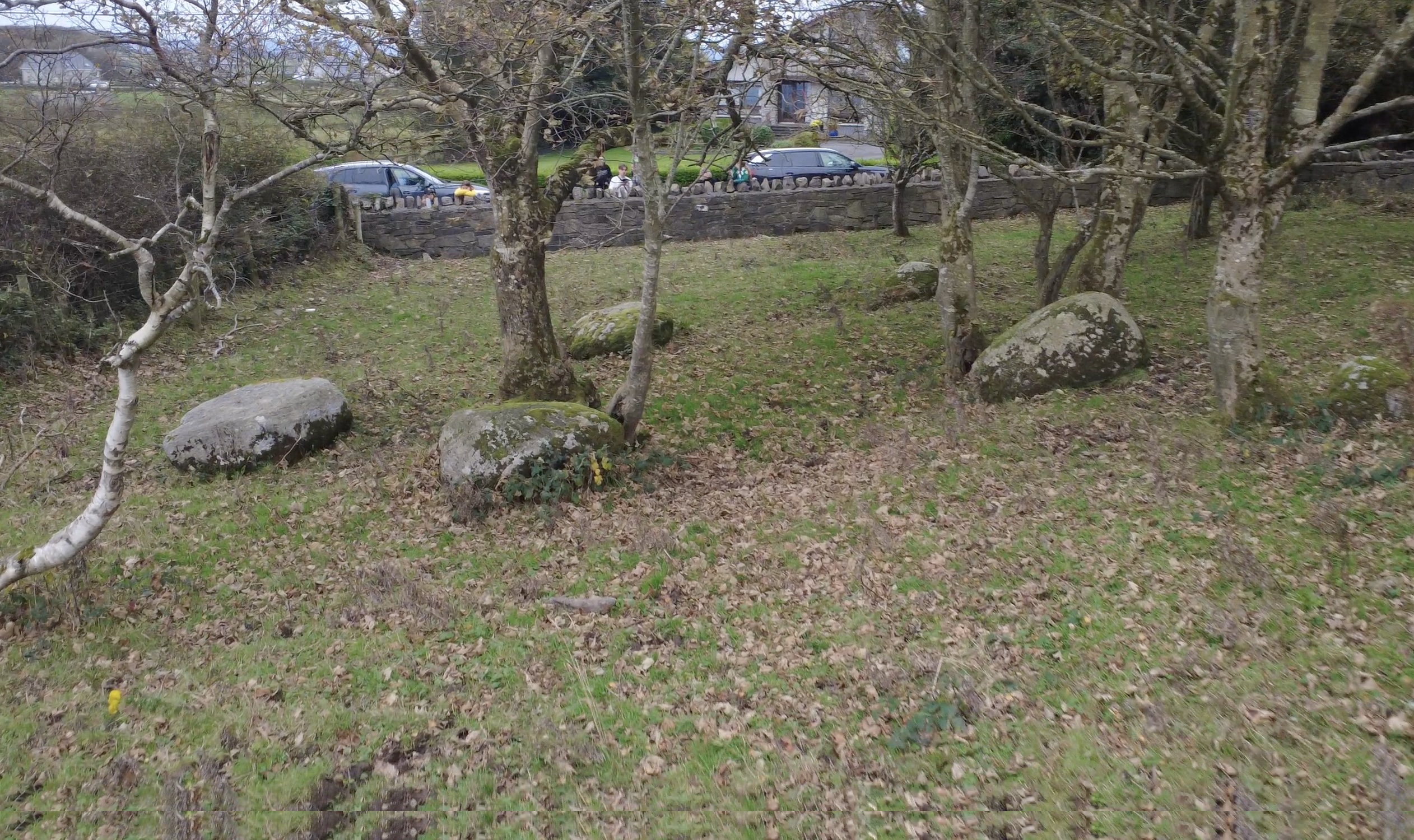
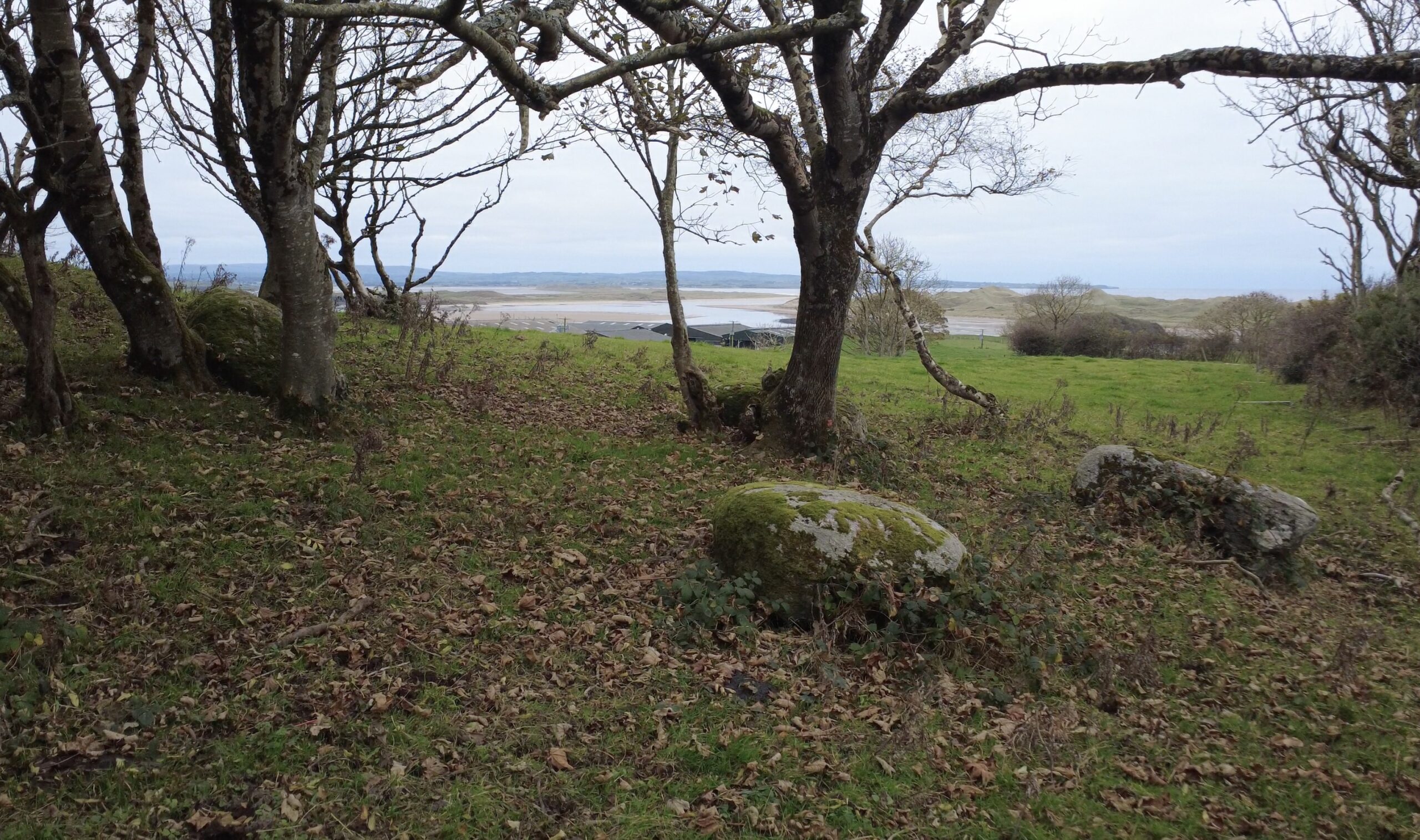
On the strand at Scurmore, just north of Enniscrone, a prehistoric burial mound rises a few feet above the dune grass, with five or six large boulders set close by. An Ordnance Survey map from the 1830s labels the site, in the plain language of the surveyor, “Children of the Mermaid, standing stone.” The site is three to four thousand years old — long predating the Ó Dubhda and their kingship of Tír Fhiachrach. The folklore, however, has turned it into something else entirely.
This page gathers the recorded versions of the Mermaid Rocks story. It is the richest single folk-tradition associated with the Ó Dubhda. Dr Marion Dowd, in her October 2025 address to the clan, called it their headline piece; fourteen separate variants survive across the Schools’ Collection in Irish and English, and the tale is attested in print as early as the 1880s. For the geographical and archaeological setting of the stones themselves — their townland, the Moy estuary landscape, and the alternative-inauguration-site question — see the companion page on Scurmore.
I. The core story
The version below was collected by a Sligo schoolchild for the Schools’ Collection in the late 1930s. It is typical of the Enniscrone variants, but not, strictly, representative — every telling differs.
“One of the principal castles of the O’Dowds was situated at Enniscrone. The chief who lived in this castle was one day walking on the strand beside the present Scurmore Hotel. In the distance sitting on a rock with her back toward him he saw a beautiful lady combing her hair. Her cochaill lay on the rock beside her. O’Dowd crept up noiselessly behind her and took possession of the cochaill and proceeded towards his castle. She followed him. He took her into his castle and after a time were married. As well as being beautiful she was also a good housewife. They had three sons, who grew up to be fine strapping boys. One day O’Dowd went on a journey leaving his wife and three sons behind. In the course of a conversation between the mother and sons one of the boys told her that he saw his father hiding something in the haystack before he left on his journey. She thought that perhaps it was the cochaill for which she longed ever since the day it was taken from her. She went out to the hay stack unknown to the children and sure enough there she found the cochaill. She called her three sons to her and all proceeded to the sea-shore. When she arrived at the seashore she struck each of her sons with the slaitín draoidheachta and each boy was turned into a stone. Then she pulled her cochaill round her and jumped into the ocean never to return. The three stones are still to be seen on the sea-shore beside the Scurmore hotel.”
Bailiúchán na Scol, vol. 0167, pp. 108–109 (Dromore, Co. Sligo)
Cochaill is the Irish for cloak or hooded mantle; slaitín draoidheachta, the magic wand.
II. The stones themselves
A Bronze Age monument. Strictly, Scurmore is not a megalithic tomb in the classic sense. It is a barrow — a low circular earthen mound — with a cluster of large boulders placed nearby. The barrow has never been archaeologically excavated, but comparable monuments are usually prehistoric burial places, some three to four thousand years old. The boulders are likely of similar antiquity. Both predate the arrival of any Gaelic Ó Dubhda chieftain by at least two thousand years.
The name is old. The Ordnance Survey mapped the site in the 1830s under the name Children of the Mermaid. A second surveying cycle in the 1910s preserved the same label. Conor Mac Hale has found an even earlier reference to the site from the 1820s, suggesting the tradition was already well settled when the first formal mapping began.
The rocks bleed. Local variants of the tradition say that the rocks bleed or sweat when an O’Dowd dies; that they bleed every seven years if struck with something sharp; that anyone of the name O’Dowd who passes by the rocks will die within a year; that if you touch each rock you will dream of the fairies that night. The Mermaid Rocks, in other words, are not inert geology in local imagination — they are alive, and their aliveness is bound to the clan.
III. The variants
No two recorded versions of the story are identical. The skeleton is fixed — cloak, capture, marriage, children, discovery, flight, curse — but every other element drifts between tellings. Marion Dowd, working through the Schools’ Collection systematically in 2024–2025, identified at least fourteen distinct variants in Irish and English. A selection from the Schools’ Collection, each linked to the original page:
| Where the O’Dowd lived | Where she was found | Children | Cloak | Ending | Schools’ Collection |
|---|---|---|---|---|---|
| Enniscrone castle | on a rock by the strand, combing her hair | 3 sons | cochaill, hidden in a haystack | sons struck with a wand and turned to stones; her parting words “mo chúl dod’ dhuithche leat, Uí Dhubhda”; “the scattering of the O’Dowds” | Dromore, Co. Sligo; vol. 0167, pp. 108–9 |
| Enniscrone castle | asleep on the rocks | 7 sons | red, hidden in a turf stack | seven rocks in Scurmore woods, which bleed every seven years if struck | Inishcrone; vol. 0164, p. 309 |
| Enniscrone (the Castle Field) | combing her hair in Scurmore wood | 7 children | mantle | six turned to rocks; the youngest, who found the mantle, taken into the sea; the rocks bleed every six years | Enniscrone girls’ school; vol. 0164, pp. 18–19 |
| Oatlands House, Bonniconlon | on a rock off Enniscrone strand | 3 sons | a white “shroud”, hidden in an oat stack | three rocks; any O’Dowd who passes two of them dies within a year | Bunnyconnellan; vol. 0128, pp. 255–7 |
| Bonniconlon (Fergus O’Dowd) | on a rock by the shore | 2 boys, 1 girl | green, hidden in an oat stack | stones near Scurmore, “Children of the Mermaid”; she foretells Fergus’s death by the Rón Mór | Carra (Carha); vol. 0128, pp. 501–2 |
| Ardnaree (a chieftain living in Carra) | on a river bank | 3 children | “a beautiful cloak” | three stones near Ardnaree; never an O’Dowd in Ardnaree after | Convent of Mercy, Ballina; vol. 0146, p. 149 |
| Ardnaree (Carra) | on the strand | 3 sons | cloak | three stones at Enniscrone; the Ardnaree curse | Rehins; vol. 0151, pp. 87–8 |
| “O’Dowd of Coolcran” | asleep by the River Moy | 7 children | mantle | six rocks by the Moy, the youngest taken with her; the rocks bleed every seven years | Cloghans; vol. 0147, pp. 655–6 |
| Castleconnor (father of John Tape O’Dowd) | on the shore | 2 or 3 | a “cover”, hidden in an oat stack | she returns to the sea, and comes ashore to comb the children’s hair | Ratheskin; vol. 0142, p. 184 |
| Dromore West | on a rock, combing her hair | 5 or 6 | cloak, hidden in an oat stack | she takes all the children into the sea; never seen again | Doonflin; vol. 0169, pp. 136–7 |
| an O’Dowd chieftain | on a rock, combing her hair (he comes riding a furious horse) | not mentioned | her secret is a silver comb | when he tells the secret after seven years, she goes back to the sea | High Park; vol. 0169, p. 364 |
Across these versions the three and the seven, the magical numbers of Irish tradition, dominate. In most the children are turned to stone; in some the youngest is taken into the sea; in a few the mermaid simply goes. The cloak is red, green or white, or a plain “mantle”, “cover” or “shroud”, and it is nearly always hidden in a stack of oats, hay or turf. In one version it is the O’Dowd chieftain who comes riding a furious horse when he finds her.
IV. O’Reilly’s 1971 retelling: Thady Rua and Aoife
Gertrude O’Reilly’s collection gives the fullest sustained retelling of the Mermaid Rocks tradition, and it names the chieftain. In her version the Ó Dubhda of the story is Thady Rua Ó Dubhda, and his wife is the mermaid Aoife. The children number seven, not three, and their fates are singular.
Thady Rua, newly made chieftain and already inaugurated on Carn Amhalgaidh, hears a song on the shore near Scurmore and finds a woman combing her golden hair, her cloak shimmering “like the scales of a silver fish”. He takes the cloak, and Aoife the mermaid becomes his bride. She bears him seven children. Years later, before riding out to battle, Thady moves the cloak to a new hiding place; the youngest child sees him and tells his mother. Aoife takes the cloak and goes down to the sea with all seven children. On the hill above the shore at Scurmore she turns six of them into rocks and carries the youngest with her into the waves. Five of the rocks sit in a melancholy circle on the hilltop, and the sixth stands a little way off, nearer the sea.
O’Reilly closes the retelling with the line that gives the tradition its standing as an Ó Dubhda omen:
“It is said that every time an O’Dowda dies, the rocks are seen to weep, even in hot weather.”
That closing motif, weeping rocks as a death-omen for the family, is the feature that most firmly ties the Scurmore stones to the Ó Dubhda lineage rather than to a generic selkie tradition. Several Schools’ Collection versions carry the same omen, that the rocks bleed or weep for the family.
Source: Gertrude O’Reilly, Stories from O’Dowda’s Country (Inniscrone, 1971), retained in the 2018 expanded edition edited by Conor Mac Hale, Ch. 11.
V. The parting curse
In several versions, the mermaid turns as she re-enters the sea and speaks a line in Irish. The version a Sligo schoolchild wrote down in the late 1930s ends this way: the mermaid “turned towards the O’Dowd Castle and said ‘mo chúl dod’ dhuithche leat, Uí Dhubhda.’ After that came the scattering of the O’Dowds and the waning of their power as chiefs of Tireragh.” Roughly: “my back to your country, O’Dowd.”
What matters is the gesture: the mermaid ends the marriage by turning her back, and in doing so she ends the clan’s power. The parting curse is the explanation for the Ó Dubhda collapse — why the Burkes took the land by the early 1600s, why the castles emptied. The community was still narrating that loss, in these terms, three hundred years after it had happened.
VI. Dr Marion Dowd’s reading
In her 2025 presentation, Marion Dowd placed the Mermaid Rocks inside a much older Irish pattern: the kingship marriage rite. Medieval scribes describe Gaelic kings as being ritually married to the land at inauguration — the land personified as a goddess. The rite was performative, symbolic, and utterly central to legitimate kingship: to be king was to be the land’s husband. The arrival of the Anglo-Norman and later English administration broke the rite at its root.
Marion’s argument: the Mermaid Rocks story is the sea-variant of this rite. Where the inland Gaelic king marries the land, the Ó Dubhda king — lord of a maritime territory, with every castle on the coast — marries the sea. The mermaid is the land-goddess in Atlantic form. The cloak is the sign of her sovereignty; taking it forces the marriage. Her departure, carrying the cloak back into the sea, is the loss of the sovereignty rite itself. After her, there is no legitimate kingship to inherit. The children — half human, half sea — freeze into stone, the visible trace of a vanished covenant.
Read this way, the tradition preserves something the manuscript record does not: the maritime identity of Ó Dubhda kingship. Every physical Ó Dubhda castle sits on the sea. The inauguration site at Aughris faces the sea. The king’s horse, in the Coradown tradition, runs into the sea. The king himself, here, marries the sea. Historians have tended to describe the Ó Dubhda inland, through their castles and their genealogy. Folklore insists on the coast.
VII. The tale in print and on the airwaves
The Mermaid Rocks story has had a life far beyond the Schools’ Collection. It appears in print as early as the 1880s in Wood-Martin’s History of Sligo, is the centrepiece of G. O’Reilly’s Stories from O’Dowda’s Country (1971), and — most strikingly — was adapted for the radio by the Anglo-Irish novelist and poet L.A.G. Strong. Strong’s musical play The King and the Mermaid was first broadcast by the B.B.C. in 1956. As Conor Mac Hale notes in The Ó Dubhda Family History (1990), Strong was himself a descendant, through Ellen O’Dowda, of Thady O’Dowda of Bonniconlon — meaning the clan’s headline folk-tale reached a British national audience in a version written by one of the family’s own descendants.
Mac Hale also suggests that the hill above the Mermaid Rocks, with its “magnificent view from the top”, “may well have been a place where the O’Dubhda chieftains were once inaugurated.” The Scurmore strand and its stones would then sit inside a larger inauguration landscape together with the hilltop cairn at Carn Amhalghaidh and the Coggins Hill mound at Carn Inghine Briain — a reading broadly consistent with Marion Dowd’s kingship-to-sea argument above, and one we hope to follow up with fieldwork in coming seasons.
Co. Sligo, on Killala Bay
never archaeologically excavated
Bronze Age, unexcavated
in Schools’ Collection, Irish & English
“Children of the Mermaid”
1882–1892
The Mermaid Rocks preserve the sea-variant of the Gaelic kingship-marriage-to-the-land rite.
The Ó Dubhda were a maritime power. Their king, in folk memory, marries the sea. The cloak is the sign of sovereignty; losing it is the loss of the rite.
The mermaid’s departure explains, in the community’s own terms, the Ó Dubhda collapse.
Uí Dhubhda.
What every version keeps
Fourteen variants, four constants. These are the load-bearing pieces of the Mermaid Rocks tradition — the elements that never change, no matter who is telling the story.
The cochall is the mermaid’s sovereignty. To take it is to compel the marriage; to return it is to end it.
Three or seven children. Both are the magical numbers of Irish tradition, recurring across a thousand years of supernatural tale.
Petrified, they say, by the mother’s magic wand. And ever since, they bleed or sweat when an O’Dowd dies.
Anyone named O’Dowd who passes the rocks, it is said, will die within a year. Consider yourself warned.
Continue Your Journey
A Note from the Clan
These pages are volunteer-authored. We document every version of each tale we can trace, and we cite our sources. Where evidence is thin or contested, we say so plainly.
If you carry a family version of one of these stories — or know of a printed source we’ve missed — get in touch.