Roslee Castle, Easkey
A coastal stronghold of the Ó Dubhda
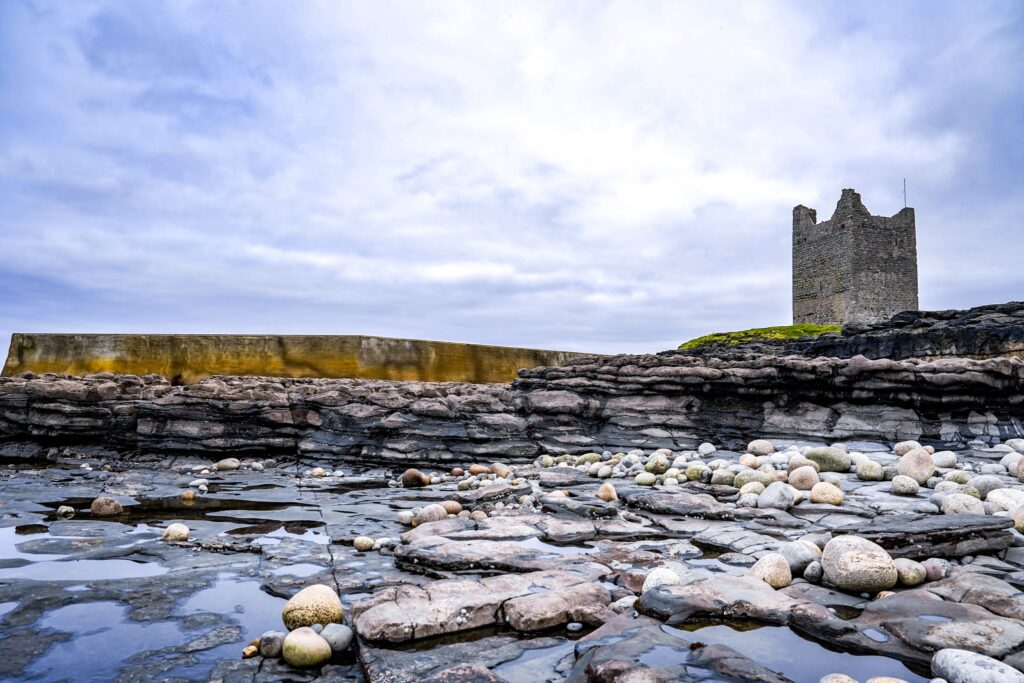
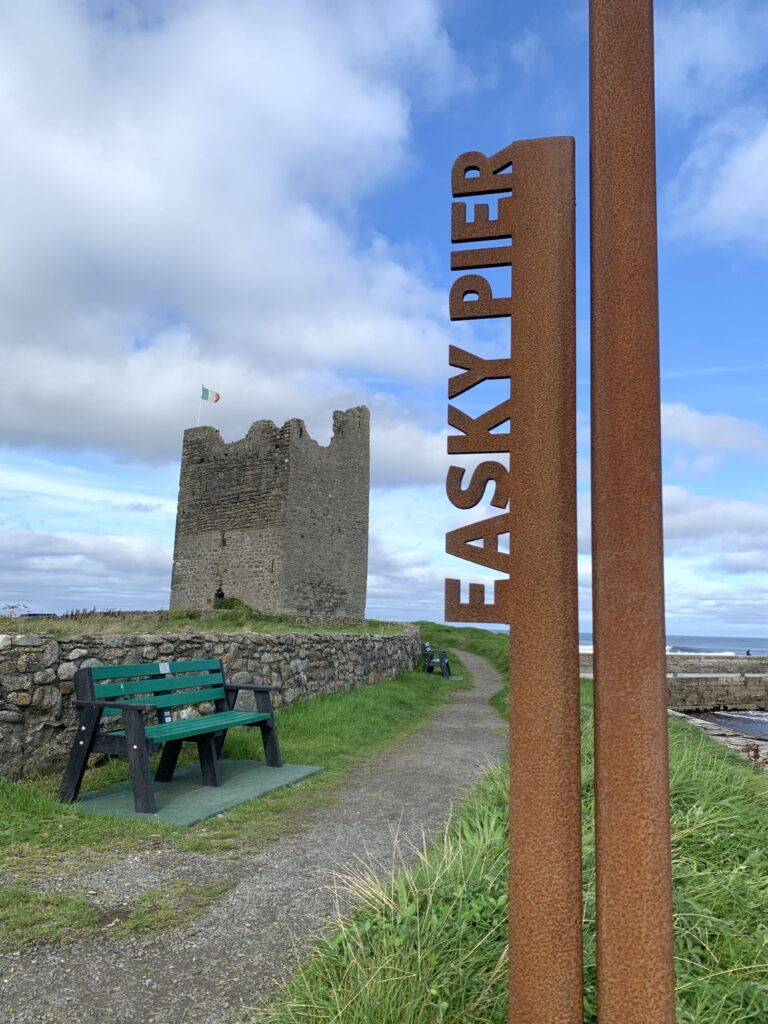
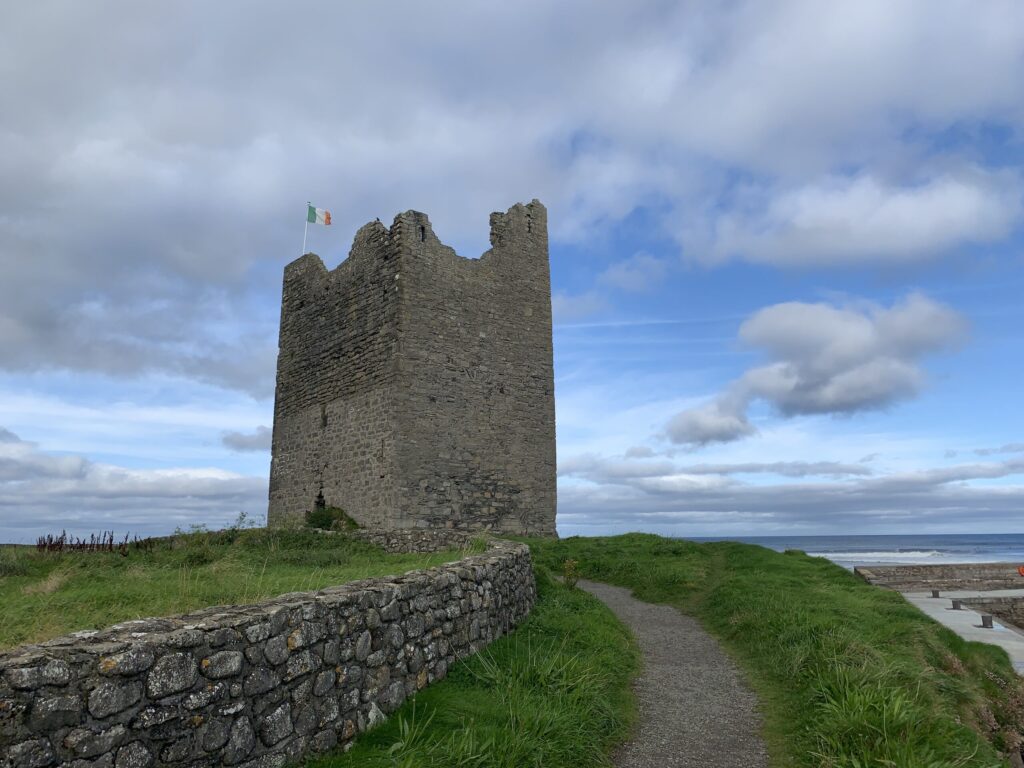
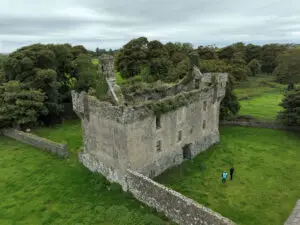
Roslee Castle stands on a low ledge of rock beside Easkey pier, on the north Sligo coast in the civil parish of Easkey, barony of Tireragh. It is the most substantial surviving fortification of the Ó Dubhda territory in this stretch of Tireragh, and the best-preserved of the several O’Dowd sites traditionally associated with the Easkey district.
I. Setting
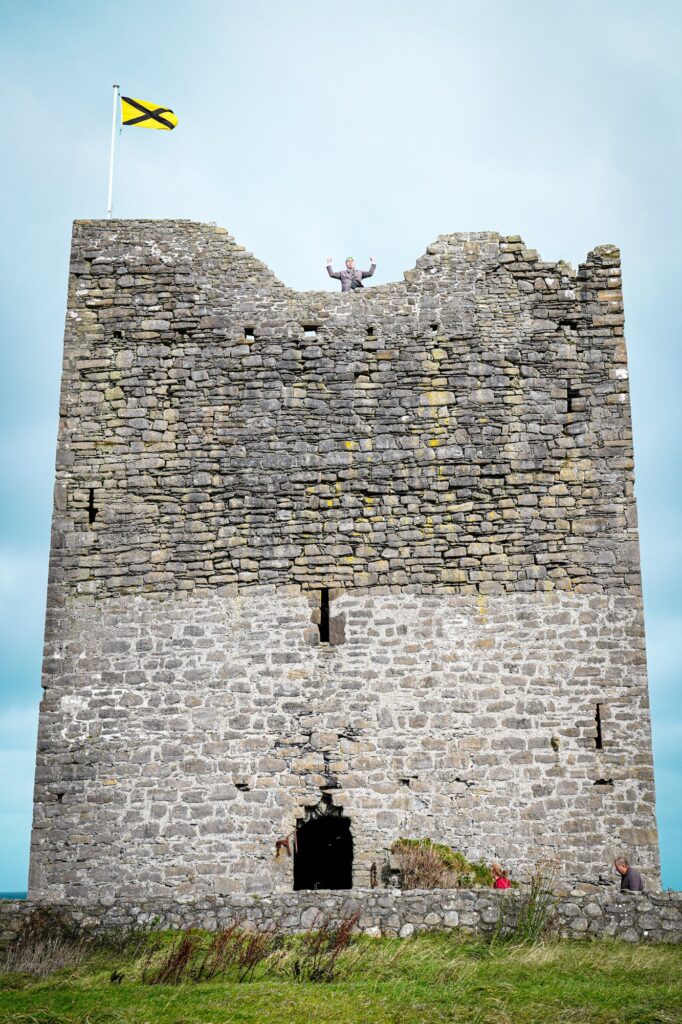
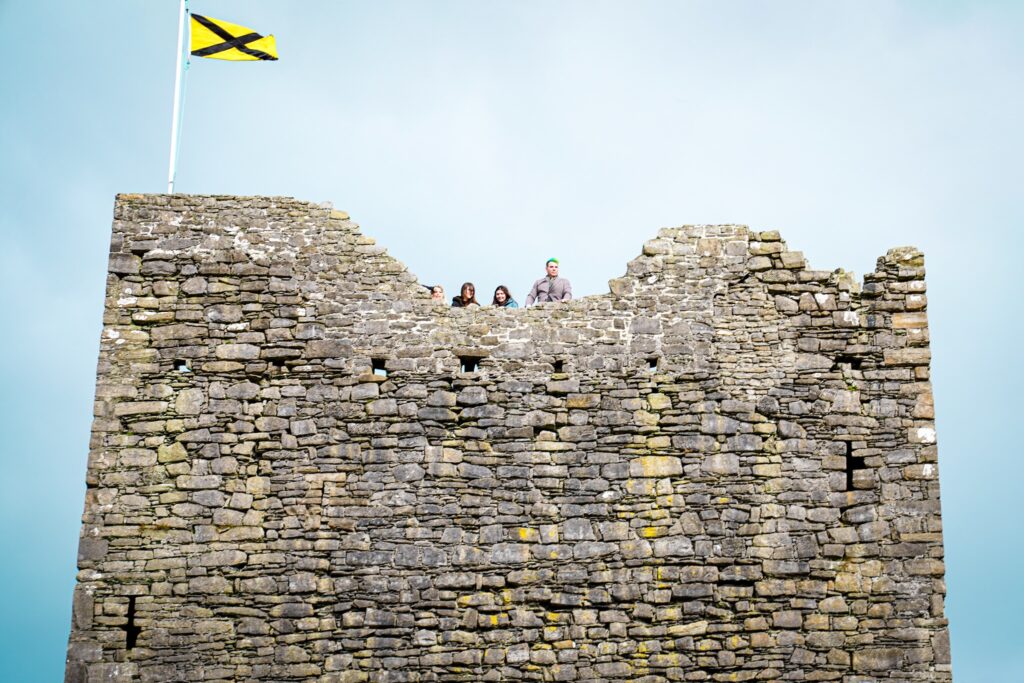
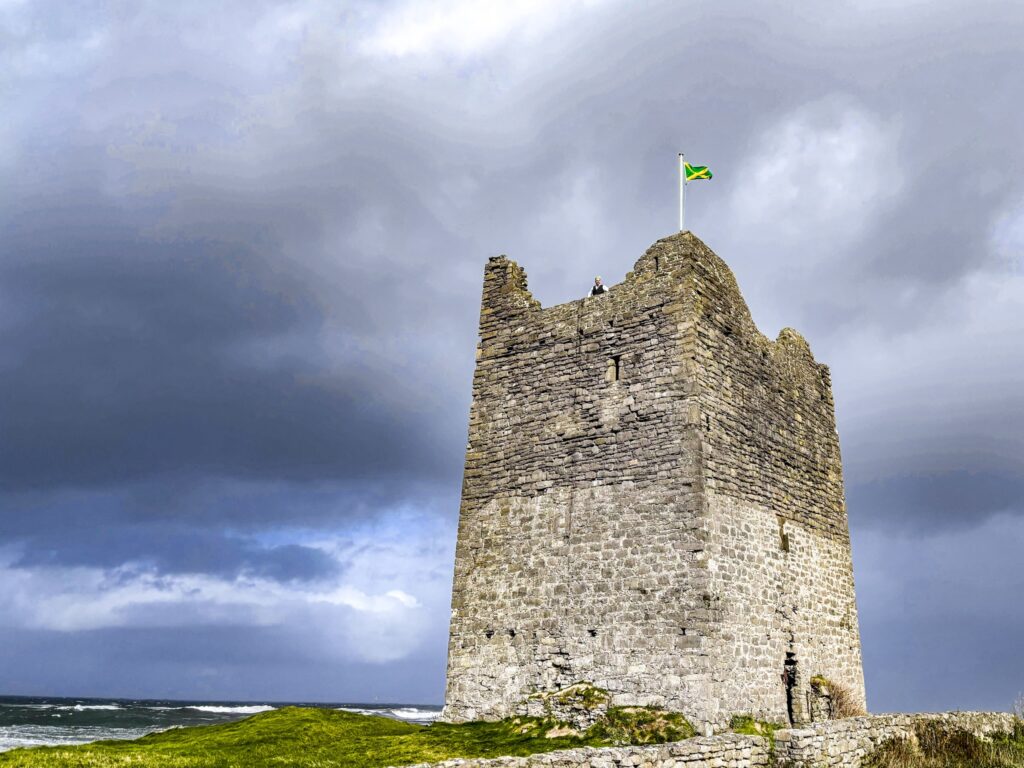
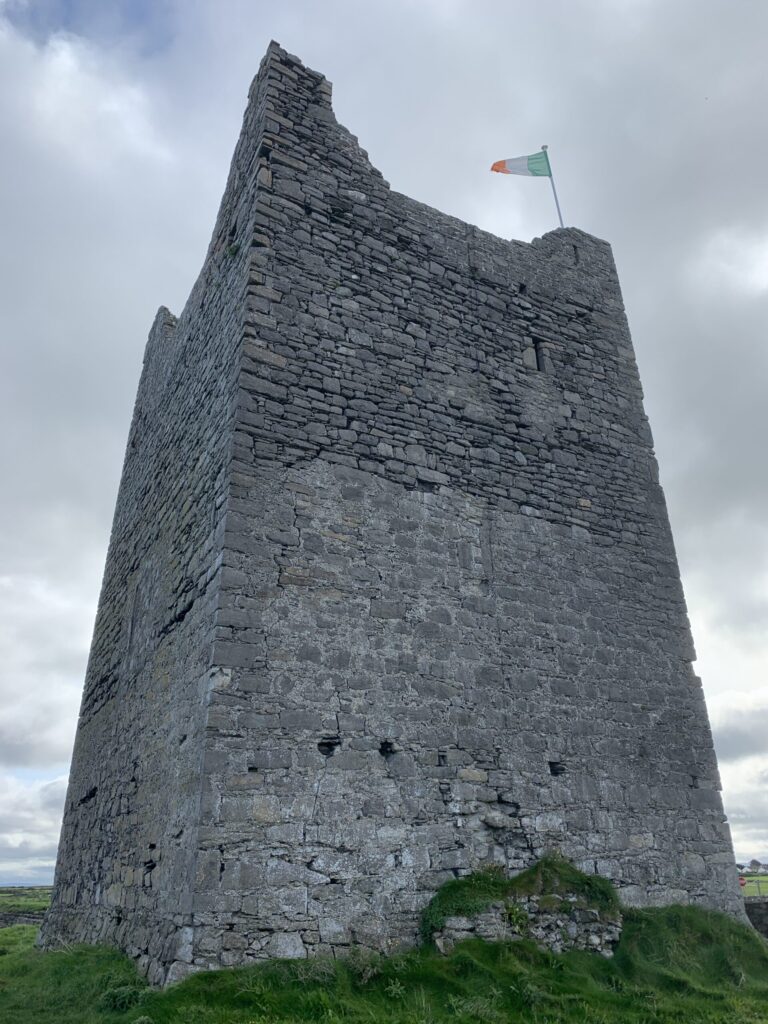
The castle occupies a small promontory of sedimentary rock at the mouth of the Easkey River, directly over Sligo Bay. The tower — some 63 feet at its highest surviving point, known locally as the Sailor’s Bed — is the dominant element of the site, but it is only one part of a larger fortified enclosure or bawn. The approach is over open grass and shore boulders; on a clear day the view reaches from Aughris Head across to the mountains of north Mayo.
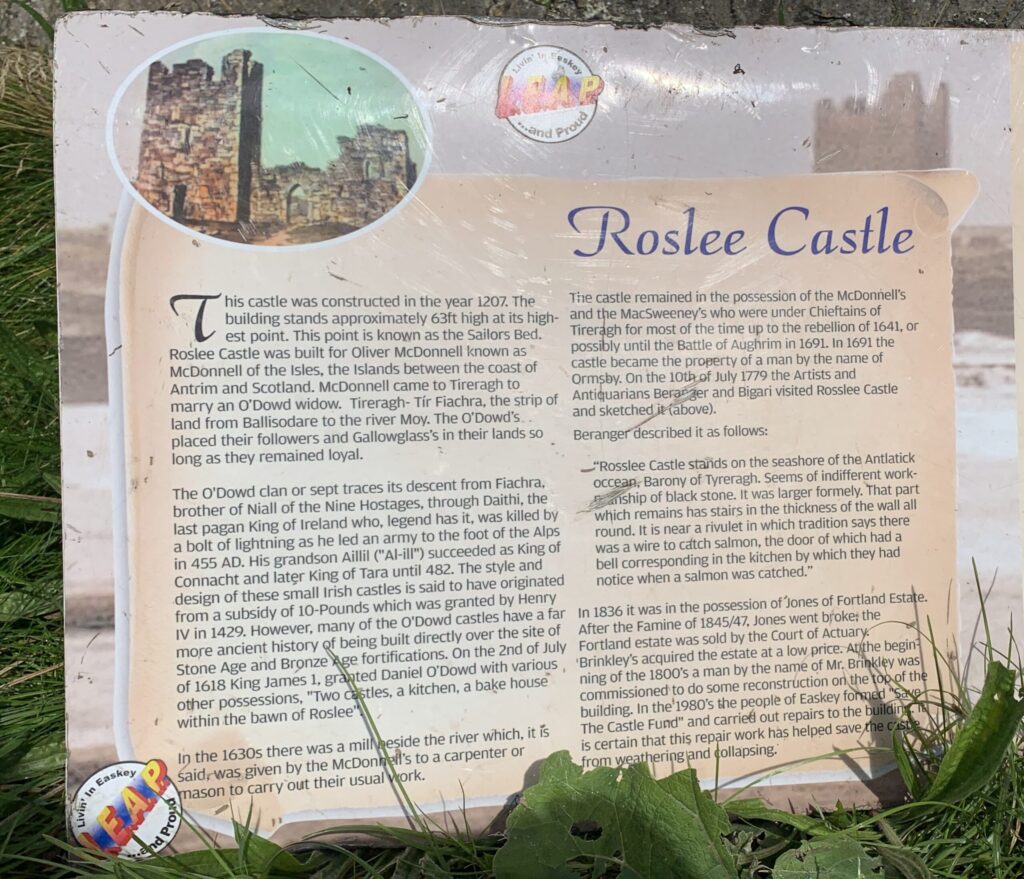
The heritage trail sign erected at the pier by the local Livin’ in Easkey And Proud (LEAP) group counts Roslee as stop 10 on its walk, and notes at stop 12 that a second castle — Castletown Castle, in the neighbouring townland of Castletown — was also an O’Dowd property. Tradition in Easkey holds that the O’Dowds had “five castles in this townland”; Roslee is the one that still stands to any height.
II. The archaeological record
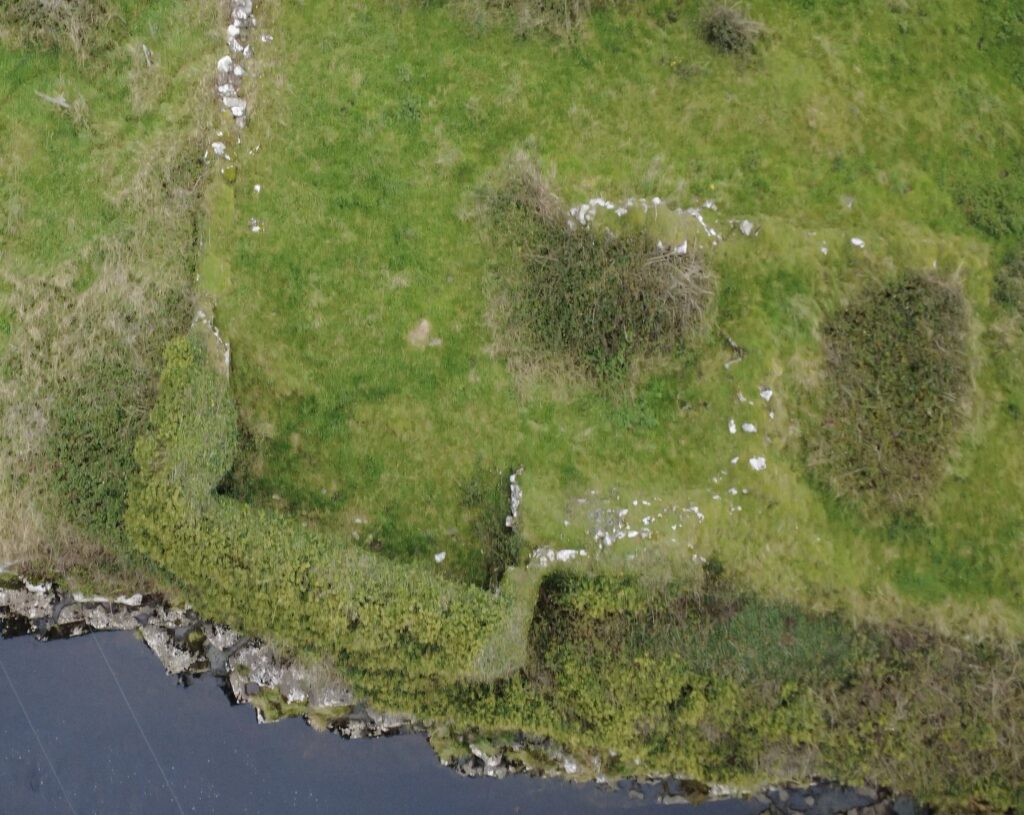
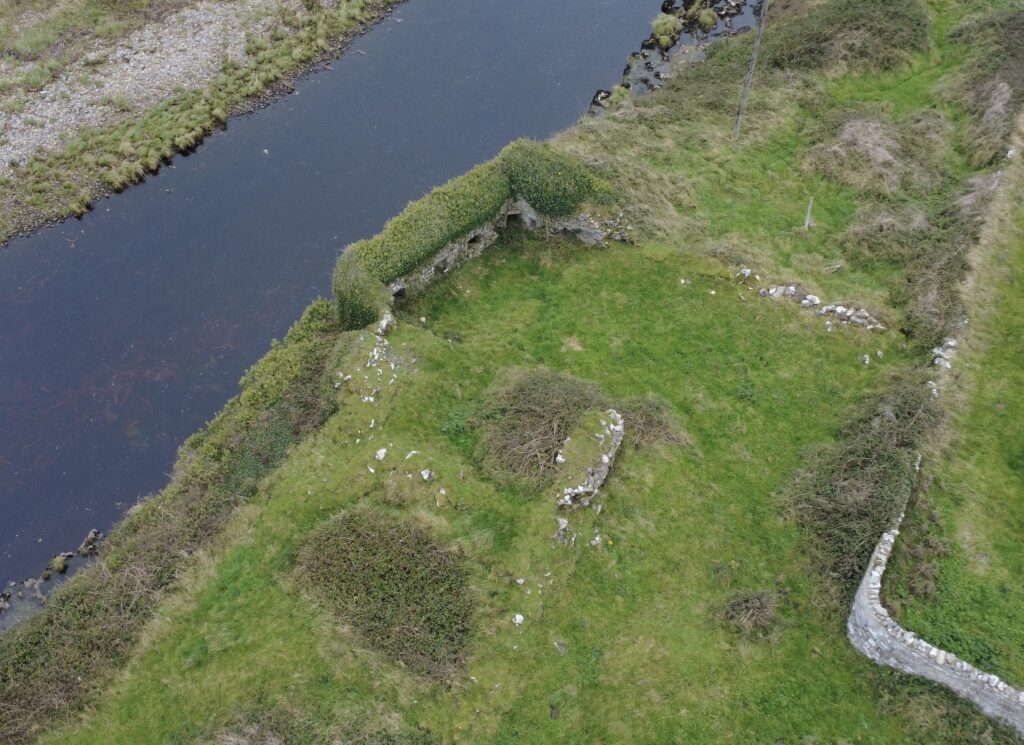
The surviving fabric has been described in detail in the Archaeological Inventory of County Sligo (Stationery Office, 2005). What we see today is not a single tower house but the remains of a sub-rectangular bawn built in two distinct phases, with the tower set on its sea-facing side.
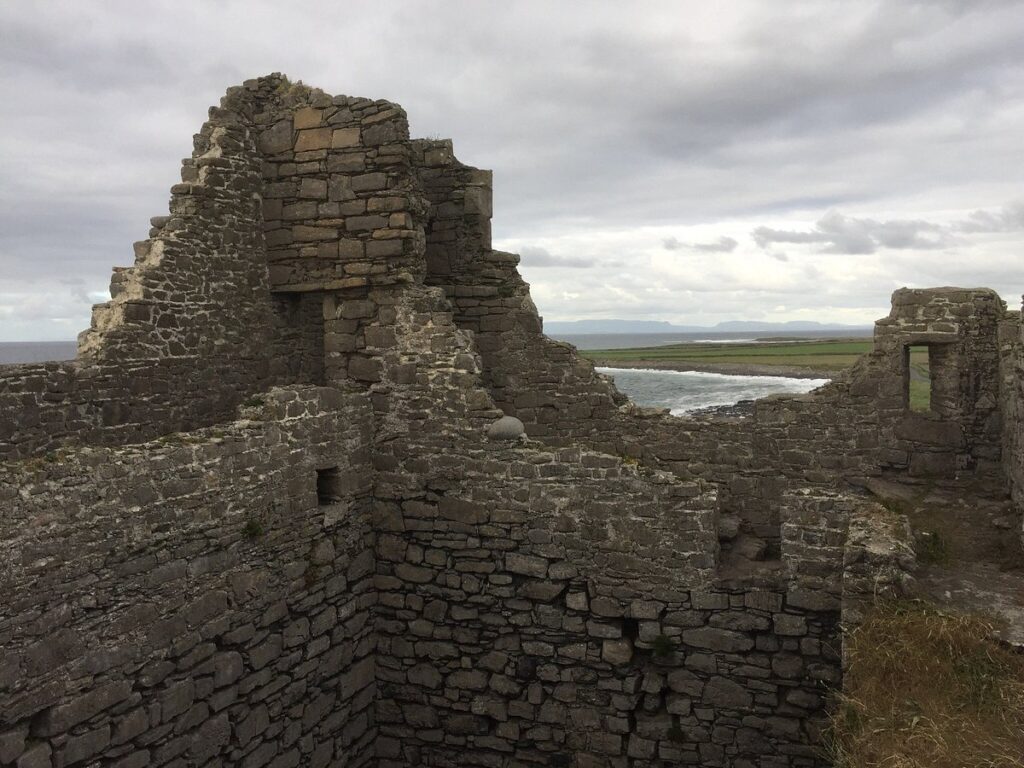
The first-phase bawn measures approximately 16.44 m east–west by 14.22 m internally, its northern and southern walls slightly out of parallel so that the plan is a shallow trapezoid. The defining feature is a profusion of gun-loops in the surviving southern and eastern walls, with circular corner turrets at the north-east and south-west. These small round turrets were designed to flank the outside face of the bawn with gunfire — a standard fortification response to the arrival of firearms in Irish warfare in the later sixteenth century. The corbelled roofs of the turrets are unusual; most contemporary examples used timber framing.
The second phase encloses a larger area, approximately 22 m north–south by 16 m east–west, with a taller and thicker wall reaching 5.3 m at its western extent. A pointed-arch gateway with a wicker-centred rear arch at the eastern end of the north wall is the main entrance; a smaller recess to its left carries a gun-loop over a waste-chute. Large well-preserved gun-loops survive in the western, northern and southern walls. A second, less regular gateway at the north end of the west wall is probably later.
On the weight of these features — the gun-loops, the round corner turrets, the wicker-centred rear arches, the sub-rectangular plan — the visible fabric dates to the late sixteenth or early seventeenth century. This puts Roslee squarely in the Elizabethan and early Stuart period, alongside bawns such as Aughnanure (Co. Galway) and Shanpallas (Co. Limerick), rather than in the early medieval age sometimes suggested by local tradition.
During the eighteenth and nineteenth centuries several new walls and farm-buildings were inserted inside the bawn, and others built against its outer face on the west. The central of three lean-to walls against the inside of the south wall would have blocked one of the original gun-loops had it risen to full height — a small but telling sign of how completely the site had been turned from a fortification into a farmyard by that date.
III. Documented ownership
The earliest unambiguous documentary reference to Roslee by name is a grant from King James I, dated 2 July 1618, confirming to Daniel O’Dowd “two castles, a kitchen, a bake house within the bawn of Roslee.” The wording is precious: it tells us that by 1618 the complex already contained more than one building within an enclosing wall, consistent with the two-phase bawn visible today.
The O’Dowds held the site through the upheavals of the seventeenth century. After the Williamite victory in 1691 it passed, with the wider Fortland estate, into the hands of new proprietors. The Landed Estates Database (University of Galway, estate 197) records the Browne family at Fortland in 1786, succeeded by the Jones family, who were in possession by 1814 and still held the estate in 1837. Following the Great Famine the Jones estate was placed before the Encumbered Estates Court, and in March 1854 was purchased by Richard Graves Brinkley. The castle remained in Brinkley ownership into the twentieth century; John L. Brinkley is recorded as proprietor in 1906. At Griffith’s Valuation in the late 1850s the estate was let to John Wingfield King.
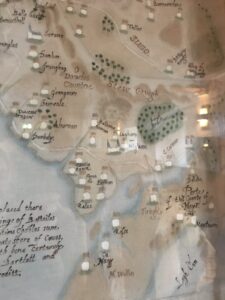
The only public access modification to the tower for which we have a date is a short episode of reconstruction work on the upper walls during the Brinkley tenure in the later nineteenth century. An earlier 1779 plan of the site — likely an estate survey held among the Fortland papers — showed a bawn wall extending north from the west side of the tower; that stretch of wall is no longer visible above ground.
IV. The 1207 tradition
The LEAP heritage-trail sign at the pier, and many guidebooks, state that Roslee was “originally built in 1207 for Oliver McDonnell, who came to the area to marry an O’Dowd widow.” This reading is well established in local memory and deserves to be recorded.
Historically, however, the date is difficult. The McDonnell gallowglass families do not appear in Irish annals until the mid-thirteenth century at the earliest, and the settled McDonnell and MacSweeney presence in the north-west is a fourteenth- and fifteenth-century phenomenon. Nothing in the visible fabric is earlier than c. 1580. It is possible that an earlier Ó Dubhda fortification stood on or near the rock before the present bawn, but no part of it has been securely identified on the ground or in the record. The 1207 story is best treated as cherished local tradition alongside, rather than instead of, the archaeological dating.
V. The wider Easkey cluster
Roslee is the best survivor of several O’Dowd sites in the Easkey district. The LEAP trail identifies Castletown Castle in the neighbouring townland of Castletown (Baile an Chaisleáin), crediting it to the O’Mailduns or Murphys in 1157 and later to the O’Dowds. Duald Mac Firbis’s Hy-Fiachrach genealogies record the O’Mailduns as an older family seated in this stretch of Tireragh, which gives some substance to the Castletown tradition even if the 1157 date is unverified. Ardnarea (Ard na Riadh, near Ballina) a short distance west along the coast is another direct Ó Dubhda site. Taken together, the Easkey – Ardnarea – Castleconnor arc formed the heart of the Ó Dubhda coastal territory of Tireragh.
VI. Visiting today
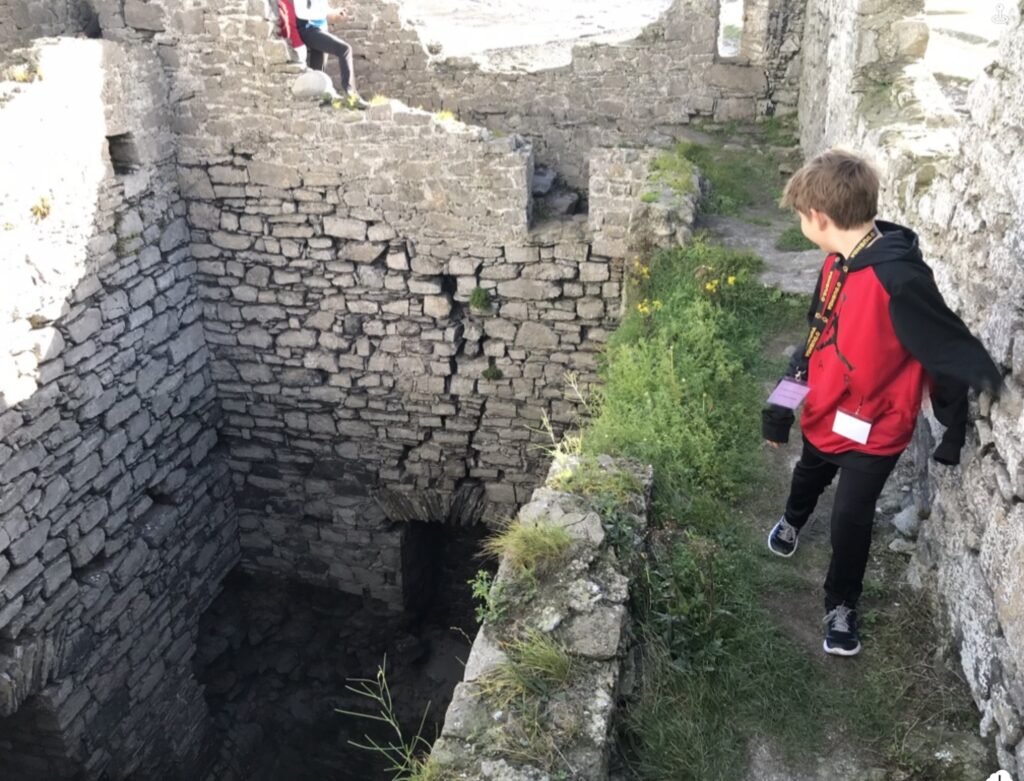
The castle sits beside Easkey pier and is freely accessible at any time. There is no formal path, no interpretive panel apart from the LEAP sign at the pier, and no guard-rails on the ruin. Visitors climb at their own risk.
From the modern south-wall entrance — a later insertion in what was originally a window — a hidden spiral stair tucked behind a low archway on the right gives access to the upper levels of the tower and to the Sailor’s Bed at the top. Lower passages inside the thickness of the wall can also be explored by the nimble. Uneven steps, low lintels and open drops are all present: this is genuinely one of the more atmospheric climbs on the Ó Dubhda castle tour, but it is not for those uneasy with heights or confined spaces.
Outside the walls the rock shore and tidal pools are a popular spot for fossil-hunting and for watching the Atlantic swell. The waves off Easkey are among the best in Europe for surfing, and the castle and the surfers have shared the same stretch of bay for as long as anyone can remember.
The continued survival of the ruin owes a great deal to the Save the Castle Fund, established by Easkey residents in the 1980s to carry out urgent consolidation work. Without that local effort the tower would almost certainly have lost more of its fabric to winter storms.