Castleconnor

Castleconnor

O'DUBHDA COUNTRY · TIRERAGH

CASTLECONNOR CASTLE

Caisleán Mhic Conchúir
“There are some remains of the old castle on the bank of the Moy.” — Samuel Lewis, 1837

Castleconnor Castle

Caisleán Mhic Conchúir — “MacConnor’s Castle” — a medieval fortification on the River Moy, long held by the O’Dubhda

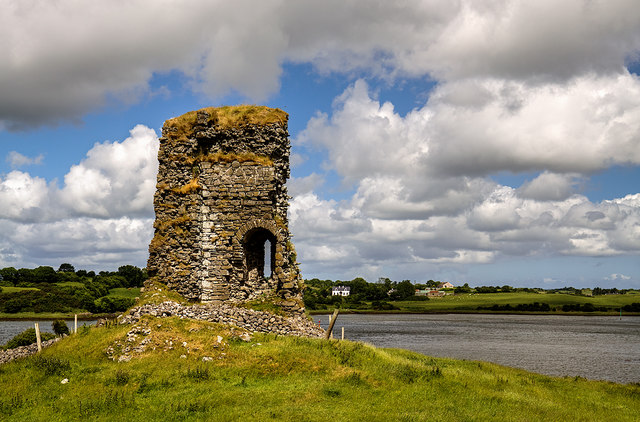
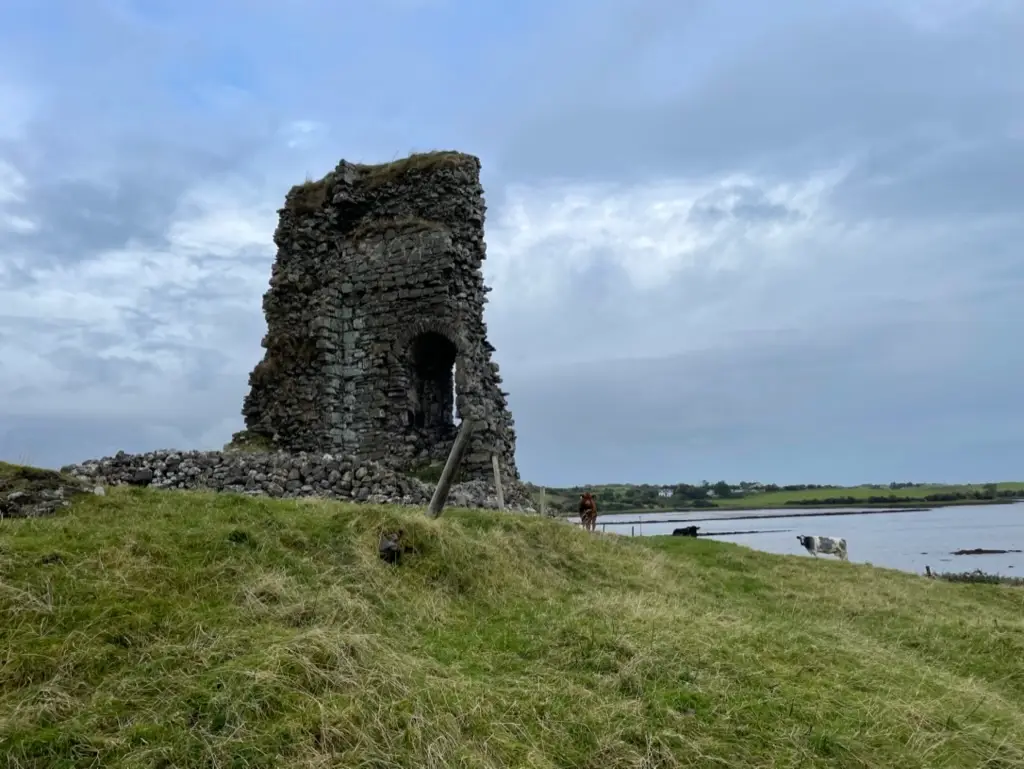
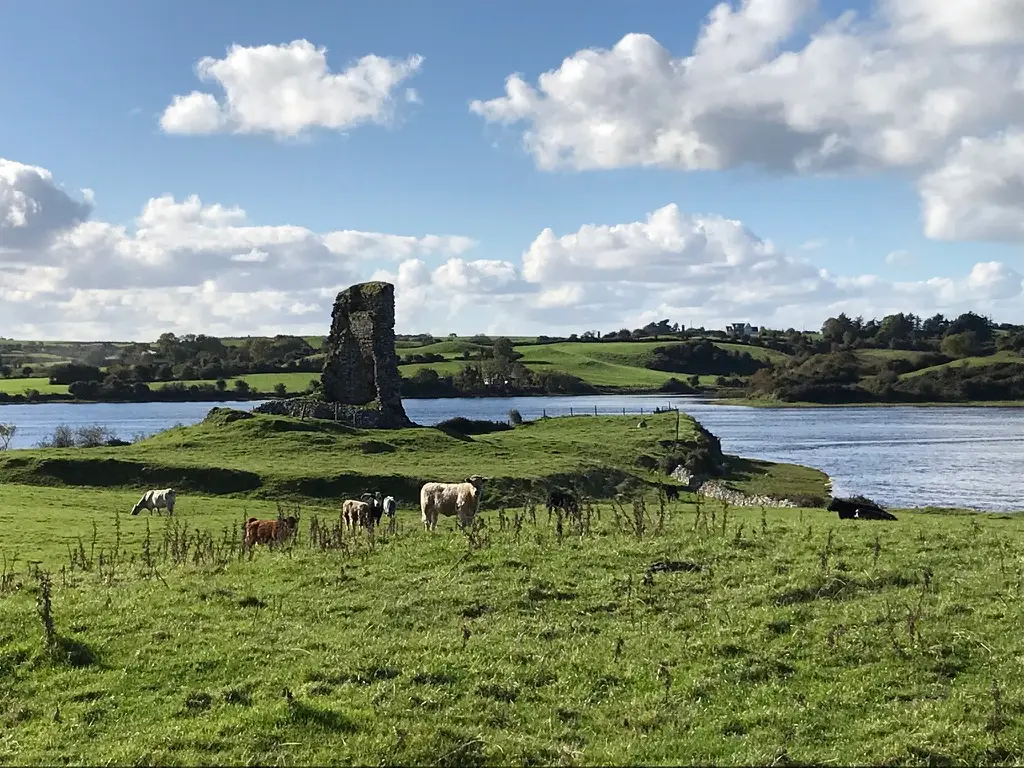
On the west bank of the River Moy, four miles north-east of Ballina, in the civil parish of Castleconor in the Barony of Tireragh, stand the remains of one of the oldest-named castles in Uí Fhiachrach. Its Irish name, Caisleán Mhic Conchúir — “the castle of Mac Conchúir” — records a family presence on the site long before the O’Dubhda rose to prominence in the late medieval period. The parish itself takes its name from the castle, not the other way around; the ruin and the surrounding townlands of Castleconor East and Castleconor West carry that name in the present-day Ordnance Survey and logainm.ie entries.

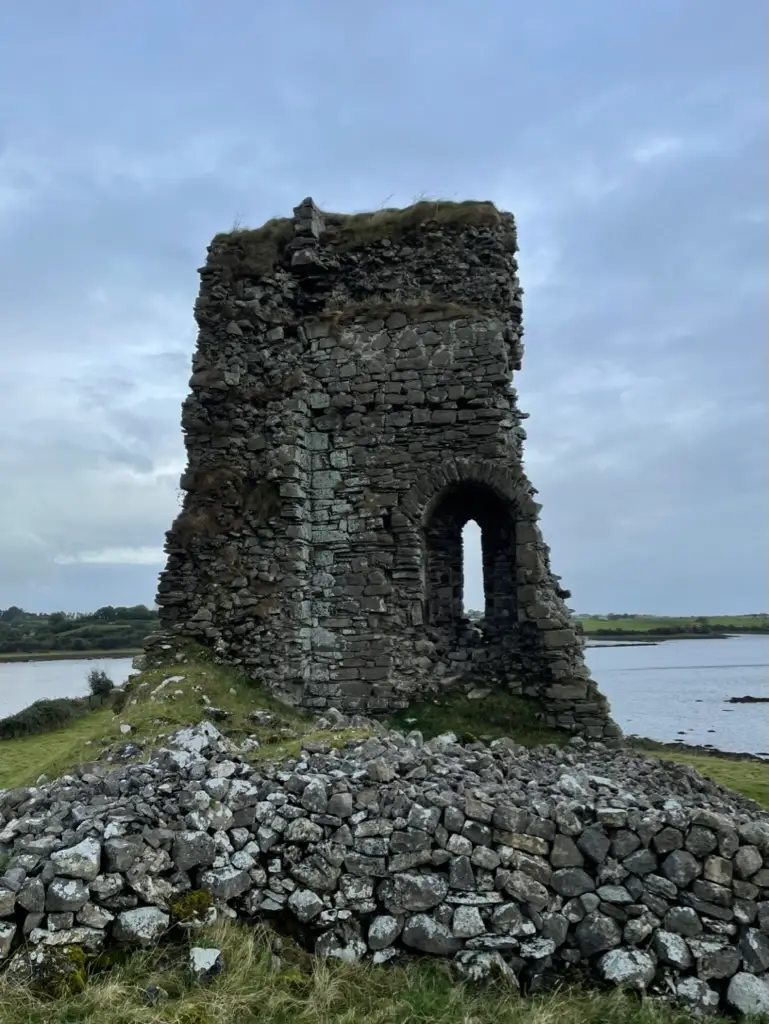
The castle has been an O’Dubhda place, in one sense or another, since at least 1371, when Domhnall Cléireach Ó Dubhda wrested it back from English hands. It remained a seat of the family through the Elizabethan and Stuart periods, and was still held by an O’Dowd in the year of the 1641 Rebellion. Today only a fragmentary ruin stands on the Moy bank — already a ruin in Lewis’s Topographical Dictionary of 1837, and unchanged in essentials since.

I. The Name and the Pre-O’Dubhda Foundation

The earliest attested form of the name appears in papal records of 1289, where it is written Castle Oconheur. It is found in the intervening centuries in variant Latinised and anglicised spellings — Castro Conchur, Castroconhor, Castle Connor — all preserving the patronymic Mac Conchúir at the second element. The Placenames Branch records the Irish form as Caisleán Mhic Conchúir. A 19th-century local tradition, gathered during the Ordnance Survey of the 1830s and summarised on logainm.ie, held that “an old castle in the townland of Castleconner on the banks of the River Moy, built and inhabited by one O’Connor in the 13th century” was the source of the parish name.

An important distinction. The name is neither Caisleán Chonchúir (“Castle of Conor”) nor a memorial to any O’Dubhda chief of that personal name. It records instead the surname of an earlier holding family — most plausibly a branch of the Uí Chonchobhair or Mac Conchobhair — who built or held the first fortification on the site in the 1200s, well before the main period of O’Dubhda castle-building. Readers familiar with older versions of this page, which attributed the name to a “Conor O’Dowd” of the 16th century, should treat that reading as a misattribution.

II. Recovery by the O’Dubhda (1371)

The castle passes into O’Dubhda history with the campaigns of Domhnall Cléireach Ó Dubhda, the great territorial restorer of the 14th century. Duald Mac Firbis’s Genealogies, Tribes, and Customs of Hy-Fiachrach, as edited by John O’Donovan (1844), preserves the tradition in plain terms:

“In the year 1371 he drove the English out of his territory and took possession of the castles of Ardnarea and Castleconor, in which they had strengthened themselves.”

— Mac Firbis / O’Donovan, Hy-Fiachrach, p. 359

From this point onward Castleconnor was counted among the O’Dubhda strongholds commanding the lower Moy — a strategic pairing with Ardnarea (on the opposite, Mayo bank, the present site of Ballina town) and further east with Enniscrone at the river mouth.

III. The Tower House Era and the 1520 Rebuild

Tradition gathered by clan historian Conor Mac Hale in The O’Dubhda Family History (1990) holds that a new castle was raised on the Castleconnor site around 1520, during the chieftaincy of Conor O’Dowd, Taoiseach of Tireragh — a later rebuild on the old Mac Conchúir foundation. This is consistent with the wider pattern across Uí Fhiachrach: a 15th- and 16th-century flourishing of tower-house building by Gaelic lords, often on sites held since medieval times. What is visible today is therefore most likely the remains of this later stone tower rather than of the original 13th-century structure.

No detailed architectural survey of the ruin is in print at the time of writing. Claims on earlier versions of this page about wall thicknesses, internal stairways, battlements, and living arrangements are not drawn from any published survey and have been removed.

IV. The O’Dubhda Chiefs of Castleconnor (16th–17th centuries)

The castle is named in the pedigree of the ruling O’Dubhda line in Tireragh. Dathi Ó Dubhda, son of Tadhg Riabhach, son of Eoghan, held Castleconnor and Kilglass in the mid-16th century. The Annals of the Four Masters record, under the year 1544:

“O’Dubhda of Tireragh (Dathi, son of Tadhg Riabhach, son of Eoghan) was slain by one of the Queen’s soldiers in one of his own castles in Tireragh of the Moy.”

— Annála Ríoghachta Éireann, A.D. 1544

The annal does not specifically name Castleconnor as the place of the killing; Dathi held more than one fortification in Tireragh of the Moy. Given his association with Castleconnor and Kilglass in the O’Dubhda pedigree, it is likely — but not certain — that the killing occurred there. His father Tadhg Riabhach Ó Dubhda had died a year earlier, in 1543 (or 1580 in some manuscript traditions); the primary sources record only the bare fact of his death, with no manner or place. Accounts of Tadhg Riabhach falling from the roof of Castleconnor, found on some 20th- and 21st-century websites, do not appear in any source we have been able to consult and have been removed as unsupported.

The castle remained an O’Dowd holding into the 17th century. A Sligo inquisition of 3 April 1623 recorded one David O’Dowde, late of Castleconnor, Esq., seised of the castle and its lands; the dower of his widow, Ellenor Lyens (later Lady Ellenor Ghest), was fixed at one-third of his estate. A later deed of 31 October 1641 — the very month of the rising that would end in the Cromwellian conquest — records another David O’Dowda of Castleconnor enfeoffing trustees of “the castle of Castleconnor, and three quarters of land thereunto adjoining,” in a settlement for the benefit of himself and his wife Jewane Burke. This is the last secure evidence of Castleconnor in O’Dowd hands.

V. Decline to Ruin

What followed is not documented on the ground. The Cromwellian transplantations of the 1650s displaced the O’Dowd proprietors from Castleconnor as they did elsewhere in Tireragh, and the castle appears not to have continued in use as a seat. By the time Samuel Lewis compiled his Topographical Dictionary of Ireland in 1837 the structure had long been a ruin:

“The parish derives its name from an ancient castle, of which the ruins are still visible… There are some remains of the old castle on the bank of the Moy.”

— Samuel Lewis, 1837

Lewis notes the principal seats of the parish in 1837 as Moyview (Col. Wingfield), Cottlestown (S. Kirkwood, Esq.), Knockroe House, Seaville, and Kinnaird — new Ascendancy houses scattered across the old O’Dowd parish. The castle itself is not named as the seat of any proprietor; it had already passed out of living use.

Claims sometimes made that Castleconnor was destroyed during the Williamite Wars of 1689–1691, or used as a Williamite military base, are not supported by the sources we have consulted. The honest answer is that the exact date and circumstances of the castle’s abandonment are unknown: held by O’Dowd in 1641, a ruin by 1837, and with no surviving narrative for the two intervening centuries.

VI. Visiting Castleconnor Today

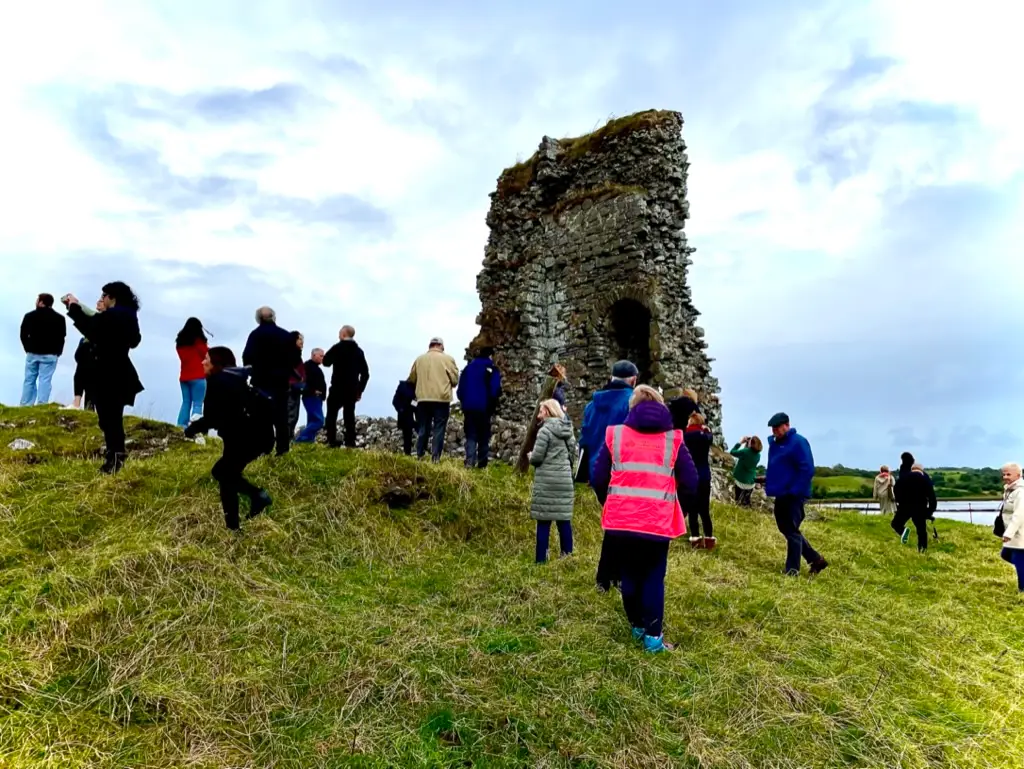
The ruin stands on private farmland above the River Moy, a few miles north-east of Ballina. It is not a formal heritage site and is not signposted from public roads. Visitors should view from the public roadway unless the landowner’s permission has been sought and given; the ground around the ruin is uneven, the walls are unstable in places, and livestock may be present.

As with the other direct O’Dubhda castle sites, please treat the land, the stones, and the privacy of those who farm alongside them with care.

VII. Sources

  • Duald Mac Firbis, The Genealogies, Tribes, and Customs of Hy-Fiachrach, ed. John O’Donovan, Irish Archaeological Society (Dublin, 1844) — the 1371 recovery of Ardnarea and Castleconor, and the 1544 killing of Dathi Ó Dubhda. Digitised at CELT, UCC.
  • Annála Ríoghachta Éireann / Annals of the Four Masters, ed. John O’Donovan (Dublin, 1848–51) — entry A.D. 1544 on the killing of Dathi Ó Dubhda; entry A.D. 1580 on the death of Tadhg Riabhach.
  • Samuel Lewis, A Topographical Dictionary of Ireland (London, 1837), entry for Castleconnor parish, County Sligo. Digitised at Library Ireland.
  • Logainm.ie, the Placenames Database of Ireland — entries for Caisleán Mhic Conchúir (Castleconor civil parish) and the Castleconor East and West electoral divisions.
  • John O’Donovan, Ordnance Survey Name Books and Letters for County Sligo (1836), Royal Irish Academy MS 14 F. 14.
  • Conor Mac Hale, The O’Dubhda Family History (1990) — the canonical twenty-castle list and the 1520 rebuild tradition. Digitised at Internet Archive.
  • Irish Pedigrees: O’Dowd (No. 2), compiled from Mac Firbis — Dathi “of Castleconnor and Kilglass.” Library Ireland.
  • Bailiúchán na Scol / Schools’ Collection (1937–9), dúchas.ie — local memory of Castleconnor as a parish landmark; no substantive folklore survives about the castle itself.
Castleconnor Castle ruin above the River Moy, County Sligo
Castleconnor Castle ruin on the west bank of the River Moy, Tireragh, Co. Sligo.

Castleconnor Castle — overlooking the Moy estuary

Castleconnor Castle

Caisleán Mhic Conchúir ("MacConnor's Castle")

📍 Location

54°09'41.5"N, 9°08'08.6"W
Civil Parish of Castleconor, Barony of Tireragh
Four miles north-east of Ballina, County Sligo

🏰 Type

Medieval / late-medieval castle ruin on the River Moy
One of the 20 castles on the Mac Hale list of O'Dubhda fortifications
Successor to a 13th-century Mac Conchúir (O'Connor-type) stronghold

📅 Date Built

First attested in papal records, 1289 (Castle Oconheur)
Local tradition: built by "one O'Connor in the 13th century"
Visible remains most likely from the c.1520 rebuild attributed to Conor O'Dowd by Mac Hale (1990)

🏚️ Date Ruined

Unknown — still an O'Dowd holding in 1641
Already "remains of the old castle" by Lewis's survey of 1837
No secure record of a specific date or cause of abandonment

🚶 Accessibility

On private farmland above the River Moy
Not a formal heritage site; not signposted
Approach requires sturdy footwear and care on uneven ground

⚠️ Note: Private land — seek the landowner's permission before entering. View from the public roadway otherwise.
⚔️ Relation to O'Dubhda (O'Dowd)

Recovered from English hands by Domhnall Cléireach Ó Dubhda, 1371 (Mac Firbis)
A seat of the Tireragh chiefs through the 16th century; Dathi Ó Dubhda "of Castleconnor and Kilglass" slain by a Queen's soldier in Tireragh of the Moy, 1544
Held by David O'Dowda as of a 1623 inquisition, and enfeoffed in a 1641 deed — last documented O'Dowd possession

📜 Heritage Note

The name Caisleán Mhic Conchúir records an older, pre-O'Dubhda foundation; the parish of Castleconor takes its name from the castle, not from any O'Dowd chief. The ruin is therefore a layered site — a Mac Conchúir stronghold taken into the O'Dubhda kingdom in 1371 and held for nearly three centuries thereafter. Today in private ownership.

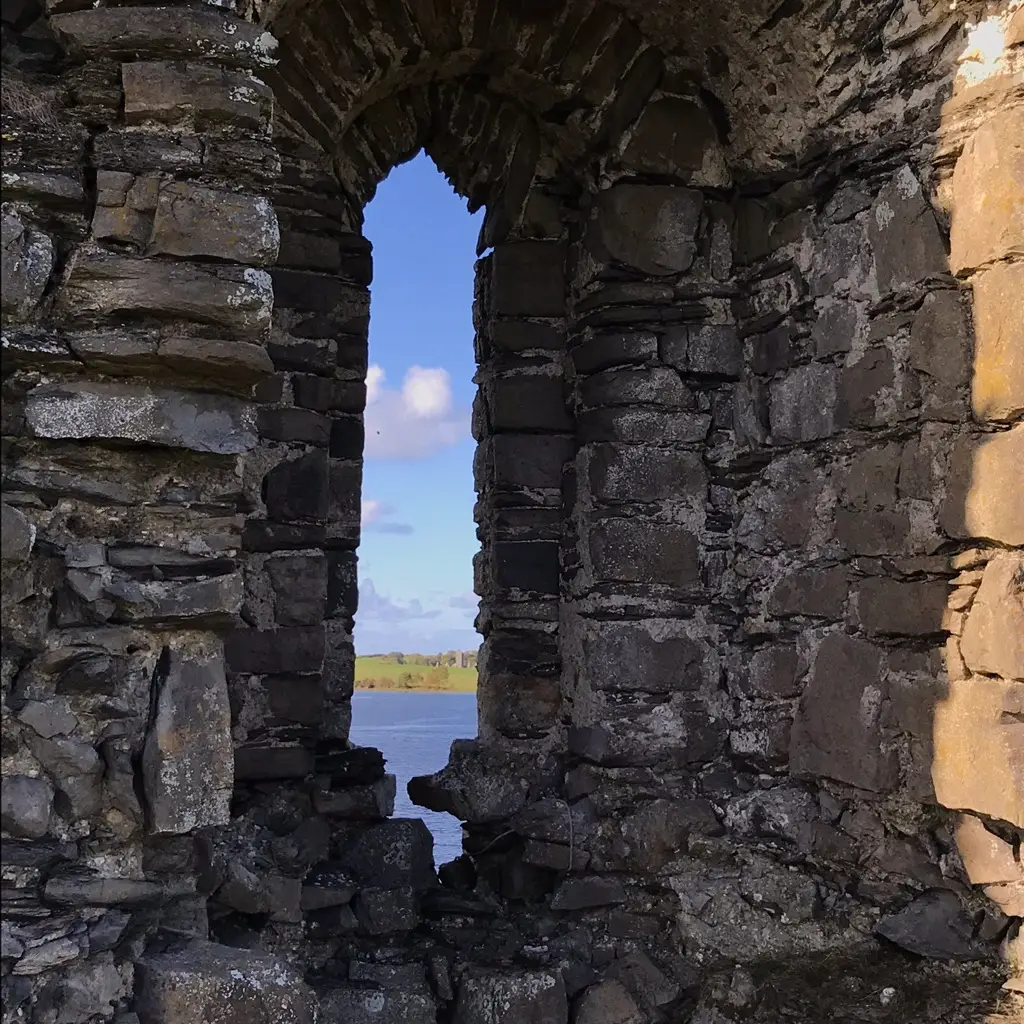
Weathered masonry of Castleconnor Castle, Tireragh
Surviving masonry of the castle — in a working farm field, not a formal heritage site.

Photographs of Castleconnor

The ruin on the bank of the Moy, in Castleconor parish, Co. Sligo. Click any image to open at full size.

From the Seanchas

Latest stories tied to Castleconnor Castle.

Tales, research and dispatches from the O’Dubhda journal.

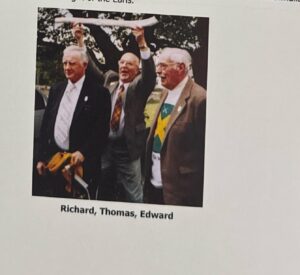
Thomas J Dowds passes the White Wand to Richard F Dowd, 2003
Rallies

The 2003 Rally — Richard F Dowd Inaugurated

The sixth gathering, September 2003, was above all a handover. Thomas J Dowds’ six-year term came to a close at Enniscrone Castle as he passed the White Wand to his Tánaiste, Dr Richard F Dowd of New Jersey — the clan’s second modern Taoiseach. At a glanceDates: 12 – 14 September 2003  ·  Base: Atlantic Hotel, EnniscroneNotable moment: Inauguration of Dr Richard F Dowd at Enniscrone CastleBook launch: Inishcrone and O’Dubhda Country by Conor MacHale at the MacFirbis Centre, Kilglass. The Gathering Registration and a welcome reception were again at the Atlantic Hotel on Friday evening. The weekend had the settled feel of a tradition — a Saturday morning tour of the Turlough Park Museum of Country Life, the Mermaid Rocks at Scurmore, and Castleconnor, followed by an evening clan council. At the MacFirbis Centre in Kilglass, Conor MacHale launched Inishcrone and O’Dubhda Country, the fuller account of the territory and its history. Transport was laid on between the hotel and the MacFirbis Hall so that no one missed the launch. The Inauguration On Sunday afternoon the clan gathered at Enniscrone Castle — the fortress last held by O’Dubhda forces in the seventeenth century — for the formal inauguration of Dr Richard F Dowd as Taoiseach of Tireragh. The ceremony followed the Brehon form adopted at Cahirmore in 2000: the White Wand was passed through the hands of every member present before the Ollamh, Conor MacHale, held it over the new Taoiseach’s head. Richard Dowd, of New Jersey, became the first American-born holder of the office. Tours & Sites Moyne Abbey, Rosserk Friary, Ardnaree Friary and Rathmullcah — the great friary corridor of Tireragh Scurmore / Mermaid Rocks and Castleconnor The closing banquet at Belleek Castle, with transport laid on both ways. Voices & Visitors Thomas Dowds, now Taoiseach Emeritus, remained at the heart of the Council. Ed O’Dowd of Chicago was named Tánaiste-elect, setting the succession for 2006. Paddy Tuffy, still at every rally, was acknowledged for his unbroken service to the local committee. Further Reading Thomas J Dowds, The O’Dubhda Gatherings: A History (forthcoming) — chapter 7 Conor MacHale, Inishcrone and O’Dubhda Country (2003) — launched at this rally odubhdaclan.com archive entry ← Previous Rally The 2000 Millennium Rally & First Inauguration in 400 Years Next Rally → The 2006 Rally — Edward P O’Dowd Inaugurated
Read the seanchas →
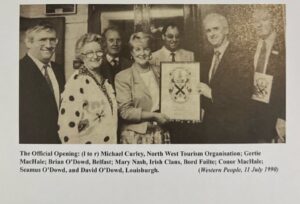
Official opening of the first O'Dubhda Clan Rally, Enniscrone, July 1990
Rallies

The 1990 Rally — First Hosting in 395 Years

On Friday, 6 July 1990, just over a hundred O’Dubhda descendants gathered in the Convent Hall at Enniscrone. It was the first hosting of the clan in 395 years — since Tadhg Buidhe was installed as Taoiseach in 1595 with the blessing of Red Hugh O’Donnell. They came from Ireland, Scotland, England, Wales, the United States, Canada, Australia and Zambia, and nobody quite knew how it was going to go. At a glanceDates: Friday 6 – Sunday 8 July 1990  ·  Base: Convent Hall, Enniscrone  ·  Attendance: 100+ from eight countriesNotable moment: Rowan tree and commemorative plaque at Enniscrone Castle — a living marker for the returned exiles. The Gathering The rally had taken shape slowly around Gertie MacHale’s pharmacy in Enniscrone, where for years O’Dowds in search of their roots had been sent with the instruction, “Go see Gertie — she knows all about the O’Dowds.” Her 1971 book Stories from O’Dowda’s Country, and a conversation with the hotelier Tom Nicholson about why foreign visitors had stopped coming to town, gave her son Conor MacHale the idea to simply ask them to come. With Mr and Mrs Tuffy and a small group of Enniscrone volunteers, they did. The opening was held in the Convent Hall, emceed by Jackie Gleeson. A vellum scroll prepared by Sr Emer Mulderrig, emblazoned with the seventeenth-century clan coat of arms, was signed by every person present — six columns of names, now held in the Uí Dubhda archive. When Mary Nash of Clans of Ireland and Michael Curley of North-West Tourism unveiled the coat of arms and explained its heraldic meaning, clan certificates were presented to David O’Dowd of Louisburg, a direct descendant of Donal O’Dubhda (brother of Tadhg Buidhe), and to Seamus O’Dowd of AIB. Any early hesitancy evaporated quickly. The planned events began almost an hour late — the ice broken, it was said, by a supper of Moy salmon and brown bread laid on by Maree MacHale and a team of local caterers. A ceilidh followed, led by the Kilglass branch of Comhaltas Ceoltóirí Éireann under Anthony Coleman, with the famed Irish piper Larry O’Dowd (whose own ancestors came from Tireragh) joining on stage. When the organised event ended, most of the clan adjourned to Maughan’s pub and stayed until the small hours, “the sound of revelry wafting down the main street in Enniscrone.” Tours & Sites Visited Demand for the Saturday tour was such that the bus filled and the rest of the clan followed in a convoy of cars. With commentary from Conor MacHale and Cyril Lonergan, they visited: Scurmore — home of the Mermaid Rocks and the old legend of the mermaid-wife whose seven sons weep when an O’Dowd dies Castleconor — where Chieftain Daithi Rua O’Dowda was murdered in 1594 Ardnaree Augustinian Abbey, Ballina — founded in the fourteenth century by Tadhg O’Dubhda, Taoiseach of Tireragh Ardnaglass Castle — home of Donal O’Dubhda, believed to have been granted the O’Dowd coat of arms in 1608 Moyne Abbey — where many O’Dowd chieftains are buried and where Fr John O’Dubhda was martyred in 1577 At Moyne, in cold weather and a drizzling rain, Jim Gilvarry of Crossmolina Historical Society guided the clan across the grass into the ruins. In a side-chapel built to mark the marriage of an O’Dubhda Taoiseach to a Burke heiress, Fr Michael Doody SJ of St Louis, Missouri, recited a short ecumenical prayer for all those buried there. Highlights For the duration of the rally an exhibition filled the Clan Rally Centre: maps of Tireragh, the O’Dowda estate at Bonniconlon (1854), the Strafford Inquisition of 1635, the 1597 deed of sale of Enniscrone Castle, and a genealogy from O’Donovan’s Tribes and Customs of the Uí Fiachrach (1844). Alongside them sat books by the MacFirbisigh bards — The Great Book of Lecan, The Yellow Book of Lecan, The Annals of Connacht and The Annals of the Four Masters — the sources that had kept the clan’s memory alive. Saturday evening saw the launch of Conor MacHale’s The O’Dubhda Family History, followed by a lively discussion during which it was explained that, through mistranscription and historical accident, the O’Dubhda surname now carried over forty recognised variations. Sunday’s meeting agreed the shape of what was to come: a formal clan newsletter, printed membership forms and subscriptions, an idea to clear the site at Scurmore so the Mermaid Rocks might one day host a proper inauguration, and a proposal that members clip every published O’Dowd reference — good or bad — so that a modern “Book of Annals” could be assembled, echoing the work of the MacFirbis bards. The Rowan at Enniscrone Castle The weekend closed in the grounds of Enniscrone Castle — last held by O’Dubhda forces in the mid-seventeenth century. In a formal ceremony, a rowan tree, sacred to the O’Dubhda ancestors, was planted by Tom Dowds of Scotland, representing the Wild Geese come home, and Francis O’Dowda, a direct descendant of Baron O’Dowda of Bonniconlon. They unveiled a commemorative plaque, and every person present took a turn filling the hole around the sapling before saying their farewells. Voices & Visitors Among those who came: Nora O’Dowd MacNamara from Lisdoonvarna, whose uncle Michael O’Dowd had been a bodyguard to President Eisenhower, and who enjoyed arguing over the spelling of the name with Mamie Doud Eisenhower herself. Seamus O’Dowd from Shannon, at 86 the oldest present. Eighteen-month-old Keelan O’Dowd from Enniscrone, who brought along his parents Edward and Linda. Four Dowds from Scotland — Andrew, Tom, Bridie and Thomas — whose descendants would later become Taoisigh. Donna Glee Williams from the USA. Tess and Bill Heery from Galway. Daphne and Arnold Booth from the UK. The full roll of the vellum scroll — six columns of signatories — is preserved in the Uí Dubhda archive. Further Reading Thomas J Dowds, The O’Dubhda Gatherings: A History (forthcoming) — chapter 1, “The First Rally 1990” Conor Mac Hale, The O’Dubhda Family History (G. MacHale, Inniscrone, 1990) — launched

Read the seanchas →

A Note from the Clan

These pages are researched and written by volunteers of the O'Dubhda Clan. Our history is vast, and our understanding of it grows with every correction, addition, and story shared by clan members and researchers.

If you have found an error, or have information that would improve this page, please get in touch.

Sources

The history of Castleconnor draws on:

  • Gertrude O’Reilly & Conor Mac Hale, O’Dowda Country Stories (2018)
  • Gertrude O’Reilly, The O’Dowda of Castleconor (novel, 2013)
  • Conor Mac Hale, The O’Dubhda Family History (1990)
  • John O’Donovan, The Genealogies, Tribes & Customs of Hy-Fiachrach (Irish Archæological Society, 1844)

Chapter 3 of the 2018 book — ‘Murder in Castleconor’ — is the fullest surviving treatment; O’Reilly’s 2013 novel dramatises the same ground.

See the full bibliography in the O’Dubhda Library.