
The James O’Dowda Monument at Bonniconlon
April 27, 2026 2026-05-07 1:54The James O’Dowda Monument at Bonniconlon
JAMES O’DOWDA MONUMENT
The James O’Dowda Monument at Bonniconlon
A village memorial to Colonel Baron James Vippler O’Dowda — soldier of empire, rebel of 1798
In the centre of the village of Bonniconlon, Co. Mayo, opposite St Joseph’s, a low standing stone set in a planted bed carries a bronze plaque to the last Ó Dubhda chief who held the family estate here. The man the stone commemorates — Colonel Baron James Vippler O’Dowda — was hanged for his part in the rising of 1798. The monument was raised two centuries later by the people of the village.
I. The man the stone commemorates
James O’Dowda (1765–1798) was head of the Ó Dubhda family at Bonniconlon at the close of the eighteenth century. His father, Thady O’Dowda, had served as a colonel in the Austrian Imperial army and had married Antonia, daughter of Baron Vippler. James was raised on the continent and is said to have been godson to the Emperor Joseph II; he too served in the Imperial army before inheriting the Bonniconlon estate from his uncle David O’Dowda around 1788. On returning to Ireland he married Temperance Fitzgerald of Mount Tallant House, Dublin. The Bonniconlon estate — sometimes still called O’Dowdastown in the eighteenth century — was, after the Cromwellian transplantations, the senior surviving seat of the family (Mac Hale 1990).
II. The Year of the French
On 22 August 1798 a small French expeditionary force under General Jean Joseph Amable Humbert came ashore at Kilcummin strand, near Killala, Co. Mayo. The landing opened the Connacht phase of the United Irish Rising. Among those who answered Humbert’s call was James O’Dowda, who raised a company of about two hundred men from his Bonniconlon estate and joined the Franco-Irish force at Killala. Bishop Joseph Stock’s contemporary Narrative (1800) names “Captain O’Dowda of Coolcarney” among the principal local leaders to commit men to the French.
III. From Killala to Ballinamuck
O’Dowda was appointed colonel in command of the Killala garrison left to hold the town when Humbert marched south. By Bishop Stock’s account he conducted himself with restraint and honour toward the loyalist civilian population. He subsequently joined the main column and fought at the action of Collooney on 5 September. Two days later, on 8 September 1798, the combined French and Irish force was overrun by a much larger British army under Lord Cornwallis at Ballinamuck, Co. Longford. Tradition records that O’Dowda had been proposed as President of a free Connacht; whatever may have been intended, the rising ended with him in arms among the Irish at Ballinamuck.
IV. Death and aftermath
The contemporary record is consistent: O’Dowda was hanged in the immediate aftermath of Ballinamuck. Sir Richard Musgrave’s Memoirs of the Different Rebellions in Ireland (Dublin, 1801) reports that he attempted to pass himself off as one of the captured French, was recognised, and was brought as a prisoner to Cornwallis’s camp before execution. A separate local tradition holds that he escaped as far as Bonniconlon and was hanged on a cart outside his own door, in front of his wife and children — an oral version contradicted by the contemporary printed accounts, which place his death at Ballinamuck.
Temperance Fitzgerald brought up their two surviving sons. The eldest, Thady, succeeded as The O’Dowda; remembered locally as an improving landlord, he was forced to sell the Bonniconlon estate in 1854 after reducing rents during the Great Famine to keep his tenants alive (Mac Hale 1990, ch. 3). With that sale the family’s two-century connection to Bonniconlon ended.
V. The Bonniconlon stone
The monument itself is a freestanding boulder set in a planted bed in the centre of the village. A bronze plaque is fixed to its face, carrying the silhouette of a 1798 pikeman and the inscription:
ERECTED TO THE MEMORY OF
JAMES O’DOWDA, 1765–1798,
WHO LED THE PEOPLE OF BONNICONLON,
ALONGSIDE THE FRENCH FORCES OF GENERAL HUMBERT,
IN THE REBELLION OF AUGUST 1798.
EXECUTED WITH HIS IRISH COMRADES
IN BALLINAMUCK, CO. LONGFORD.
The stone was raised by a local committee under the chairmanship of Liam Gillard — himself said to descend from one of the French soldiers who came ashore at Kilcummin in 1798 — to mark the bicentenary of the rising and the part the village played in it. An earlier private plaque, paid for in 1995 by Frank O’Dowda, a descendant of James, is fixed to the family table-tomb in Kilgarvan cemetery a few miles to the north (Mac Hale 1990).
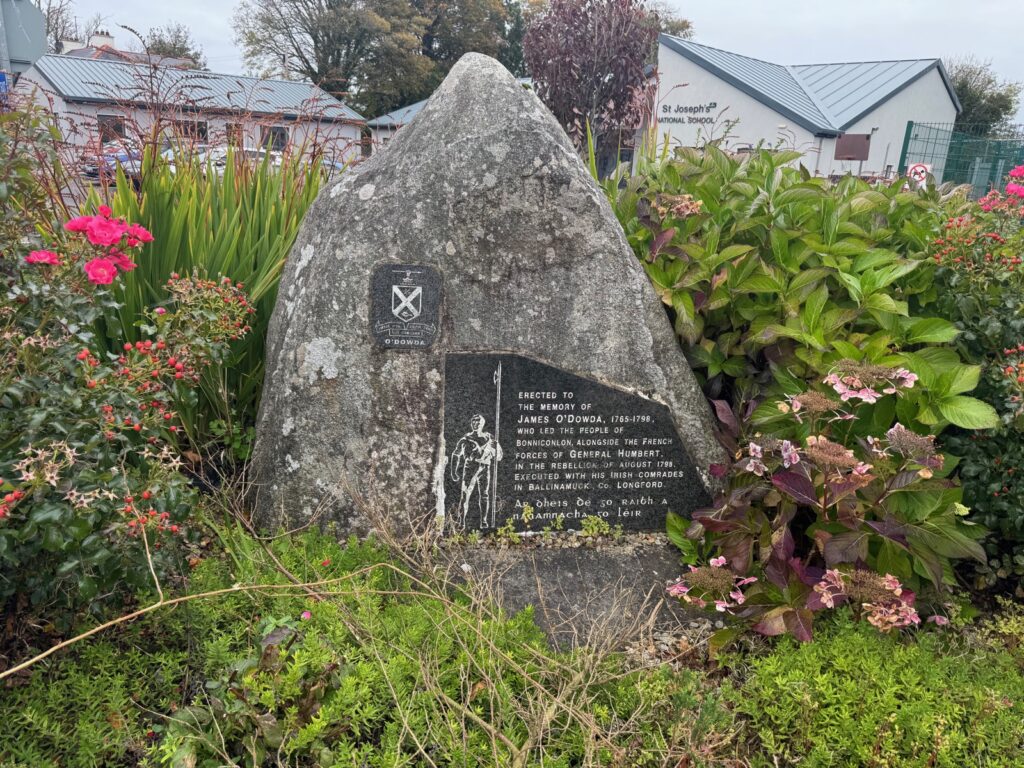
James O’Dowda Monument — Bonniconlon village, Co. Mayo
James O’Dowda Monument
A Note from the Clan
Our monument pages are written by volunteers from primary sources where we can find them. We welcome corrections, additions, and photographs — particularly from descendants of the Bonniconlon committee who raised this stone, or from anyone with archival material on the Baron, his family, or the company of two hundred Bonniconlon men who marched out of the village in August 1798.
Please get in touch if you have something to share.