
Killala Round Tower
May 2, 2026 2026-10-14 20:44Killala Round Tower
Killala Round Tower
Cloigtheach Chill Ala — the round tower of the ancient see of Killala
The Round Tower of Killala — Cloigtheach Chill Ala — rises more than twenty-five metres above the rooftops of Killala town on the west shore of Killala Bay, in north Co. Mayo. It is the last standing medieval structure of what was once an important early-Irish monastic establishment, the seat of the Bishops of Killala and, by ancient association, one of the principal ecclesiastical centres of the old Ó Dubhda kingdom of the Uí Fhiachrach of the Moy. Four Ó Dubhda were elected to the bishop’s chair here; and a Franciscan friar of the name died a martyr rather than break the seal of confession.
I. Location and Setting
The tower stands in the centre of Killala town, on rising ground beside the Cathedral Church of St Patrick (Church of Ireland) — the ground on which the original monastery is thought to have stood. From the top of a flight of stone steps on Tower Hill the tower is visible above the low roofs of the town, a tall finger of coursed limestone topped with a conical stone cap.
The coastal bay immediately to the east is the same Killala Bay on which, centuries later, the three medieval religious houses of Moyne, Rosserk, and Rathfran would be founded — all of them within sight of the tower across the bay or along its shore, and all of them standing on land that had once been Ó Dubhda territory.
II. The Tower
Built of limestone on a low plinth, the tower stands more than twenty-five metres (over eighty feet) high. Its round-headed doorway is positioned three metres above ground level — a security feature common to Irish round towers, intended as much against raiders as against the Viking incursions that had prompted the construction of such cloigthíthe (“bell-houses”) across Ireland from the late tenth century onward. The tower at Killala is generally dated to the twelfth century. Small windows open high in the bell storey beneath the cap; the conical stone roof is intact.
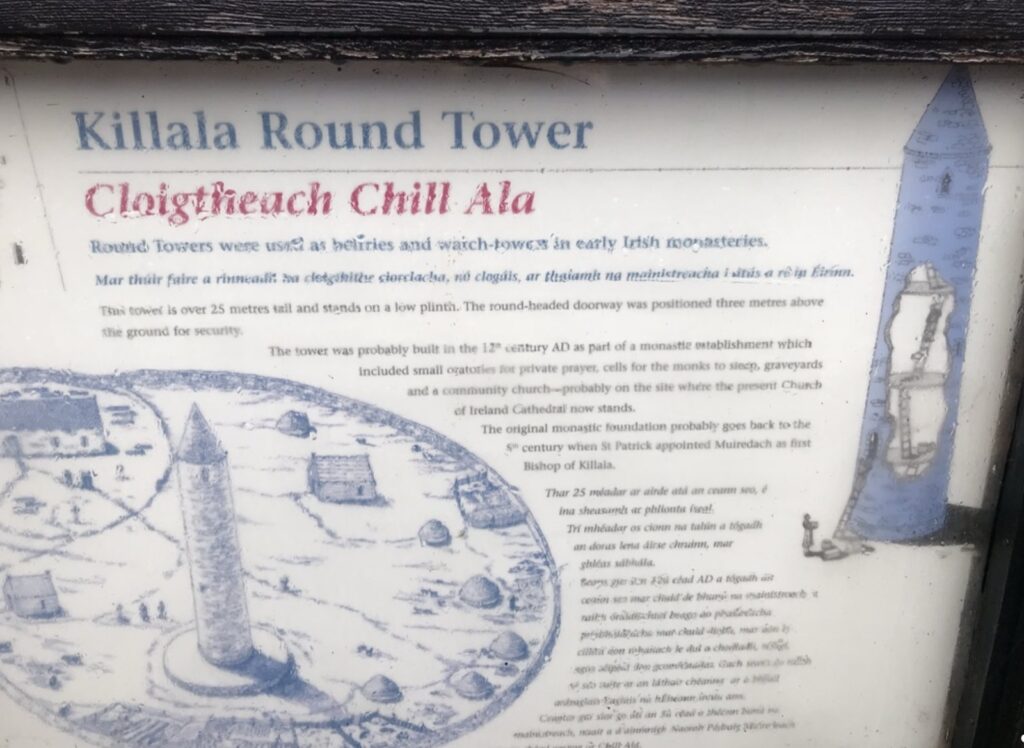
An on-site interpretive plaque, in English and Irish, describes the wider monastic establishment that once surrounded the tower — small oratories for private prayer, cells where the monks slept, graveyards, and a community church — probably on the site where the present cathedral now stands.
III. Origins — St Patrick and Bishop Muiredach
The Killala foundation is one of the most ancient in Connacht. Tradition — carried in the Patrician lives and still attested on the plaque at the tower — holds that the original monastery goes back to the fifth century, when St Patrick appointed Muiredach as the first Bishop of Killala. The see endures to this day. The Irish name Cill Ala (older Cill Alaidh) is glossed “the mottled church” in the Placenames Database; the modern town takes its name from the monastery that preceded it.
IV. The Ó Dubhda Bishops of Killala
Over the medieval centuries the see of Killala was served by a succession of bishops drawn from the local families of the diocese. Several of the Ó Dubhda appear in the line. The sept’s stronghold in Tír Fhiachrach and its landed status gave it the means to educate its sons and the ecclesiastical influence to place them. Conor Mac Hale records four Ó Dubhda elected to the see of Killala in the fourteenth and fifteenth centuries ‐ William, Brian, Muircheartach Cléireach and Mághnus ‐ of whom William and Mághnus took possession of the bishopric (The O’Dubhda Family History, Inniscrone, 1990).
V. Father John Ó Dubhda, Franciscan Martyr, 1579
The most remembered Ó Dubhda churchman of the persecution era is Father John Ó Dubhda (John O’Dowd), Franciscan friar, who was put to death in 1579. The martyrologies record that he refused to reveal what he had heard in confession, and that soldiers killed him by crushing his skull with a twisted cord; they place his death at Elphin, while Mac Hale’s family history places it at Moyne Abbey on 9 June 1579. He belongs to the early and severe phase of the Elizabethan persecution — the generation in which the crown moved to suppress the Catholic religious orders in Ireland by force of arms. He is numbered, with many of his Franciscan brethren, among the Irish martyrs of that persecution.
VI. The Jacobite and Williamite Years, 1641–1691
In the following century members of the name appear repeatedly in the Catholic cause. Ó Dubhda men are recorded among the Confederate Catholics of the 1641–52 wars and, a generation later, in the army of the Catholic King James II of England during the Williamite War in Ireland (1688–1691).
Tradition ‐ as Mac Hale records it ‐ holds that David Ó Dubhda of Bonniconlon, eldest son and heir of the house, was killed at the Battle of the Boyne on 1 July 1690, and that he was said to have been more than seven feet tall. The detail is of a piece with the folklore that surrounds the Jacobite defeat: a giant of a man of the blood of chiefs, falling in the battle that broke the old order in Ireland.
VII. 1798 — The French at Killala
A century later Killala entered history again. On 22 August 1798 a French expeditionary force under General Jean Humbert came ashore at Kilcummin Strand, a short distance north of Killala town, in support of the United Irish rising. The French occupied Killala for several weeks; Bishop Joseph Stock of Killala, confined in his own palace, left A Narrative of What Passed at Killala in the Summer of 1798 (Dublin, 1800), which is one of the primary documents of the Year of the French. Many of the north-Mayo country people, including men from within the old Ó Dubhda territory, rose with the French and fought at the engagements at Ballina, Castlebar (“the Races of Castlebar”), and finally at Ballinamuck.
For the Ó Dubhda country’s own route through the events of that year, see the self-guided tour of the 1798 Rising in North Connacht.
VIII. The Tower Today
The tower stands in the centre of Killala town, immediately adjacent to the Cathedral Church of St Patrick. Access to the exterior is free and unrestricted at all times of the year; the interior is not open to the public. The site is a National Monument in the care of the Office of Public Works. Sacred Landscapes interpretation panels in English and Irish explain the monument on the approach from Tower Hill.
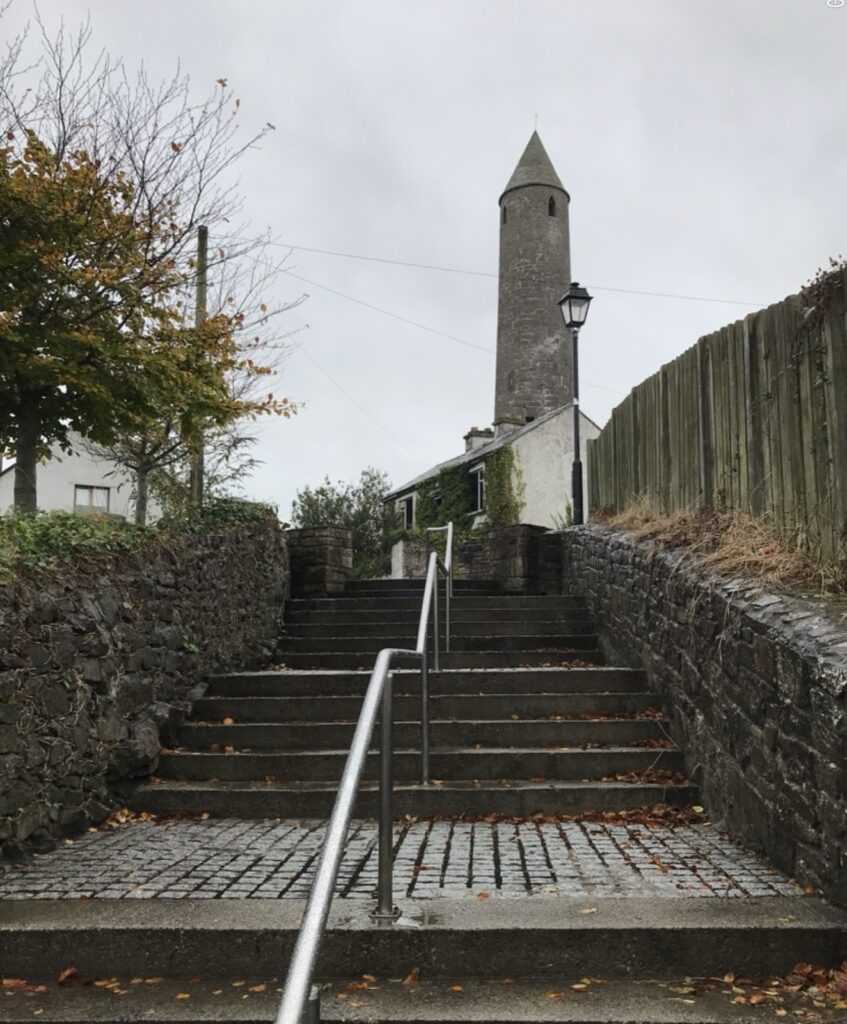
Killala Round Tower — centre of Killala town, west shore of Killala Bay, Co. Mayo
Killala Round Tower
54.21337°N, 9.22070°W
Belfry and watch-tower of an early Irish monastery
Original monastery founded 5th c. (St Patrick & Bishop Muiredach)
Limestone on a low plinth; round-headed doorway 3 m above ground
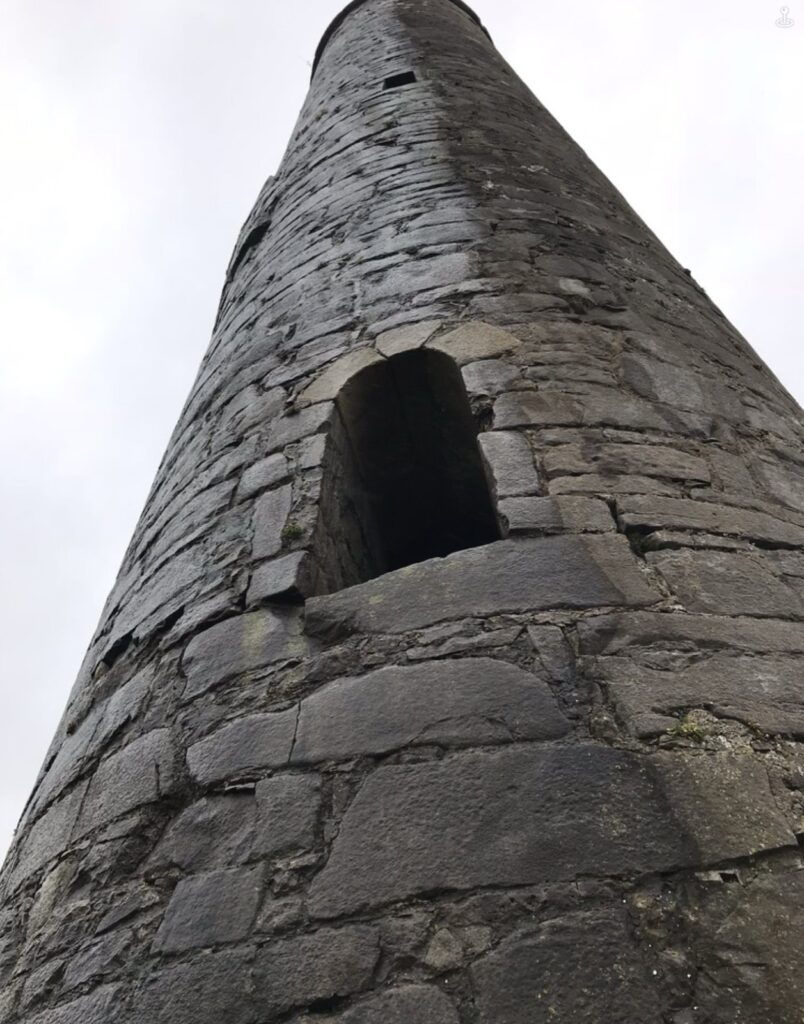
From the Clan
Photographs of Killala Round Tower submitted by clan members.
A Note from the Clan
These pages are researched and written by volunteers of the Ó Dubhda Clan Association. The record here reflects the best evidence we have been able to gather from primary sources — placename records, Lewis’s 1837 dictionary, the Mac Fhirbhisigh genealogies, and the standard monastic reference works.
If you know of a correction, a family tradition, a photograph, or a source we should have cited — please get in touch. We welcome additions, and we would rather be corrected than wrong.